



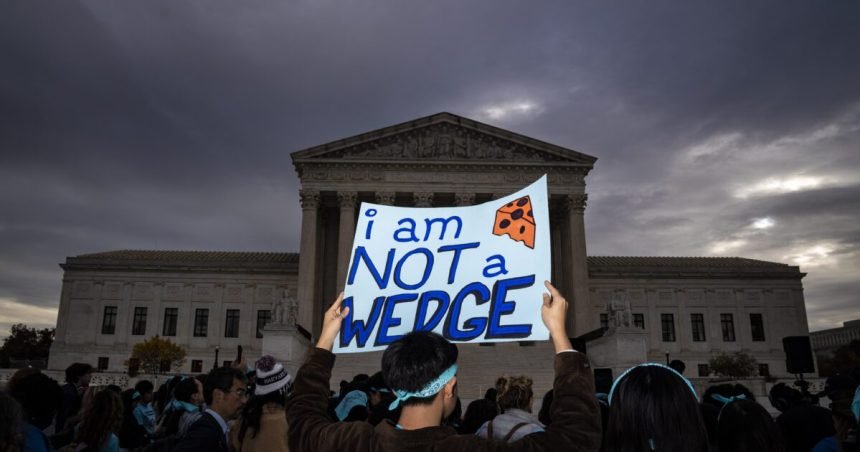
On Monday, the Supreme Court agreed to hear a case about what might feel like well-trodden ground for this six-justice conservative supermajority: a school admissions policy designed to improve the ability of students of color and low-income students to access rigorous academic programs.
The challengers, a group called the Association for Education Fairness, and their right-wing allies frame their lawsuit as a natural outgrowth of the Supreme Court’s 2023 ruling in Students for Fair Admissions, a pair of cases that struck down race-conscious admissions programs at Harvard and the University of North Carolina. But this case is very different: The policy is race-neutral, and the students are in middle school. When the Court rules on Association for Education Fairness v. Montgomery County Board of Education next term, it could make it harder for communities to take even small steps to provide children with quality, integrated education.
The public school system in Montgomery County, a largely suburban area in Maryland bordering Washington, D.C., is one of the biggest and most diverse public school systems in the country. But its magnet schools, four specialized schools that serve the entire county, don’t reflect that diversity. In the 2013-2014 school year, for example, Black and Latino students made up 47.4 percent of the total district student body, but only 13.5 percent of middle school students enrolled in the magnet programs, according to a study commissioned by the school board in 2015.
The study bolstered the advocacy of families and community groups who had long argued that the existing selection process, which relied on parent-initiated applications and teacher recommendations, was failing to identify all qualified students. And in the years that followed, the school system made several major changes to its admissions process in order to give students a fairer opportunity to compete for spots.
Most recently, in response to the COVID-19 pandemic, the district implemented a system in which all fifth-grade students are universally screened, and students who meet defined eligibility criteria are then entered into a random lottery. In the first year of the lottery process, the share of Black and Latino children admitted to the middle school magnet program jumped to over 33 percent.