



It’s an idea that’s percolated for two decades: electing the U.S. president by national popular vote.
Democrats’ midterm wins brought them control of five state governments, boosting the possibility of enacting the National Popular Vote Interstate Compact — a long-discussed agreement between states that would shift presidential elections away from the Electoral College system America uses to choose the president.
States that pass legislation to join the compact pledge their electoral votes to the candidate who wins the national popular vote, not just who wins their state under the current system. Since 2006, 18 states and the District of Columbia have passed laws to pledge their combined 222 electoral votes toward this agreement. But the bills would only take effect after enough states join the compact to reach 270 electoral votes — the number needed to decide a winner in a presidential election.
The new Democratic “trifectas,” with the party controlling both legislative chambers and governorships in Michigan, Minnesota, Nevada, Pennsylvania and Wisconsin, contain enough combined electoral votes, in theory, to propel the agreement past that 270 threshold, if all five states vote to join the compact.
If so, America could elect the president by popular vote as soon as 2028. Whether they’ll seek to do so isn’t yet clear.
Election law experts say the compact likely would face a raft of legal challenges, including whether it would need congressional approval.
“I think that there will definitely be efforts made by the compact advocates to move things forward in those states where there is a trifecta,” said Alexander Keyssar, a Harvard University professor of history and social policy and author of “Why Do We Still Have the Electoral College?”
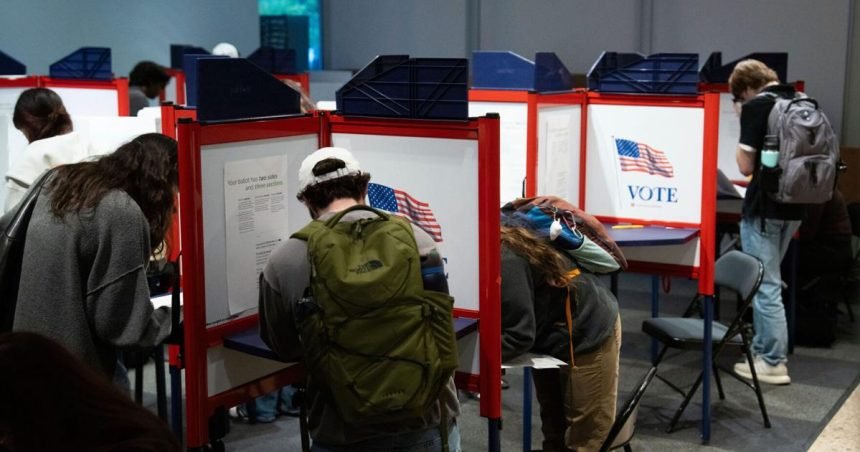
Students vote inside the University of Michigan Museum of Art polling site in Ann Arbor on Nov. 3.
Debate over the Electoral College
Nationally, about 80% of Democrats and 46% of Republicans said they would prefer to use a popular vote system to elect the president, according to a 2024 Pew Research Center survey.
At issue are the quirks of the United States’ Electoral College system. States get electoral votes equal to their two senators plus representatives (at least one) based on population. The U.S. presidency and vice-presidency are the only public offices elected through an Electoral College system in America.
Supporters say the Electoral College system forces campaigns to pay attention to voters in areas that would otherwise be ignored under a popular vote system, USA Today has reported. But it also gives more representational weight to votes in less populous states, according to the Brookings report.
And it often leaves presidential elections decided by a handful of swing states. Democratic voters who cast a ballot for president in a solidly red state, or vice versa, may feel like their votes won’t have a meaningful effect on deciding the presidency.
The Electoral College system has led to candidates winning the presidency despite losing the popular vote five times in U.S. history. Most recently, Democrat Al Gore lost to Republican George W. Bush in 2000, and Democrat Hillary Clinton lost to President Donald Trump in 2016.
Enter the interstate compact, which aims to ensure that the candidate who wins the most national votes also wins the Electoral College, where a win requires a majority of at least 270 electoral votes. It would not eliminate the Electoral College — that would require a Constitutional amendment.
Instead, states that join the compact commit their electoral votes to whichever presidential candidate wins the popular vote nationwide, rather than the candidate who won the vote in just their state, according to the National Conference of State Legislatures.
The bills would only take effect when enough participating states combine for 270 electoral votes.
‘Forefront of some pretty aggressive lobbying efforts’
Since 2006, every state legislature has considered a bill to join the compact, according to the conference of legislatures. California, for example, voted to join the compact in 2011 after lawmakers twice approved legislation that was vetoed by the governor.
In April, Virginia became the latest to sign on, bringing the compact’s total electoral votes to 222. Over the years, Democrats have more often favored the idea, in part because the Electoral College has in some cases benefited Republican-leaning states.
The Nov. 3 election results brought new potential to enact the compact.
“It’s now a very real possibility. And these state legislatures will meet soon and start their sessions, and I imagine this is going to be at the forefront of some pretty aggressive lobbying efforts,” said Derek Muller, an election law professor at Notre Dame.
We all know that once every four years, Americans go to the polls to vote for a new President. But this technically isn’t true. Americans don’t actually vote directly for a commander in chief; they elect representatives who then decide the next president. Complicated? Sure, and maybe even a little misleading. But this system wasn’t designed on a whim.
Possible future hurdles
How far such efforts will get is far from clear.
Battleground states such as Pennsylvania may be reluctant to join because participation could reduce their influence and the attention they demand during a presidential campaign, said Edward Foley, an Ohio State University law professor.
In 2019, Nevada’s then-Democratic Gov. Steve Sisolak vetoed a bill to join, arguing at the time it could “diminish the role of smaller states like Nevada in national electoral contests.”
A 2023 bill in Michigan’s legislature failed to pass. Harry Roth, director of the opposition group Save Our States, criticized more recent bills in the Detroit News, part of the USA Today Network, in part because they allow that “a candidate rejected by Michigan voters could still receive Michigan’s electoral votes.”
Supporters note that the U.S. Constitution allows states to appoint electors in the manner that their legislatures see fit. But if the compact is enacted, it’s likely to draw an array of challenges, including whether it would need to be approved by Congress under the Constitution’s Compact Clause. Muller, an election law expert, believes it would.
In such a case, Democrats would have to overcome the Senate’s 60-vote filibuster — and then likely a presidential veto, several experts said.
“There may be some reluctance on the part of Democrats in Congress to get involved in a prolonged and a kind of sticky process for implementing a compact,” Keyssar said.