



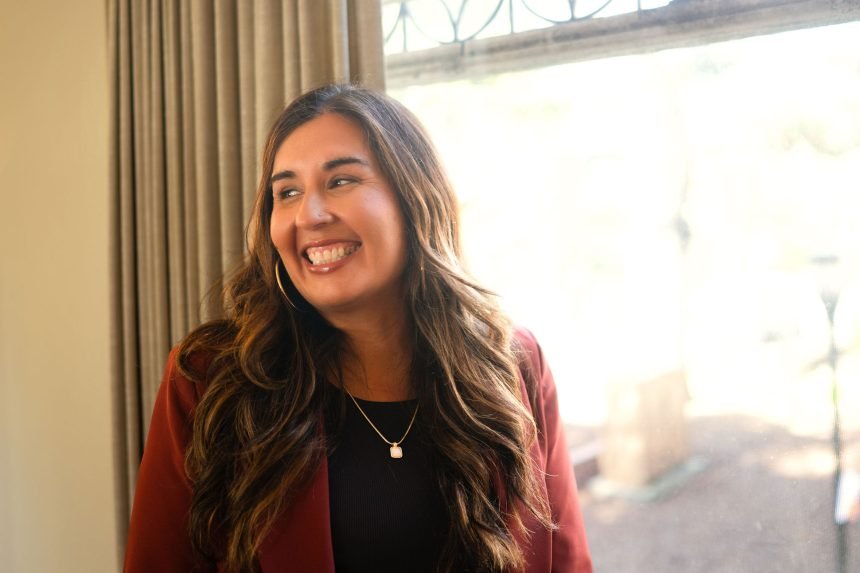
G. Cristina Mora grew up just miles away from film studio lots where Hollywood blockbusters were made, but in all the picture-perfect media of California and America, she didn’t see herself.
As the daughter of Mexican immigrants who worked in fields and then textile factories, Mora was raised in a densely Latino pocket of Los Angeles. At a time when California voters and politicians advanced harsh immigration policies, she felt like her community was being shunted to the side, unrecognized and made to feel unwelcome. Today, she holds the title of Chancellor’s Professor of Sociology at UC Berkeley, and much of her scholarship brings this often excluded community to the fore.
A Berkeley alum, Mora works to illuminate the issues that matter most to the many people who fall under the umbrella term “Latino,” including attitudes about inequality, immigration and trust in government. She delves into these nuances both qualitatively, through in-depth interviews, and quantitatively; Mora serves as co-director of the Institute of Governmental Studies, whose polls provide California’s leaders with valuable information about the priorities of voters across the state.
In this interview for After Office Hours, a UC Berkeley News series in which faculty explain the “aha” moments powering their research, Mora brings us into her scholarship, tells us what she learns from her students and explains how her work can help us interpret today’s political landscape.
What was your Fiat Lux moment — the breakthrough or new insight that changed your work?
Most of my work is on Latino communities in the United States, and my first book was on how the nation developed this idea of “Hispanic/Latino” in the first place. This insight stemmed from growing up Mexican American in Los Angeles and then moving to the East Coast for graduate school and seeing how different Puerto Ricans and Caribbean Latinos were from Mexicans, even though we were all grouped in the same category. That realization led me to a series of questions: How did we get this category in the first place? What makes identity categories salient? How do new categories form and last?
What do your students teach you?
Every day these students teach me resilience. Berkeley students inspire me — they constantly challenge the status quo, they question me about what my generation has done to create a better future, and they motivate me to more clearly lay out the stakes and make a case for social science in our ever-changing world. More than anything, Berkeley students push us as professors to show why research matters and what it implies for us all. This kind of environment inspires us as scholars to be more intellectually courageous and to push the boundaries of science so that many more might learn and benefit.
What’s one thing happening right now that your research helps explain?
Many people these days talk about the Latino vote and its characteristics. My research on the history of the Latino category and my most recent work on Latino public opinion show that lumping this group into a single label has always been complicated. To speak of the “Latino vote” is to notice important trends but also to risk reifying and abstracting a very diverse and dynamic community into a whole. Our challenge is to balance category and nuance — to show how gender, generation, nationality and region slice through this community. Only in doing so will we be able to truly understand how various Latino communities are faring in the U.S. and what this means for our understanding of the nation.