


The Spanish Mission Era in California began in 1769 and lasted until 1834. During this time the Franciscan missionaries founded 21 missions in California, or, more precisely, Alta California. These missions sought to capture souls for Christ by converting the Indians to Catholicism and to solidify Spain’s imperial control over the region. The missionary efforts, aided by Spanish soldiers, centered around bringing the Indians into a segregated community centered around a church. Here they would be forcibly converted while they worked as unpaid laborers for the Mission. The Franciscan missions were basically slave plantations, requiring the Indian people to work for the Spanish under cruel conditions.
According to the Old Mission Santa Barbara Museum: “The Spanish Crown’s strategy to build a colonial society in California relied on Franciscan Friars to incorporate native peoples through conversion to a new religion and acculturation into Hispanic culture. The missions were the sites of this undertaking as centers of evangelization and education.”
Between 1772 and 1804, five missions were established on Chumash territory: Santa Bárbara, Santa Inés, La Purísima Concepción, and San Luis Obispo. In their book California’s Chumash Indians, Rosalind Perry et al report: “As these missions were established, the Chumash found their way of life changed dramatically and quickly.”
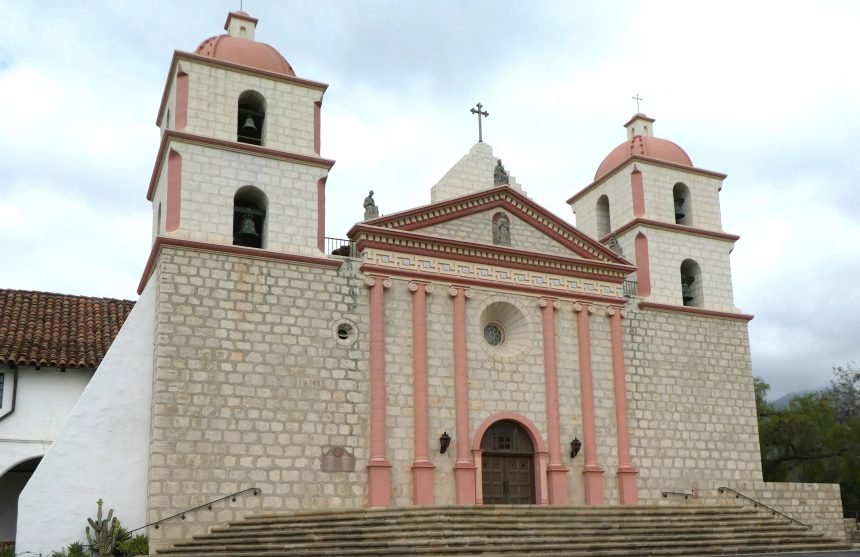
Mission Santa Bárbara was founded by Spanish Franciscans in 1786 to convert the Chumash Indians to Christianity. The Old Mission Santa Barbara Museum in Santa Barbara, California has an exhibit showing the work of Chumash Indian artisans at the Mission.

According to the Museum: “Ceiling stars were carved and painted by the Chumash to decorate the church. They were assembled with wood dowels and hand forged iron nails. Dyes and pigments from the surrounding area, as well as Mexico, were used for decoration.”


More about the Chumash
Indians 101: An Introduction to Chumash Baskets (museum exhibit)
Indians 101: “Gifts from our Ancestors” (museum exhibit)
Indians 101: Chumash Indian storage baskets (museum exhibits)
We’ll get straight to the point: The financial hardships that Daily Kos is facing this year are tough.
We continue to be paywall-free. We continue to be supported by our readers, not billionaires or corporations. But we need to bring in more revenue. We are leaning on our community more than ever to help make ends meet. Can you donate $5 or more to support Daily Kos and our continued work?
Was this story worth reading?
Recommending and sharing stories helps us decide which stories are most important to show our readers.