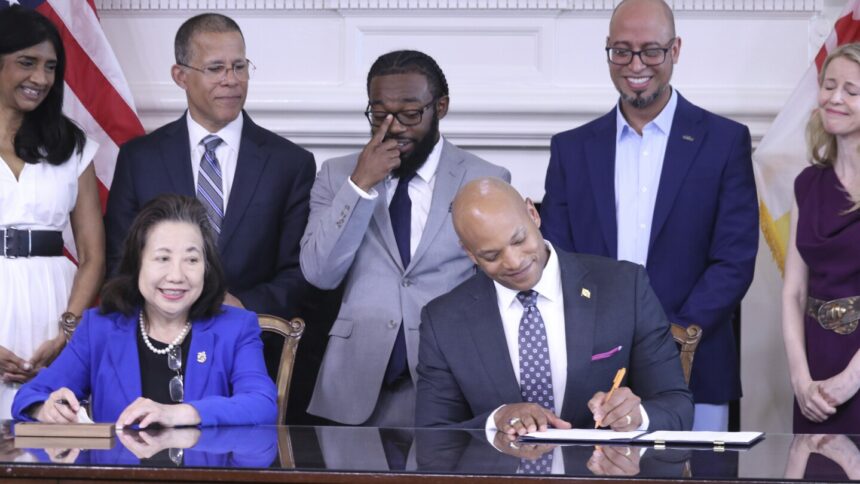
Maryland this week became the latest state to announce mass pardons for people convicted of marijuana-related crimes as the nation wrestles with how to make amends for the lives disrupted in the decadeslong war on drugs.
Under Gov. Wes Moore’s plan, more than 175,000 convictions for possession of cannabis or drug paraphernalia will be pardoned, but not permanently erased from people’s criminal records.
Here’s a look at where the U.S. stands in addressing old marijuana convictions.
A fraction of cannabis convictions have been expunged or pardoned
NORML, a group that advocates for legalized marijuana, has tallied about 2.5 million expungements and pardons for cannabis convictions in recent years.
“It’s also a drop in the bucket when you consider the reality that over the last 50 years or so, over 30 million Americans have been arrested at the state or local level for marijuana,” Paul Armentano, NORML’s deputy director, said in an interview.
Pardons forgive people for their crimes. A pardon can restore civil liberties, such as voting, serving on juries and gun ownership. Expungements go further, hiding the record of convictions entirely; that can clear the way for receiving federal college tuition assistance, qualifying for public housing and allowing parents to participate in their children’s school activities, among other benefits.
Executive branch officials such as mayors, governors and the president can offer pardons on their own, and relatively few executives have done sweeping ones like Maryland’s. They’ve done so in Massachusetts, Nevada, Oregon, Birmingham, Alabama; and Kansas City, Missouri.
President Joe Biden has ordered multiple rounds of pardons for those convicted of possession on federal lands or in the District of Columbia. It’s not clear exactly how many people are covered. For proof they’ve been pardoned, people have to apply for a certificate; as of this month, only a little over 200 covered by Biden’s pardon had done so.
It takes a court — often at the direction of a law — to order expungements, though Oregon provides those along with pardons, and the Maryland approach makes it easier to obtain an expungement.
Clearing crimes is rooted in legalizing marijuana
Marijuana laws have changed vastly since the late 1990s when states began allowing medical marijuana, something most states have since done. Twenty-four states have legalized recreational use for adults, 26 have decriminalized it and the U.S. Justice Department this year moved to reclassify it as a less dangerous drug, a move that gives hope to advocates in the remaining 12 states that it could be legalized there, too.
When Colorado and Washington became the first states to legalize marijuana in 2012, it raised an issue: Is it OK for people convicted in the past of something that’s legal now to continue to suffer consequences?
Increasingly, voters and lawmakers have been saying no. Most states that have legalized the drug recently have had as part of that policy a way to clear convictions for past use. An expungement-by-application provision was included when Maryland’s voters approved legalizing marijuana in a 2022 ballot measure.
But often those provisions require people with convictions to petition to have their records expunged, a process that can take time and require the help of a lawyer.
Policies like Maryland’s can address racial disparities
Advocates say that granting pardons or expungements in one swoop, as Maryland did, is a way to address long-standing racial disparities.
A major toll of the nation’s drug policies is that Black people have suffered more direct consequences than white people, even though studies have found they use marijuana at similar rates.
An ACLU analysis of federal crime data found that Black people were more than three times as likely as white people to be charged with marijuana possession in 2018. There were disparities in every state.
Automatic pardons and expungements cover everyone who qualifies and don’t introduce more chances for disparities.
A 2020 study by University of Michigan Law School professors found that less than 7% of the people eligible for expungement there were granted it. Most didn’t apply.
“Under the old petition model, you needed a lot of resources to get an expungement,” said Adrian Rocha, policy manager at Last Prisoner Project, which, like other advocacy groups, is pushing for large-scale pardon and expungement policies.
“The blanket pardons for whole categories of activities that were previously criminalized — they do help Black and brown communities and help address the impacts that all communities have faced,” said Cat Packer, director of drug markets and legal regulation at Drug Policy Alliance.