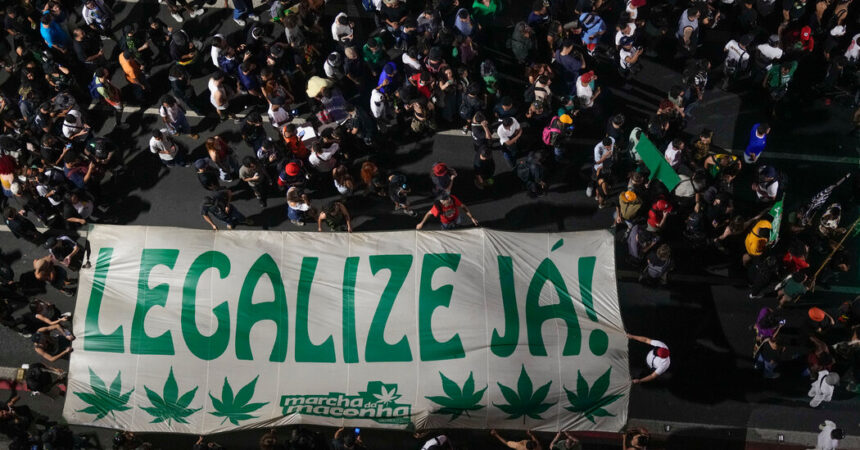
Brazil decriminalized marijuana for personal use on Wednesday, making the nation of 203 million the largest to take such a measure and the latest sign of a growing global acceptance of the drug.
Brazil’s Supreme Court ruled that Brazilians could possess up to 40 grams of cannabis — roughly enough for 80 joints — without facing penalties, a decision that would take effect within days and stand for the next 18 months.
The court asked Brazil’s Congress and health authorities to then set the permanent amount of marijuana that citizens could possess. Selling marijuana remains a criminal offense.
Thousands of Brazilians are serving prison sentences for possessing an amount of marijuana below the new threshold, legal analysts said. It is unclear how the decision would affect those convictions.
Many are Black men, who represent 61 percent of drug-trafficking prosecutions but 27 percent of the population. Studies have shown thousands of Black Brazilians have been convicted in situations that have led to lesser or no charges against white people.
Brazil has long taken a harsh criminal approach to drugs, so its decision to effectively allow citizens to smoke marijuana is part of a remarkable shift in public opinion and public policy on the drug over the past two decades. More than 20 countries have now decriminalized or legalized recreational use of marijuana, most in Europe and the Americas.
Mexico legalized marijuana in 2021; Luxembourg did so last year; and Germany in April.
Canada and Uruguay have allowed licensed sales of marijuana for years. Many more countries have decriminalized marijuana, meaning they abolished criminal penalties for possessing small amounts of the drug, though it technically remains illegal and authorities still target traffickers.
In many cases, the changes have been part of a broader policy shift to treat drug use as a health issue rather than a criminal act.
In the United States, marijuana remains illegal at the federal level but states are now able to set their own policies. Since voters in Colorado and Washington first approved recreational use of marijuana in 2012, more than half of Americans live in states where marijuana is legal.
Seventy percent of Americans now believe marijuana should be legal, according to Gallup, up from 31 percent in 2000.
Brazil has had the opposite experience. While the country now has a more lenient federal marijuana policy than the United States, far fewer Brazilians are in favor of the drug than Americans.
Less than a third of Brazilians said they supported decriminalization of marijuana, according to a March survey of 2,000 people by Datafolha, a Brazilian pollster.
“The perception of the risk of cannabis has decreased, and you see this in the data on the percentage of young people that believe cannabis is harmful,” she said. “There’s been a huge drop both in North America and in Europe.”
Brazil’s Supreme Court decriminalized marijuana after nearly a decade of deliberation on a 2009 court case. That case centered on a 55-year-old man who was caught with 3 grams of marijuana while in prison on a separate charge in São Paulo. He was sentenced to two months of community service, but his lawyer appealed, arguing that punishing drug users violated Brazil’s Constitution.
Since 2015, the Supreme Court has delayed ruling on the case as justices disagreed on how to distinguish between users and traffickers, what drugs should be decriminalized and who should be in charge of setting drug policy. The court reached a majority on Tuesday and finalized its decision on Wednesday.
In the ruling, Chief Justice Luís Roberto Barroso said the decision does not condone marijuana use but rather recognized failed drug policies, which have led to the mass incarceration of poor youth, pushing many of them into organized crime.
“At no point are we legalizing or saying that drug use is a positive thing,” he said. “The strategies we’ve adopted are not working.”
In 2006, Brazil’s Congress passed a law that aimed to increase penalties for drug traffickers and reduce them for users.
The law called for softer forms of punishment for drug users, such as community service. Yet the law was vague on what constituted a trafficker, and critics say that the police and prosecutors have used it to put more drug users in prison.
Ten years after the law passed, the percentage of prisoners detained on drug charges rose from 9 percent to 28 percent, according to Human Rights Watch.
Studies have shown that Black men have been disproportionately affected. One study of drug cases between 2010 and 2020 in São Paulo, Brazil’s largest city, showed that the police classified 31,000 Black Brazilians as traffickers in situations where white people were treated as users, according to the Insper Institute of Education and Research, a Brazilian university.
“Skin color counts when it comes to how drug law is applied,” said Cristiano Maronna, director of Justa, a research group that investigates the Brazilian justice system. “The darker your skin,” he said, the greater the chances of being accused of “trafficking, even with small quantities.”
In its decision, the Supreme Court aimed to clarify the threshold between possession and trafficking. The court said people could still be charged with trafficking if found with other items commonly used in drug sales, such as a scale.
Mr. Maronna said that despite the new policy, Brazil still has some of the harshest drug laws in Latin America, which have helped fill the country’s prisons. Brazil has the world’s third largest prison population, after the United States and China.
Even before the new marijuana policy had been finalized, there were already efforts on Brazil’s right to undo it. Conservatives in Brazil’s Congress are pushing a bill that would modify the Constitution to criminalize any possession of marijuana.
Congressional leaders have said that the issue should be left to Congress and that most lawmakers oppose decriminalization.