New York (CNN) — President Donald Trump on Wednesday announced 25% tariffs on all cars shipped to the United States, a significant escalation in a global trade war.
The tariffs, set to take effect on April 3 at 12:01 am ET, are aimed at expanding America’s auto manufacturing prowess. For decades, because of a free trade agreement, automakers have treated Canada, Mexico and the United States as one big country, with no tariffs among them. Although the United States is home to a significant automaking industry, Trump wants to grow it.
“Frankly, friend has been oftentimes much worse than foe. And what we’re going to be doing is a 25% tariff on all cars that are not made in the United States,” Trump told reporters on Wednesday before signing an executive proclamation in the Oval Office. “If they’re made in the United States, it’s absolutely no tariff.”
New tariffs will be applied not just to foreign-made cars but also to car parts, including engines and transmissions. The tariffs on car parts are set to take effect “no later than May 3,” according to the text of the proclamation Trump signed.
Parts coming from Canada and Mexico that comply with the United States-Mexico-Canada Agreement (USMCA) will be exempt from the tariffs until US Customs and Border Protections has a system in place to apply tariffs to non-US parts, according to a fact sheet published by the White House on Wednesday.
Trump said he’s been in touch with the Big Three automakers, Stellantis, Ford and General Motors. “If they have factories here, they’re thrilled,” he said. “If you don’t have factories here, they’re going to have to get going and build them.”
All three companies’ stocks fell in after-hours trading after Trump’s announcement. Shares in General Motors (GM) plunged more than 7% after-hours, while Ford (F) and Stellantis (STLA), which produces Jeep, Ram, Chrysler and Dodge cars, both fell by more than 4%.
Shares in German automakers fell Thursday morning on the news. Stocks in Volkswagen were down 1.7%, and BMW down 1.8%, by 6.29 a.m. ET.
It was a similar picture in Asia. In Japan, shares in Toyota (TM), the world’s largest carmaker, ended Thursday about 2% lower, while Honda (HMC) lost 2.5%.
Japanese Prime Minister Shigeru Ishiba told lawmakers that “all options” against the tariffs would be on the table, while in Seoul, the government held an emergency meeting with auto makers to discuss the impact of the tariffs.
“The US tariffs are expected to pose significant challenges for our automobile companies exporting a large volume to the US market,” said Ahn Duk-geun, South Korea’s trade minister.
In Canada, Prime Minister Mark Carney said the tariffs were a “direct attack” in violation of the USMCA, and that Ottawa will examine its options for a response — including possible retaliatory tariffs.
Tesla CEO Elon Musk wrote on X on Wednesday that auto tariffs will have a “significant” impact on Tesla. Musk is a close advisor to Trump and heads up the new Department of Government Efficiency.
“Important to note that Tesla is NOT unscathed here,” he said, noting in a separate post that tariffs will “affect the price of parts in Tesla cars that come from other countries.”
“The cost impact is not trivial,” he added.
On-again, off-again tariffs
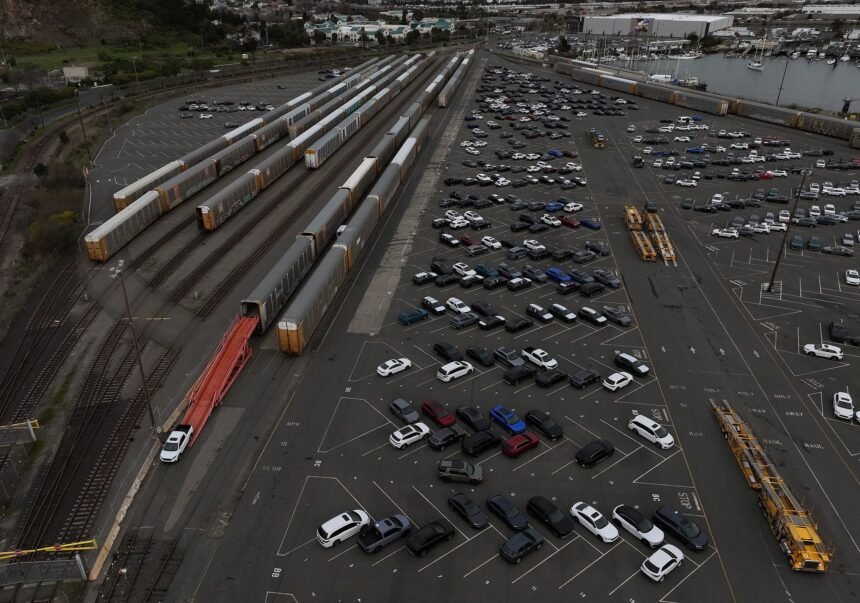
The tariffs threaten to upend a crucial manufacturing industry and stand to raise prices for American consumers. Half of the roughly 16 million cars, SUVs and light trucks Americans bought in 2024 were imports, a White House official said in a call with the press Wednesday.
Car companies are all but certain to pass along added costs from tariffs to consumers, especially given they cannot easily move their entire supply chains to the US. And even if that were possible, it would come with hefty costs, too.
The announcement comes after the Big Three automakers successfully lobbied for exemptions to 25% tariffs on all goods coming to the US from Canada and Mexico that were set to go into effect earlier this month.
The exemption Trump announced allowed for autos to come in duty-free if they were USMCA-compliant. Trump later applied that to all goods coming from the two countries. However, that is exemption is set to expire on April 2, when Trump is expected to announce sweeping tariffs against America’s trading partners.
The move didn’t come as a huge surprise to automakers. An executive at one of the automakers, who spoke on background to CNN on Wednesday, said they had already been working with the assumption that auto tariffs would take effect next week.
“We were all kind of expecting April 2 to be our day,” said the auto executive. “But if the Trump administration has shown us anything, I mean, things are unexpected.”
United Auto Workers union President Shawn Fain said he supports the tariffs. “We applaud the Trump administration for stepping up to end the free trade disaster that has devastated working class communities for decades,” he said in a statement on Wednesday.
“Ending the race to the bottom in the auto industry starts with fixing our broken trade deals, and the Trump administration has made history with today’s actions.”
Countries hold off on announcing retaliatory measures
Following Trump’s announcement, European Commission President Ursula von der Leyen condemned the tariffs. However, she said the European Union will wait to announce any retaliatory actions.
“We will now assess this announcement, together with other measures the US is envisaging in the next days,” she said in a statement.
The European Automobile Manufacturers’ Association said in a statement Thursday that it is “deeply concerned” about the impact of the new levies, which will arrive during a time of “fierce international competition” for the region’s automakers.
Germany, the region’s biggest economy, could be particularly hard-hit by the tariffs. Autos and their parts are the country’s biggest export product, according to its Federal Statistical Office, with the largest share of car exports going to the US.
Hildegard Mueller, president of Germany’s auto association VDA, called the tariffs a “disastrous signal for free, rules-based trade” in a statement on Wednesday.
“The German automotive industry is calling for urgent negotiations between the US and the EU on a bilateral agreement,” Mueller added.
Ontario Premier Doug Ford said Canada should retaliate. “I’ve spoken with Prime Minister Carney. We agree Canada needs to stand firm, strong and united,” Ford said in a post on X. “I fully support the federal government preparing retaliatory tariffs to show that we’ll never back down.”
At a press conference in Kitchener, Ontario, Carney noted that Canada had slapped retaliatory tariffs on US goods before in response to Trump’s repeated taxes on Canadian exports.
“We will defend our workers,” he said. “We will defend our companies, we’ll defend our country, and we’ll defend it together.”
Beijing also condemned the tariffs, with a spokesperson for the Foreign Ministry saying on Thursday that “there are no winners in a trade war or a tariff war.” Unlike its Asian rivals, China’s car industry is largely insulated from this round of US levies. Last May, the Biden administration increased tariffs on Chinese electric vehicles to 100%, which has effectively shut them out of the market.
The UK’s finance minister said the country would hold off on imposing retaliatory tariffs “at the moment.”
“We’re not at the moment at a position where we want to do anything to escalate these trade wars,” Rachel Reeves told Sky News on Thursday.
The US is the second-largest market for UK car exports after the European Union, according to data from the Society of Motor Manufacturers and Traders, with 16.9% of British auto exports heading to the US last year.
Car prices likely to rise quickly
Given the auto tariffs include parts, they could quickly raise the prices of new cars by thousands of dollars, according to industry experts.
There is no such thing as an all-American car, since all depend on parts from Mexico and Canada for a significant part of their content. Parts from the two countries could soon be subjected to the tariffs Trump unveiled Wednesday.
According to analysis by Michigan-based think tank Anderson Economic Group, the cost of producing vehicles built at US plants will rise by between $3,500 to $12,000 each.
The US government tracks what percentage of each car’s parts is made “domestically.” But under current trade law, Canadian-made parts and US-made parts are all counted as the same domestic content. Even with the broader definition of “American made,” none exceed 75%.
The North American car industry has operated for decades as if the continent is one giant country, thanks to free trade agreements signed by US presidents from Bill Clinton to Trump himself. Parts and whole vehicles have flowed freely across borders, sometimes multiple times, before they end up in an American dealership.
Even if tariffs were only applied to fully assembled vehicles and not auto parts, they would likely raise average car prices by eliminating some lower-cost options for car buyers. Some Mexican-assembled vehicles, like the Chevrolet Blazer or Honda HR-V could be priced out of the market, and automakers might decide to stop offering them altogether rather than build them at US factories. Cars built in Mexico are most often lower-priced, lower-profit models that are only able to maintain their profitability by being built with cheaper Mexican labor.
“One of the losses from tariffs tends to be a loss of product variety,” said another auto industry executive who spoke to CNN Wednesday.
It’s not only the smaller, entry-level models built in Mexico that could see price hikes. Trump’s auto tariffs could impact many models that car buyers don’t realize are imports, such as the heavy-duty versions of Ram pickup trucks, which are built in a Stellantis plant in Saltillo, Mexico. Some versions of the Chevrolet Silverado are also built in Mexico. Even if the automakers shift production of those more profitable vehicles back from Mexico to US factories, it would take years to accomplish the switch.
There were a total of 4 million vehicles built in Mexico in 2024, according to data from S&P Global Mobility, of which 2.5 million, or 61%, were shipped to the United States. Most of the nation’s largest automakers have assembly plants in Mexico, including General Motors, Ford and Stellantis, as well as Asian automakers Toyota, Honda, Hyundai, Nissan, Mazda and Mitsubishi and German automakers Mercedes-Benz and Volkswagen.
Canadian auto plants built 1.3 million vehicles last year, of which 1.1 million, or 86%, were exported to US dealerships.
But it won’t just be Canadian and Mexican workers hurt by the tariffs. If the 3.6 million cars coming from those two countries become unaffordable, it could hit US auto parts plants that supply those countries’ assembly plants.
The US exported $35.8 billion worth of parts to Mexico last year, according to federal trade data, and another $28.4 billion of parts to Canada. Parts suppliers, which employ about 550,000 workers, or nearly twice as many as work in auto assembly plants, could be forced to cut back their production and staffing if Canadian and Mexican plants shut down, even temporarily.
In addition, United States car exports to Canada and Mexico reached nearly 1 million vehicles last year. There were 799,000 US-built cars, worth $14.9 billion, exported to Canada, according to data from S&P Global Mobility and the US Commerce Department. In addition, there were 160,000 US-made cars, worth $4.6 billion, exported to Mexico. That represents nearly 10% of US auto production. If those countries retaliate with their own tariffs on US-assembled vehicles, it could force some US assembly plants to scale back their own production.
Cox Automotive estimates that about 30% of North American auto production, or roughly 20,000 vehicles a day, could be halted due to tariffs, assuming tariffs both on auto parts and assembled vehicles.