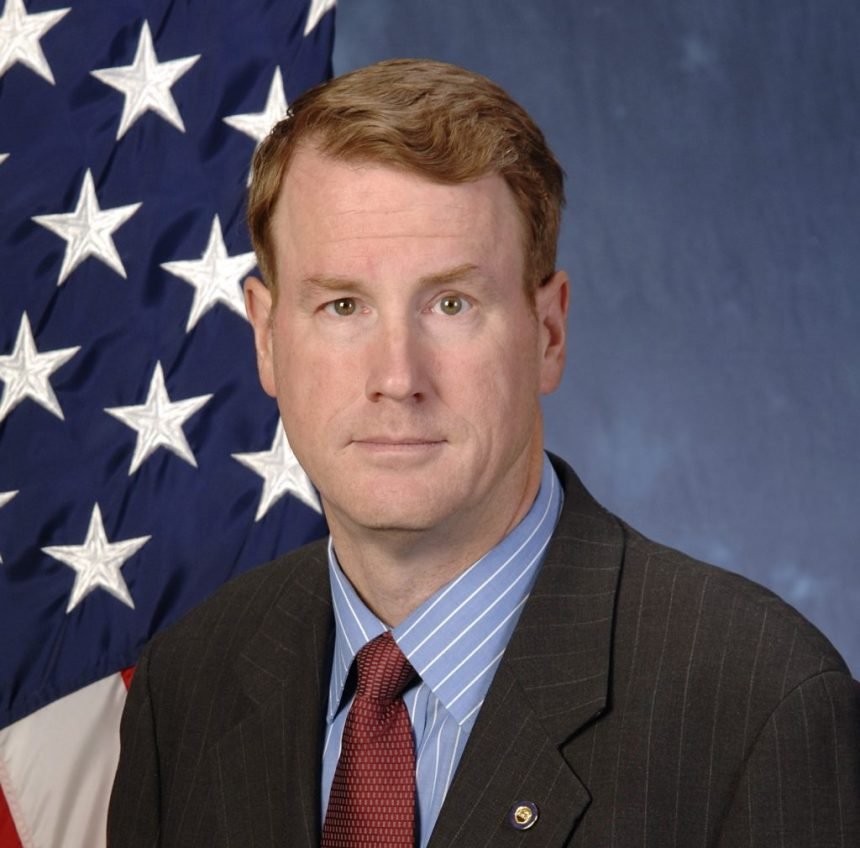
Do we have a workhorse emerging from Colorado’s Third Congressional District? I’m not sure, but an interesting bit of legislation U.S. Rep. Jeff Hurd introduced is at least a bit suggestive he just might be in Washington, D.C. to get work done, even if the cameras are not aimed his way.
As my regular reader (Hi, Jeff!)…
Now wait just a sec: I need to explain my Jeff won’t actually read this any time soon. He is leading a cruise (that’s one of his jobs) on a five-masted sailing boat heading for a port in France as I type these words. He was in Portugal, where at least of few of his groups bought hats with the Canadian flag on them, in hopes of avoiding the apparently widespread irritation at United States citizens.
That’s a sad commentary on the current way the world is viewing our nation, and this all cascades down from the worst president in American history, but all that must await a future column. Let’s pretend Jeff just said “hi.”)
Anyway, my Jeff knows I’ve oft written about the fact we old poli-sci professors talk about the two basic types of representatives we see in elective office. There are show horses and workhorses. Show horses are elected folks who care most about appearing on TV and, well, showing off (think Ted Cruz). Workhorses are the folks who care about getting the work done and aren’t that concerned with public attention. Obviously, most of our elected officials bounce back and forth a bit, but the ones who are the hardest workers (like my old boss U.S. Sen. Michael Bennet) tend to appear far less on television as they crank out bills and other work products.
As Hurd appeared to be a GOPer who tended to be pretty loyal to President Donald Trump, I had mostly written off Hurd as a minion of the president. But, not that long ago, he distanced himself from Trump by being one of six Republicans in the House to vote with the Democrats who objected to Trump’s poorly thought out and dangerous tariffs on Canadian goods.
Trump, never a man to let any presumed afront, no matter how petty, go by uncommented on, dramatically withdrew his endorsement of Hurd in the GOP congressional primary and threw his support to another candidate. Heck, Trump even labeled Hurd as “one of a small number of Legislators who have let me and our Country down.” Ouch.
However, as special election after special election turned congressional seats from red to blue, GOP House Speaker Mike Johnson — who cares only about gaining and keeping power — privately urged the White House to rethink its endorsements, and not long after, Trump announced he was supporting Hurd after all, because his GOP opponent, and I kid you not, these are Trump’s words: “will be leaving the Campaign trail in order to join my Administration, in a capacity to be determined.” He added, “Therefore, I will be fully supporting Jeff’s Re-Election to the House of Representatives, giving him my Complete and Total Endorsement!”
That must give Hurd a warm, fuzzy feeling, right? I’m especially taken with the phrase “in a capacity to be determined.” Trump must really need that guy on his team.
Anyway, it appears Hurd has been forgiven for doing the right thing. And a recent bill he introduced with little fanfare further suggests he might be a serious legislator, albeit one with whom I sharply disagree on most things.
Hurd introduced House Resolution 8257, with two co-sponsors (one from Montana and the other from Guam! You didn’t know a guy from Guam was in Congress? There are actually six “delegates” in Congress, one from D.C. and one from each of our five U.S. territories, including Guam. They get to do most things a “regular” House member gets to do, except vote on the floor. There, you learned something. The more you know!).
Given Colorado’s Third Congressional District is vast and lightly populated, it makes sense Hurd would be the one to introduce HR-8257, known as the “Small County PILT Parity Act.” This proposal takes on a problem faced by especially small communities in Colorado and, I suspect, around the country.
PILT, or “payment in lieu of taxes,” recognizes in many rural areas, there are large tracts of land that are federally owned, and therefore there are no “regular” property owners who would being paying property taxes on such lands. The federal government does not pay property taxes to local governments. PILTs are a way in which federal funds are transferred to these rural areas to help make up for the lack of tax dollars that other, less rural and more privately owned property areas, would be getting.
Hurd’s bill is designed to help the tiniest of the little counties out there west of the Continental Divide by lowering the population requirements to get various PILT payments. These payments are staggered by population size, and Hurd’s bill would change the current population requirements from 5,000 to 500 which would, as he states in his press release, “allow counties with populations under 5,000 to receive higher per capita payments, bringing parity with larger counties where funding increases as population decreases.”
Frankly, this seems like a good idea to me. And it suggests an opportunity for bipartisanship, as rural folks around the country, red or blue, could profit from this legislation. Currently, the bill is in the Natural Resources Committee, and, frankly, most bills sent to committees die there.
Though Hurd is in the majority party, it is just barely the majority party, and I don’t believe Speaker Johnson will risk too much political capital on a bill that, ultimately, would only affect a tiny portion of the electorate. But we’ll see. I’ll be curious if additional people sign on as sponsors, and especially if any Democrats sign on. This could get interesting!
Stay tuned.
Hal Bidlack is a retired professor of political science and a retired Air Force lieutenant colonel who taught more than 17 years at the U.S. Air Force Academy in Colorado Springs.