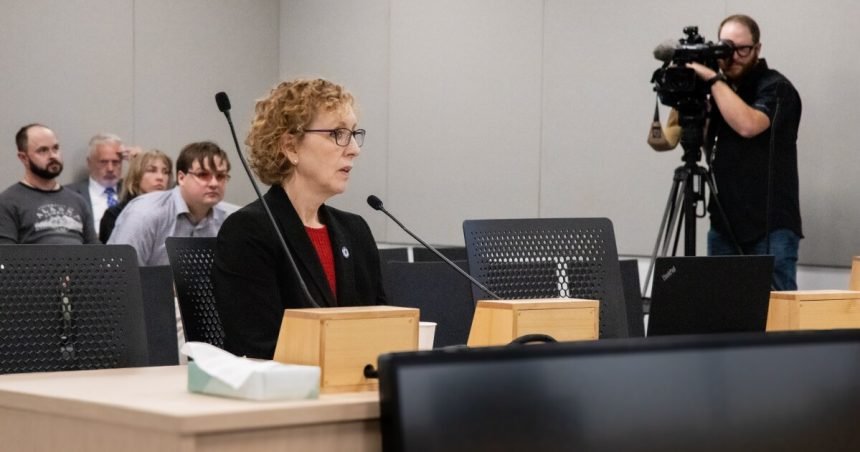
Members of the House Judiciary and State Affairs committees questioned Alaska Division of Elections director Carol Beecher on Wednesday about the state’s response to a U.S. Senate candidate with the same name as the incumbent — Dan Sullivan. It was the second investigatory hearing on the subject after elections officials failed to appear at an initial hearing in June. Alaska Lieutenant Governor Nancy Dahlstrom, who oversees the division, declined an invitation to appear.
At issue was the state’s decision to disqualify the U.S. Senate candidate Dan J. Sullivan of Petersburg and its determination that he was not a “good faith” candidate. The Alaska Supreme Court nixed that decision in late June.
Beecher testified for nearly two hours and defended the division’s actions from the choice to disqualify Sullivan to the choice to list him without a party affiliation on the primary ballot. She also answered questions about how 3,500 Alaskan residents received notices that they have inactive voter status pending verification of citizenship.
Since the first legislative hearing, the Sullivan from Petersburg challenged the state’s decision and the fast-tracked case reached the Alaska Supreme Court. The court upheld a lower court’s ruling that Sullivan was eligible and said the division did not have the authority to add additional eligibility requirements, like whether a candidate was acting in “good faith,” beyond what is outlined in the U.S. Constitution.
Lawmakers raised concerns about how the division chose to list the candidates on the primary ballot. They asked Beecher about why the division chose to list the challenger as “Sullivan, Daniel J, Jr.” without his party affiliation as a registered Republican. It listed the incumbent senator as “Sullivan, Dan S.” and identified him as the incumbent and a Republican.
Mikayla Finnerty
/
Alaska Public Media
The two Sullivans are among 16 candidates for the U.S. Senate seat, including Democratic former U.S. Rep. Mary Peltola, in the primary election on August 18. The top four vote-getters will advance to the general election on November 3.
Beecher defended the division’s position that Sullivan was running with the purpose to confuse voters. She cited complaints filed by national and state Republican groups, Sullivan’s party affiliation as Republican and campaign materials as evidence of his intention to mimic the U.S. Senator Dan Sullivan and confuse Alaska voters.
“The division acted then to prevent manipulation of the ballot and to protect voters from purposeful confusion, consistent with its responsibility to maintain fair, neutral, and trustworthy elections,” she said.
She noted that the division’s action was unprecedented, but said the situation merited such a response. “The division understood all along that this action could be challenged in court, and recognizes the court’s authority to review these important questions,” she said.
Judiciary committee chair Rep. Andrew Gray, D-Anchorage, had several questions about how the division determined Sullivan was not a “good faith” candidate. “Where is the evidence that he did this to trick voters, to mislead the voters whom we are here to protect?” he asked.
“The information that we were presented with painted for us a picture of someone who was trying to confuse the ballot,” Beecher replied.
Gray probed the division’s criteria later in the hearing.“In your opinion, Director Beecher, what does it mean for a candidate to have a good faith intention to serve?” Gray asked.
“In my opinion, that it would be someone who actually wants to win, and is running because they want to to get the seat,” Beecher replied. “And in this situation, all of the facts that were presented to the division were that this was an individual who was not running to be what I would call a true candidate. This individual was running to confuse the ballot. It was an intentional attempt to gain access to the ballot for the purpose of confusing.”
Lawmakers also raised this issue of of how the candidate was listed on the primary ballot after the state Supreme Court ruling. The challenger was listed as “Daniel J. Sullivan, Jr.” when he has publicly stated he goes by his first name as “Dan.”
Beecher said it was a choice by the division. “And it’s a bit of first in time, first in place, that Dan Sullivan has already been on the ballot prior, as Dan Sullivan is known as Dan Sullivan,” she said, referring to the incumbent senator. “So it was simply a way to differentiate between the two.”
Rep. Genevieve Mina, D-Anchorage, asked Beecher about the division’s decision not to list Sullivan’s Republican party affiliation.
Beecher said she believes it was also within the division’s authority to do so. “Whether or not it has to be on the ballot, we believe that has been left to the discretion of the division, and in line with that, we made that determination,” she said.
“It also could still be litigated,” Beecher added.
Rep. Ashley Carrick, D-Fairbanks and chair of the House State Affairs Committee, said she was concerned about the precedent and the agency’s discretion to remove party information that could be informative for voters.
“Having his party affiliation may help those voters feel like they’re more informed and directed to a candidate they would rather support,” she said. “But not having his affiliation included there seems to provide less information and be more confusing.”