The arboretum spans more than 12 miles along completed trail segments.
The tree canopy along the Atlanta Beltline’s Eastside Trail. Beltline officials said Thursday it’s home to the world’s longest linear arboretum, spanning more than 12 miles along completed trail segments. (Courtesy of Atlanta Beltline)
Atlanta has long been called the “city in the forest” for its lush tree canopy.
Now, the city boasts a new title: home of the world’s longest linear arboretum.
The Atlanta Beltline announced the designation Thursday, highlighting an arboretum (or a collection of woody plants and trees) that spans more than 12 miles along its completed trail segments. The public garden is expected to grow to more than 16 miles by this summer when Atlanta hosts the FIFA World Cup, officials said.
The new designation highlights a 20-year partnership with Trees Atlanta, which has included design, installation and community projects, officials said.
The arboretum, which stretches 60 acres, features 647 unique tree and woody shrub species and cultivars. Special collections include a pitcher plant bog, native azaleas and more than 15 cultivars of pawpaw. Trees Atlanta has also planted more than 700,000 native plants, including grasses and wildflowers, according to the release.

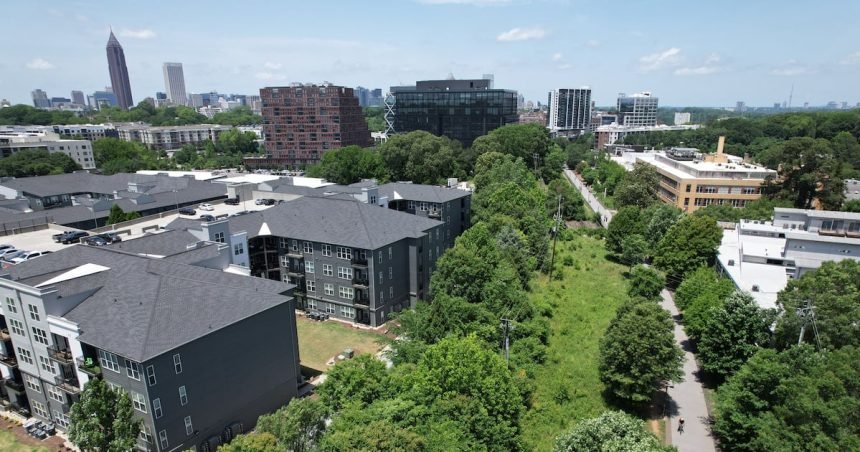
An aerial photo shows dense trees along the Beltline’s Southwest Trail on Thursday, March 12, 2026. (Hyosub Shin/AJC)
The Beltline Arboretum is longer than the Stanley Park Seawall in Vancouver or the High Line in New York, Beltline officials said. It maintains an accreditation from ArbNet, an international network of more than 900 arboreta.
Greg Levine, executive director of Trees Atlanta, reflected at a Thursday event how far the plant diversity of the Beltline has evolved from its former days as a railroad.
“Twenty years ago, it was a 22-mile liability for neighborhoods,” he said at a news conference. “It was basically a linear snake running through the city that was delivering kudzu to everyone’s backyard … What it’s become is an opportunity to restore the land and become a place for a community to be brought together through a public garden.”
The new designation does not impede future transit expansion along the Beltline, Clyde Higgs, president and CEO at Atlanta Beltline Inc., told The Atlanta Journal-Constitution at the news conference.
“All these things can coexist … They’re actually enhancements,” Higgs said, adding later the Beltline has advocated for what’s called a “green track,” a railway track planted with vegetation. “Having plantings, having the connection to Trees Atlanta, will actually enhance transit in the future.”
He said while there is vegetation in the planned transit corridor, much is “meadow-based plantings.” Some trees were planted in transit corridor, but that was to enhance the trail and spur economic development, he said.
“Now, there will be a time where we’ll have to make some decisions about taking some trees away and the meadow, but it’s not going to slow down transit at all,” Higgs said.
He did not immediately know how many trees would need to come down for transit, but he said it would depend on the width of the particular trail segment.
“So if it’s tight on the Eastside (Trail), you can imagine that it’s probably going to have more of a significant impact,” he said. “But on Southside, where you have significant width, then perhaps a lower impact on the trees and arboretum.”

The green lines show completed trail segments of the Atlanta Beltline. Officials say the arboretum spans more than 12 miles along completed trails. (Courtesy of the Atlanta Beltline)
Higgs said in a prepared statement following the event that since transit timelines have shifted, some plantings have had more time to mature than originally expected.
“If tree removal becomes necessary during transit construction, it will be done thoughtfully and will include a replanting strategy as part of the final transit plan,” he said.
Beltline officials also said that adding transit would not remove its title as the world’s longest linear arboretum. Only a competing project could.
Officials last August revealed a new $3.5 billion transit plan, but efforts to build a light rail system on the Beltline have been riddled with delays, evolving plans and controversy for years. Last year, Mayor Andre Dickens pulled his support for starting light rail construction on the Beltline’s Eastside Trail, though he has signaled support for starting light rail on the Southside of the loop.
Earlier this year, The Atlanta Journal-Constitution uncovered that a small group of officials voted in a committee meeting to halt all work on a planned streetcar project along the Eastside Trail. But the matter was not taken up by the full MARTA board.
The Beltline extends its arboretum as research has shown Atlanta’s tree cover is shrinking as its population grows.
A canopy assessment produced by Georgia Tech researchers’ in 2018, the most recent one released publicly, showed the city’s tree coverage stood at 46.5%, down 1.5% from a decade earlier. That’s well below the city’s stated goal to maintain 50% canopy coverage. A new assessment could be released soon and many tree advocates expect it will show the canopy has shrunk below 45%.
In urban “heat islands” like Atlanta, trees benefit public health and help take the load off stormwater infrastructure.
Research has found areas shaded by trees are significantly cooler than ones packed with heat-absorbing pavement and buildings. And with Atlanta and many other cities facing more intense heatwaves fueled by climate change, studies have found trees are among the most cost-effective ways to keep the city cool. Forested areas also help absorb stormwater runoff and prevent flooding.
— Staff writers Sara Gregory and Drew Kann contributed to this report.

Amy Wenk is the consumer brands reporter for the AJC.