For decades, Little Village has been a cultural heartbeat of Latino Chicago, a role on display this week as thousands packed the 26th Street corridor for its 55th annual Mexican Independence Parade.
But neither Little Village nor Pilsen is home to Chicago’s largest Latino population, a new University of Illinois Chicago study found. That title now belongs to a neighborhood about 8 miles north.
Belmont Cragin, on the Northwest Side, is home to more Latino residents than any other area of the city, according to findings released Thursday by UIC’s Great Cities Institute. Of the nearly 802,000 Latino residents citywide, more than 57,000 call Belmont Cragin home, accounting for roughly 80% of the neighborhood’s population.
The report offers a sweeping look at how a community that now accounts for nearly 30% of the city’s population is changing. Its findings trace not only shifts in where people live, but changes in income, education and employment that show a Latino Chicago increasingly extending beyond the neighborhoods historically associated with it.
“For us, it’s about taking a comprehensive look at who the Latino community actually is. I think many times, we think of the Latino community as a single issue,” said Oswaldo Alvarez, executive director of the Illinois Legislative Latino Caucus Foundation. “It’s about having a snapshot of who the Latino community is and how the Latino community has been able to bring Chicago to its next level, without necessarily Chicago’s help.”
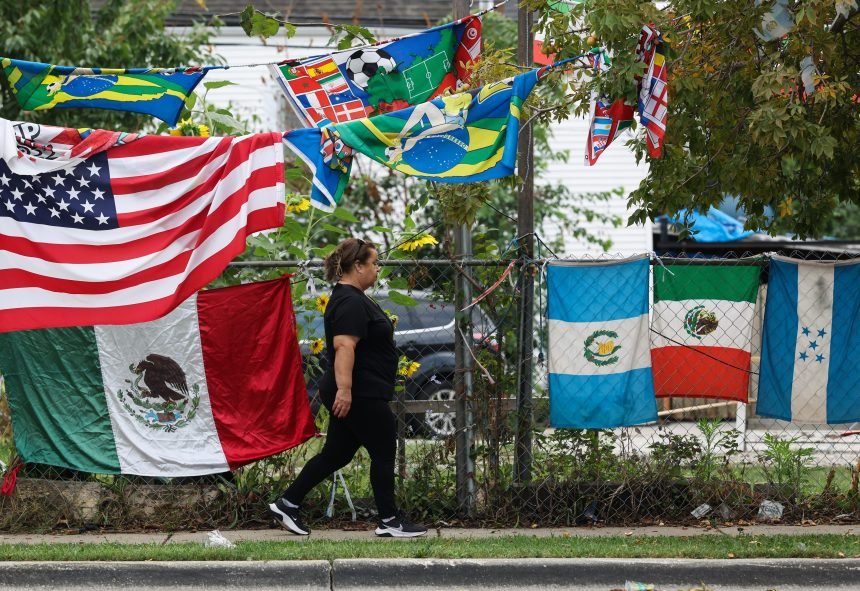
Belmont Cragin, a neighborhood less than 3 miles across, reflects the changing demographics documented in the study. Flags of Mexico, Argentina and Colombia decorate the front porches of family homes. Along Fullerton Avenue in Belmont Cragin, multilingual signs hanging in storefront windows reflect the diversity of a community with roots stretching across Latin America.
Fullerton Avenue on the Northwest Side also won the title of Chicago’s busiest commercial corridor, generating approximately $181 million in taxable sales in 2024, the study found. It surpassed that of the “Mexican Magnificent Mile” on 26th Street, which generated nearly $177 million and recorded the largest year-over-year increase of any corridor studied by UIC.
Though Mexican residents remain the largest Latino group in Belmont Cragin, the study identifies significant Puerto Rican, Central American and South American populations in the area, including Guatemalan and Ecuadorian residents.
Luisa Rodriguez sees that diversity firsthand. She operates Niko’s Multiservices and Cell, a small business settled near the intersection of North Parkside and West Fullerton avenues, where customers can send money to family members abroad.
“This is a place with people from all different places,” Rodriguez said in Spanish. She said her customers come from Guatemala, the Dominican Republic and Honduras.
That diversity, according to the study, reflects a broader pattern. The Southwest and Southeast sides remain heavily Mexican, while the Northwest Side includes substantial Mexican, Puerto Rican, Ecuadorian, Guatemalan, Colombian, Salvadoran and Honduran populations, among others.
Austin, the majority-Black neighborhood on the West Side, recorded the largest increase in Latino residents of any Chicago community area, according to the report. Garfield Ridge, Chicago Lawn, Ashburn, Clearing and West Lawn have also recorded increases, challenging long-held associations of the demographics historically associated with each community.
At the same time, some longtime communities have seen Latino population declines, including Logan Square, Avondale, Albany Park, Irving Park and Pilsen.
There is no single explanation for why Chicago’s Latino residents are moving to neighborhoods like Austin or Belmont Cragin. But Alvarez suggests housing costs and homeownership are important variables in understanding the changing map.

Gentrification, driven by high rent prices and low housing stock, has pushed residents farther from the city center. Roughly half of Latino renters citywide are “cost-burdened,” meaning they spend at least one-third of their household income on rent and utilities, according to the study.
“What we’ve been seeing, especially on the Northwest Side, in Logan Square and Humboldt Park, you’ve seen gentrification impact the Latino communities at a greater rate than other communities. It has to do with affordability of people being able to afford the rising rents, the rising taxes for homeowners.”
Still, even as families are being priced out of longtime Latino neighborhoods, others are finding opportunities to buy homes and build wealth elsewhere, the report found. Latino homeownership exceeds 80% in Ashburn and Garfield Ridge, and in 2024, Latino borrowers accounted for more than 90% of new mortgages in Gage Park, West Lawn and Chicago Lawn.
The changing geography coincides with a growing Latino middle class, with nearly one-third of Latino households in Chicago now earning at least $100,000 a year. That’s up from 20.7% roughly a decade ago, according to the report.
Chicago now has 77,798 Latino households earning six figures, an increase of nearly 35,000 households over that period. The share of Latino adults with a bachelor’s degree or higher has also climbed from 12.6% to 20.4%, while the number of Latino workers employed in management, business, science and art occupations has jumped even more.
But the report cautions against viewing those gains as evidence that Chicago’s Latino working class is disappearing. With almost 60% of Latino employment still spanning industries that traditionally pay less, Alvarez designed the report to capture growing income and employment in the context of persistent housing costs and working-class populations.
“My hope is that it provokes questions, that it provokes a lot of questions of cross-issue areas and that it challenges the way we are thinking or boxing what the Latino community actually is,” Alvarez said.