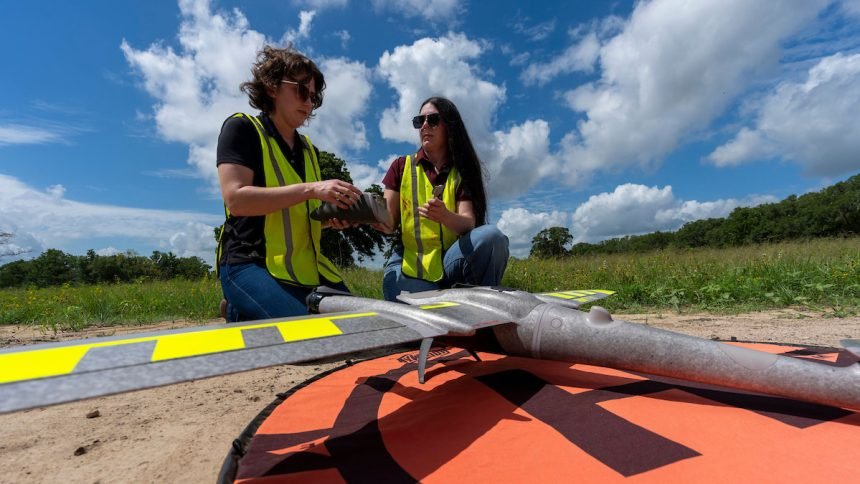
The Landscape Ecology and Drones Lab within the Texas A&M University Department of Rangeland, Wildlife and Fisheries Management is developing ways to use drone technology to manage invasive species and improve the accuracy of forage mass and quality forecasts, all in a short time frame, demonstrating its role as a high-tech force for good in rangeland health.
“The main objective of our lab is to provide new insights into how to assess the health and resilience of ecosystems — particularly rangeland systems — through the adoption of spatial technologies,” said Dr. Humberto Perotto, lab director, associate professor and Joan Negley Kelleher Endowed Professor in Ranch Management. “We are working with ranchers, nonprofits and state and federal agencies to answer questions and provide solutions that have a direct impact on rangeland and wildlife ecology and management.”
While the foundation of rangeland health is based on terrestrial factors such as soil and vegetation, lab members use drones, remote sensors, and satellite and hyperspectral imaging technologies, along with other advanced tools, to capture insights from above at very high resolution.
Through statistical and computational modeling, data becomes projections on land-use change, vegetation composition and cover, grazing and land-use impacts, habitat quality, forage production, wildlife populations, soil health and more.
Perotto said the lab develops technology-based approaches to rangeland management by mapping out best practices for and parameters of what drones and remote sensing tools can and can’t do. But the primary goal is to translate information that matters for ecosystem health into applied, landscape-scale solutions for producers.
One such project is translating drone data into detailed forage forecasts, allowing livestock producers to develop and adapt grazing management plans for optimal livestock and forage productivity alongside ecological health. Another is using AI to identify, treat and control invasive species across vast land expanses.
Perotto said the lab is also highly focused on being a professional training ground and launching point for students. Since the lab’s establishment in 2023, seven students have earned Federal Aviation Administration drone pilot licenses while raising the department’s profile through award-winning academic publications and presentations at state, national and international conferences.