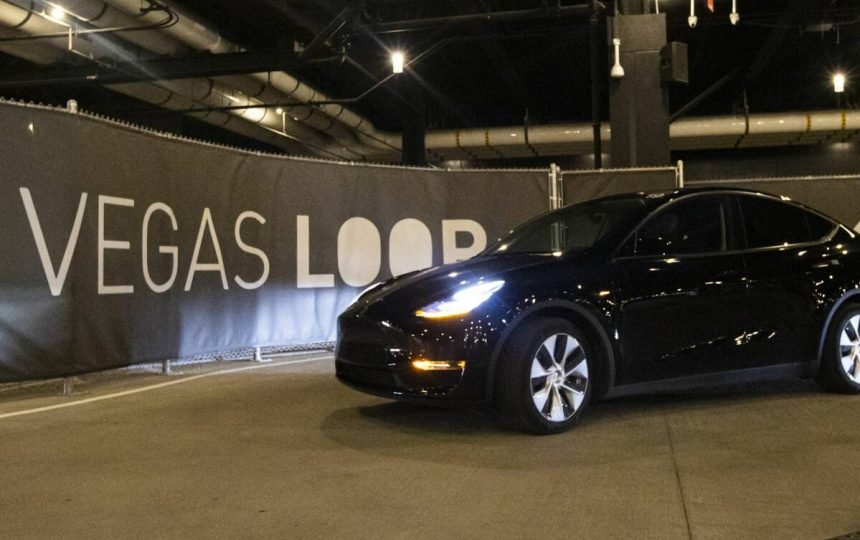
Water is one of the biggest challenges to Boring Co.’s Vegas Loop project, despite Southern Nevada’s dry climate.
When Boring Co.’s tunneling machines are burrowing under the Las Vegas Valley, they encounter a mix of sand, clay, caliche and groundwater.
The company’s Prufrock boring machines are engineered to handle water as they dig without much interruption, according to Boring Co. President Steve Davis.
“Everything is under water,” Davis said. “The entire system is fully submerged. You think it’s a desert, and I always read about how dry it is, but the water tables in Vegas vary between eight and 20 feet, and our tunnels are 30 feet below. So, everything we build is fully under water.”
Davis said groundwater is the hardest part of building the Vegas Loop. Crews have to go in after tunnels are dug and the wall panels are installed, which happens almost simultaneously, and look for leaks. They then address the leaks ahead of the final painting.
After tunnels are open, a team will go through the system every three months and pinpoint leaks and stop up the leaks with foam. Leaks are common in underground transportation systems, but ones occurring in the Vegas Loop don’t pose a safety or operational hazard, Davis said.
“The nice thing, this is very important, this is not a safety issue,” Davis said. “Picture a Tesla going through a tunnel and a drop of water drips on it, it doesn’t matter. It’s just a mild nuisance. Subways, if you drip water on them, they shut down. In (Washington) D.C. the Metro shuts down about 10 times a year because of water, because it’s under water and it leaks as well.”
The loop’s Las Vegas Convention Center central station, a large underground station that is the flashiest of the open stations, took a large effort to make it come to fruition. Boring Co. had to build the central station between conventions and used an unconventional method to finish constructing the station.
“We were the first-ever Vegas project to do steel sheet piles, which is a huge risk, and it worked,” Davis said. “But the problem with steel sheet piles is they’re steel, so that’s not good with water. Se, we have to do crazy corrosion mitigations, but then everything was just leaking. So, we had to bring in a team of underwater scuba welders to do 2.5 miles of seam welding to seal it up.”
Due to the large amount of water Boring Co. encounters during its tunneling operations, the company has a water waste treatment plant at the company’s 4744 Paradise Road work site.
“Because all the water in Vegas is polluted, if you take it out of the ground, you can’t put it back in the ground,” Davis said. “So, you treat it, turn it into clean water and then you can discharge it.”
Bronson Mack, spokesman for the Southern Nevada Water Authority, said there are two groundwater aquifers in Southern Nevada: a primary aquifer, which is located between 300 and over 1,000 feet underground and a shallow aquifer, which is between just below surface level to about 100 feet underground. The two aquifers are separated by a layer of caliche, a hardened layer of soil or sediment cemented by calcium carbonate, so the primary aquifer is not contaminated, while the surface aquifer that the portion Boring Co. deals with contains some level of contaminant.
Mack said that for the most part, groundwater encountered by crews during construction work has fertilizer remnants, from irrigation runoff that frequently is absorbed by the ground in Southern Nevada.
“If you’ve got fertilizer on there, that percolates down into the shallow aquifers,” Mack said. “That shallow aquifer is pretty thin, and it’s pretty dispersed throughout the valley. So, it’s not like it’s a viable water source for us, and we’re fortunate that we’ve got this separation between the primary aquifer and the shallow aquifer.”
Boring Co. was fined $500,000 by the Clark County Water Reclamation District for illegally dumping drilling water into the sewer system at their 3824 Paradise Road site, the former site of the Firefly restaurant. Davis said the water was nothing but groundwater and that the company owned up to the mistake and paid the fine.
Contact Mick Akers at makers@reviewjournal.com or 702-387-2920. Follow @mickakers on X.