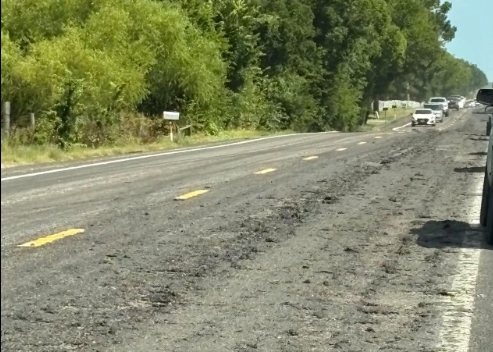
Drivers traveling along U.S. 69 between Greenville and Celeste—about 65 miles northeast of Dallas— on Thursday afternoon encountered an unusual hazard as chunks of asphalt reportedly lifted from the roadway and stuck to their tires, damaging both the pavement and vehicles, according to WFAA. The culprit? Extreme heat.
Officials said the incident occurred after a sealcoat—an oil-based protective surface treatment used to preserve roadways and extend pavement life—’melted’ due to extremely high heat.
“A sealcoat was done in that area about a year ago. With the recent temperatures, the material started to ‘activate,'” Jeffrey Williford, public information officer with TxDOT, told Chron on Monday. “There was a crash in that area as well, and traffic was forced to idle for an extended period, increasing the temperatures on the roadway.”
Williford said some vehicles also decided to U-turn, which also further damaged the pavement. As the sealcoat softened, it began adhering to vehicle tires, pulling material from the roadway and damaging the pavement.
TxDOT said repairs were expected to begin Monday but were delayed because of rain.
The agency estimates that on the two-lane road, about a mile of the northbound lane needs repairs, with about five miles of repairs needed on the southbound stretch.
“Repairs were supposed to start today but have been delayed due to rain,” Williford said. “Weather permitting, the repair is scheduled to take 1-2 weeks.”
TxDOT said once the issue was identified, the agency responded as quickly as possible to address safety concerns and make necessary repairs.
“While pavement failures caused by extreme heat cannot always be completely prevented, TxDOT works to minimize the risk through routine roadway inspections, ongoing maintenance, and monitoring of pavement conditions,” Williford said.
Last week’s incident wasn’t the first of its kind in Texas.
In June 2022, part of a roadway in Crockett started “bleeding asphalt,” according to KPRC2. With temperatures recorded around 100 degrees that day, heat brought asphalt binding agents to the surface of the pavement.
Williford said he didn’t have data readily available on how often similar incidents have occurred across Texas. Looking ahead, TxDOT stopped short of saying whether ‘melting’ roads are expected to become a more common issue as the state experiences hotter temperatures.
“TxDOT continuously monitors roadway conditions and adjusts maintenance and repair strategies as needed to address weather-related impacts and keep the transportation system operating safely,” Williford.