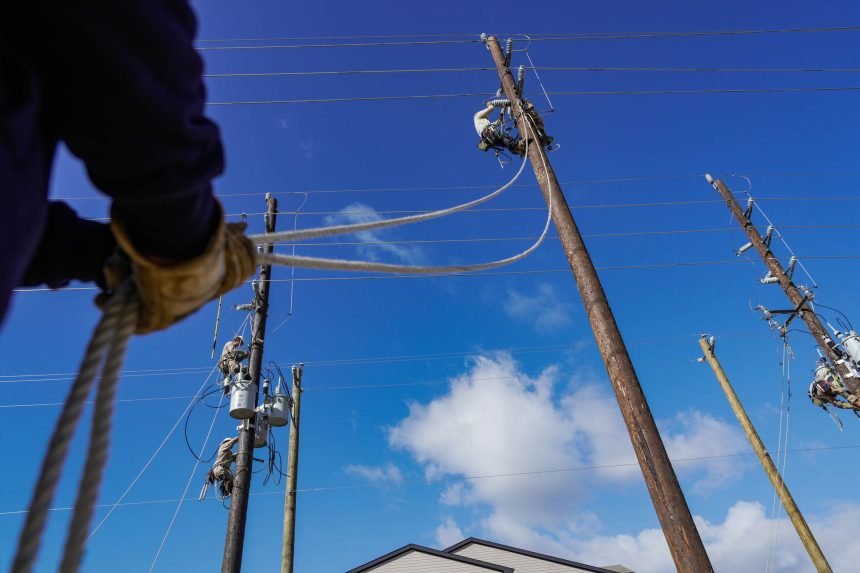
Apprentice linemen, pictured here in 2025, practice at CenterPoint’s Hiram O. Clarke Training Center in Houston. The utility company raised its transmission rates by close to 30% this month as part of a seasonal shift.

Starting this month, Houston residents may notice an increase in their energy bills as CenterPoint Energy raises a little-known charge for delivering power to their homes.
CenterPoint increases the line item — known as the transmission and distribution charge — every September, as Texas utilities transition from typically lower summer rates to higher winter rates. In Houston, the rates decrease on March 1.
For an average family, CenterPoint calculated that the new TDU rates — which increased from 4.99 cents per kilowatt-hour to 6.41 cents per kilowatt-hour — would lead to them paying roughly $14 more for an otherwise identical energy bill.
Article continues below this ad
The higher charge helps CenterPoint cover the cost of maintaining and building the poles and wires that deliver power to consumers, as well as ensuring its rate of return, essentially profit. The charge usually appears on customers’ electric bills as a “TDU” or “TDSP” charge, and the rate change will kick in on bills sent in September for August energy use.

The August energy bill of this reporter, which includes both an electricity charge and a TDU charge.
Every major utility in Texas changes its TDU rates on Sept. 1. But CenterPoint had a far bigger increase than its peers, with rates up 28% from March, as opposed to 7% for Dallas-based Oncor and a rate cut of more than 4% for AEP Central in Corpus Christi.
Ken Head, the vice president of Sugar Land-based energy broker Savant Energy Services, said he had been getting frequent calls from confused clients who were surprised by the increase, because they had signed fixed-rate contracts with their electricity provider.
Article continues below this ad
But fixed-rate electricity contracts, typical in Texas, only apply to the amount customers were charged for electricity, not delivery charges, he said.
“What stands out to me isn’t simply the TDU rate change in September; that’s normal,” Head said. “But the increase, the magnitude of it. We haven’t had any kind of major thing happen here to create that to justify that much of an increase.”
The rate increase, Jason Ryan, CenterPoint’s executive vice president of regulatory services and government affairs, said, was to make up for the fact that customers use less electricity in the winter than in the summer.
Article continues below this ad
Ryan said that it would be ideal to have a fixed rate every month, but that the current system is a product of state regulations. The size of CenterPoint’s rate increase reflects that it kept rates lower than other utilities over the summer, he said
In July, the TDU charge for an average family with CenterPoint was $56.36, lower than $65.26 for Oncor and $61.51 for AEP Central, according to data from Savant Energy.
Ryan also argued that rates had been mostly flat over the last decade, when adjusted for inflation.
But rate increases have outpaced inflation, according to data from Savant. In September 2017, the average CenterPoint customer paid about $62.13, adjusted for inflation, for delivery charges. Today, the same customer pays about $69.03 after the recent rate increase.
Article continues below this ad
In Head’s view, his clients’ annoyance with the rate increase was less about the dollar amount than their lack of say in the change.
Centerpoint’s increased TDU rate was approved by the Public Utility Commission at a series of meetings in July and August. A spokesperson for the commission did not immediately respond to a request for comment.
“Consumers can shop their electricity bill all the time. But you can’t shop for another transmission and distribution utility,” Head said. “That’s where the frustration is, because they have a monopoly on us.”