Tehmina Haider and Michael O’Leary lead L Catterton Impact, the impact investing arm of the consumer private equity firm L Catterton. Michael is also the author of Accountable: The Rise of Citizen Capitalism (HarperCollins 2020).
This spring, ExxonMobil chief Darren Woods came under fire after telling Fortune Magazine that consumers—not ExxonMobil—were the ones holding back the transition to clean energy. “We have opportunities to make fuels with lower carbon in it,” he said, “but people aren’t willing to spend the money to do that.”
The SEC’s new rules on climate disclosures similarly put emissions on consumers’ shoulders: though public companies must now report their emissions, they don’t have to include the emissions that come from consumers using their products. Instead, those emissions implicitly remain part of the consumer’s carbon footprint.
Many in the climate community bristle at blaming consumers. After all, even the concept of a consumer’s “carbon footprint” was only popularized by a BP-funded ad campaign in the early 2000s.
But Darren Woods is right in principle: It doesn’t matter what sustainable products companies create if consumers don’t buy them. We shouldn’t blame consumers for companies’ actions, but we should focus on what they actually want to buy.
Within the climate movement, we’ve too often taken an “if we build it, they will come” approach to climate investing, assuming that if we can just develop the technology, then climate-conscious consumers will be eager to adopt it. Consider transportation and food, which together make up roughly half of a consumer’s total emissions in many countries. Within each, we’ve developed technologies that offer substantial reductions, but we’re now seeing just how fickle consumer adoption can be.
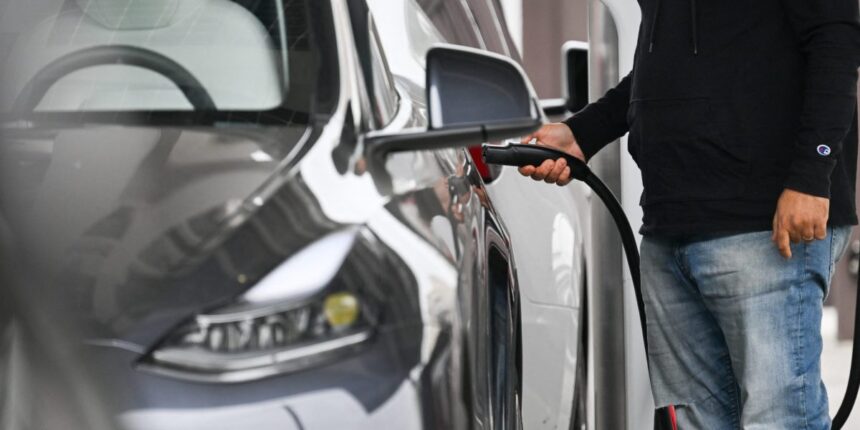
According to the Department of Energy’s latest analysis, the cradle-to-grave emissions for today’s electric vehicles are 48% lower than comparable gas vehicles. However, electric vehicles only made up 7.6% of automotive sales in the U.S. last year, up from 5.9% the previous year but still a long way from the two-thirds share some project for 2030.
Within our food system, independent assessments of alternative proteins suggest emissions savings of up to 90% compared with beef, similar in scale to the savings from adopting a vegan diet. But at just 2% market share, alternative proteins have yet to break into the mainstream.
Overall, consumption accounts for 72% of greenhouse gas emissions, just above consumer’s 68% share of U.S. gross domestic product. To limit global warming to 1.5°C above pre-industrial levels, we need to cut per capita emissions by 50% within the decade. But whatever emissions savings these and other climate technologies boast will only come to fruition if consumers love them enough to pull out their wallets.
At the impact fund we lead, we’ve seen that despite the many studies citing how much consumers—especially younger consumers—care about shopping more sustainably, the reality is more complicated.
Consumers may like sustainability, but they abhor a trade-off
For any category, consumers tend to have a set of criteria they care most about, like price, quality, or convenience. Eighty percent of consumers now say it’s important for brands to be sustainable, but sustainability is almost never among their most important criteria. If forced to make a trade-off between sustainability and those other factors, support for the sustainable option can collapse by 70% or more.
Indeed, one way to tell the story of the stalling growth of plant-based meat is that as close as it’s gotten to mimicking meat, it still fails to outperform on consumers’ most important criteria of taste and nutrition. Many consumers marvel at these almost-meat alternatives, but not enough prefer them.
The only way to drive long-term adoption of a sustainable product is by flipping the trade-off, and finding ways to make its sustainability a positive driver of the other criteria that consumers care about. Ironically, only when consumers prefer the sustainable product for reasons unrelated to sustainability will it achieve mainstream success.
For example, far more consumers will say they buy a dairy alternative because it’s healthier and tastes better than because of any desire to help the environment, something organic produce has long benefited from. Electric heat pumps, which now make up a majority of new heating system sales in the U.S., save money for the average consumer. More Gen Z consumers say they shop sustainable brands because of quality or value rather than concern about the climate.
As with any consumer market, segments of consumers may weigh factors differently. For decades, cars sold in Europe have had roughly 50% better fuel economy on average than those sold in the United States. That’s not because of unique European technology. That’s because of historical consumer preferences supported by tighter regulations. Similar patterns are playing out again with electric vehicles, as penetration in Europe is double that in the U.S.
Though much of the conversation about climate companies focuses on the cutting edge of the technology landscape, innovation in business models can also be highly impactful.
Resale, rentals, refillable products, and reusable packaging all require very little novel technology but can still outperform on consumers’ key purchasing criteria. Secondhand apparel has grown far faster than apparel at large, for example, mostly because it satisfies consumers’ desire to save money.
The lesson is simple: The consumer is still king. If we hope to make significant progress towards a world with net zero emissions, we need to build products they want to buy more than the traditional alternatives. And that matters far more than on whose environmental balance sheet we decide to measure those emissions.
We can’t blame consumers for climate change until we give them better options.
More must-read commentary published by Fortune:
The opinions expressed in Fortune.com commentary pieces are solely the views of their authors and do not necessarily reflect the opinions and beliefs of Fortune.