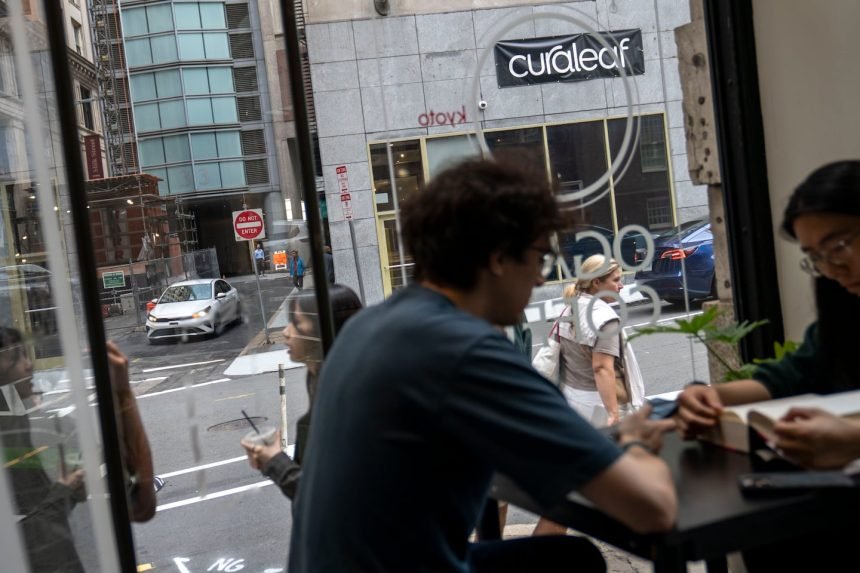
The arrival of Curaleaf at 21 Milk St. has revived old debates about whether regulators are allowing too many pot shops to saturate the same neighborhoods. Meanwhile, several entrepreneurs and industry watchers said its approval downtown exemplifies a shift in the city away from supporting small Black and Latino marijuana businesses owners in the state’s social equity programs.
“Really all this does is cannibalize other businesses and it puts equity operators in a precarious situation,” said Tito Jackson, a former Boston city councilor and owner of Apex Noire, a dispensary located within a half-mile buffer zone from the new Curaleaf shop.
He argues downtown is already too crowded with small local competitors, let alone now dealing with a well-heeled chain store.
“Nothing against Curaleaf but … having small, local Black-owned businesses competing against multi-state operators in an area that has already had multiple approvals is not the direction that we should be going in,” Jackson said.
Representatives of the city’s cannabis licensing board referred to the public meeting where the license was approved but did not answer additional questions on Friday.
Jackson’s shop is one of roughly 100 in the state licensed through the state’s social equity programs. These programs are aimed at trying to repair some of the harms done to vulnerable communities that were disproportionately targeted by marijuana policing.
Following a whirlwind year of plummeting pot prices and sweeping legislative reforms, just Apex Noire and two other social equity dispensaries, Primitiv and Firebrand Cannabis, remained in the downtown area.
Now, they’ll be competing with Curaleaf, a cannabis giant listed on the Toronto Stock Exchange with a $2.6 billion market valuation and over 160 stores active in 15 states, according to its website.
Curaleaf did not respond to multiple emails requesting comment.
Jackson said he hopes Boston will commit to advancing other policies that would help social equity businesses, like approval of zoning for social consumption, or pot cafes, in light of Curaleaf’s arrival.
“Big business doesn’t mean good business,” said Shanel Lindsay, entrepreneurship director at the Parabola Center, a Malden-based equity-focused think tank. She called the location of Curaleaf, near social equity businesses who thought they were safe from neighboring wealthy competitors, “very concerning.”
According to buffer zone rules established in 2016, Boston dispensaries are meant to sit at least half a mile away from each other, which if followed, would have precluded the large chain from moving downtown. However, the city cannabis board has repeatedly waived the buffer-zone rule.
Even before Curaleaf’s opening, Jackson said the market has made it clear it can’t handle more shops.
This year so far, two social equity dispensaries closed downtown, citing financial hardships.
The first, Rasta Rootz, had only just opened in 2025, but its owner Fernando Bent-Mullings had previously said “false promises” around the rollout of social equity programs like indoor smoking lounges contributed to a fast decline, the Globe reported.
The other social equity-owned cannabis store that closed was Pure Oasis, which shuttered in April after the state froze its accounts for unpaid taxes.
“Even if we fought to stay open, splitting that small market with Curaleaf would have been untenable,” said Kobie Evans, co-owner of Pure Oasis.

He’s since begun efforts to reopen another of the company’s stores in Grove Hall, but said he decided against doing that downtown after learning that Curaleaf was set to move in just blocks away.
“It made the decision super easy,” said Evans, whose downtown store was also the first ever Black-owned dispensary in the city.
Still, a city-commissioned study performed by cannabis research firm Whitney Economics in February concluded that downtown fields enough foot traffic to possibly support as many as 15 dispensaries.
According to their location proposal, Curaleaf’s Milk Street dispensary also revives a storefront that has been empty since multi-state cannabis operator, The Cannabist, shuttered in the same spot in 2024, and offers something to downtown consumers they haven’t had since that closure: access to medical cannabis.
In a March meeting before the Boston Cannabis Board, Pete D’Agostino, a partner at government relations firm Tenax Strategies speaking for Curaleaf, detailed what he called a Curaleaf Downtown Boston Equity program.
The program, which became a key condition for to the company’s approval downtown, offers discounted rates on Curaleaf wholesale cannabis products to downtown equity businesses.
“With this program, people that prefer Curaleaf products will be able to go into any store, so we’re not creating a monopoly,” D’Agostino said at the meeting.
Still, according to Evans, the discounts would not “move the dial” when having to compete with a Curaleaf store.
Their approval, he said, “was just a clear indication that whatever the controls that were there to protect the equity organizations just aren’t there anymore.”
Bryan Hecht can be reached at bryan.hecht@globe.com. Follow him on Instagram @bhechtjournalism.