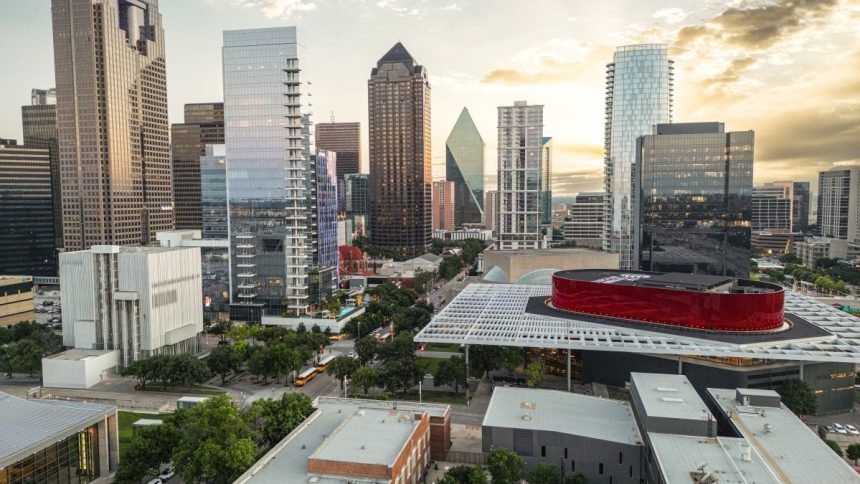
Nearly 80 years after Margo Jones opened her theater-in-the-round in Dallas’ Fair Park and launched the American regional theater movement, Dallas Theater Center and AT&T Performing Arts Center announced a proposed merger that represents a new chapter for the regional theater industry.
Under this proposed merger, AT&T Performing Arts Center will be the unified organization and Dallas Theater Center will become the producing division of the combined organization. Warren Tranquada, AT&T Performing Arts Center’s President and CEO, and Kevin Moriarty, Dallas Theater Center’s Executive Director, have been discussing how to build a stronger partnership while navigating a challenging post- pandemic environment for arts organizations.
“About a year ago, we started talking first in very general terms and then with more and more specificity about what would happen if instead of competing against each other, both us offering live theater here in Dallas, what would happen if instead we combined our efforts? Would we be stronger together than by standing apart? And after many, many months of very complicated work, financial modeling, legal conversations, engaging with board members and key stakeholders, we ultimately came to the realization that we can be stronger as partners and allies and that a merger would allow us with that broader base of support, the larger audiences, the combined efforts of our very skilled staff, that we would be able to have a significantly greater impact on Dallas in support of the arts,” Moriarty said.
“I believe that this has the potential to be a model here in Dallas and across the country for ways that we can start to rethink the nonprofit performing arts model and ways in which partnerships and collaborations can strengthen all of us,” Tranquada said. “There was a moment a few months ago where Kevin and I were looking at the different options and the barriers to collaboration and how others have attacked it and really came to the realization that to achieve the benefits we really needed to fully align incentives and fully integrate, and that the collaboration as separate organizations was only doing half the job. And we got very excited about how we could take this further than has been done before and really have a much stronger approach to building a season, to addressing customer integration, operating efficiencies, all the different things that will make us stronger organizations.”
Founded in 1959, Dallas Theater Center won the 2017 Regional Theatre Tony Award, and the theater has been a resident company of the AT&T Performing Arts Center since 2009. Despite its longevity and prominence, the theater has not been immune to the trend of the stretched philanthropic dollar. According to the theater’s tax filings, contributions have dropped from $7.4 million in 2023 to $3.9 million in 2024 to nearly $2.5 million in 2025.
“I think in the philanthropic community throughout Dallas and the country, there is so much need for philanthropy, so much more need than even 20 years ago when I first came to Dallas and was part of moving DTC into the Wyly and opening the Performing Arts Center. There was a time when philanthropy was really focused on adding additional essential elements to the civic life, supporting faith and the arts and then supporting aspects around education. But if you look at what’s happened in the last several decades and accelerated since 2020, there is now this immense need for individuals and corporations to be supporting large infrastructure projects and health initiatives and clean environments and initiatives that in previous times would have been handled by government or by other larger organizations,” Moriarty said. “That’s why if we can be efficient in our operations, if we can maximize our impact on the community, and if we can ensure that we are looking for all of the ways that we can bring resources to the table, that that’s more necessary now than it was, you know, back in the, when the regional theater movement was created in the early 1960s.”
Karen Almond
Karen Almond Dallas Theater Center’s A Christmas Carol will remain a staple of Dallas holiday traditions after the merger.
As one organization, programming will be coordinated and patrons will have a greater variety of shows that match their specific interests. Dallas Theater Center’s annual production of A Christmas Carol will continue.
“We have the opportunity to actually think about how does this all fit together. The timing of when shows happen, how space is allocated, what themes we can apply across both presenting and producing. And I think you can imagine that that could lead to a holistic look at a season beyond what either of us can do independently,” Tranquada said.
The education and community outreach program will benefit from this merger, with each company’s current assets being shared seamlessly. Moriarty noted how the merger would amplify Dallas Theater Center’s summer camps and AT&T Performing Arts’ workforce development program.
“By coming together we’re going to be able to expand and deepen those in some very meaningful ways,” Moriarty said.
Dallas Theater Center’s Diane and Hal Brierley’s Resident Acting Company will continue and may be busier than ever following this merger.
“I hope it means more work,” Tranquada said.
Dallas Theater Center named Jaime Castañeda as its new Enloe/Rose Artistic Director in December 2025. He will lead the producing division of this combined organization.
“The most significant thing is that it provides a platform from which Jaime will be able to lead Dallas Theatre Center to reach more audience, more students, and have more resources to create that art,” Moriarty said. “But what surrounds that work, the size and scope of the audience that we can invite to experience that work, the infrastructure that that allows us to market that work and raise funds and operate the facilities and greet audiences, that will change very radically.”

Jim Carmody
Jim Carmody Dallas Theater Center named Jaime Castañeda as its new Enloe/Rose Artistic Director in December 2025.
Currently, AT&T Performing Arts Center employs 85 people full-time and Dallas Theater Center has 39 full-time employees plus a significant cadre of part-time union members and artists. This merger will move finance, marketing, human resources, fundraising and ticketing under AT&T Performing Arts Center’s umbrella, led by Tranquada.
“What will happen practically is all employees will become employees of AT&T Performing Arts Center, and then we will go through a holistic review of every department, understanding what is the structure that is best going to lead to the success of this new combined organization with its increase in scope,” Tranquada said. “And we’re committed to being very transparent with employees throughout that process and moving as quickly as we reasonably can. Again, we can’t jump ahead of ourselves. We’re still separate organizations, and it’s going to take a minute to learn what will work best. But we also don’t want employees operating in a period of uncertainty for an unnecessarily long time or to drag this out.”
Tranquada anticipates there will be a 10% reduction in force, but he emphasizes no decisions have been made.
“As independent organizations there is duplication and by combining forces we can gain more economies of scale and you know that’s everything from how departments are structured to having fewer systems and even just getting you know better scale for things like employee benefits and like and of course bringing down operating costs is always a good thing for this business where we operate on such tight margins,” Tranquada said.
Once the merger is complete, Moriarty will leave the Dallas Theater Center, having served the company since 2008, first as the Enloe/Rose Artistic Director and recently as Executive Director.
“Once we fully complete the transition and the integration, I’ll be looking for new opportunities. And I would have said four or five years ago that that would be as an artist or as an educator. But in these last couple of years, when I’ve been asked to step into an executive leadership role, I’ve discovered challenges and rewards in that work that I hadn’t known before, including all of the work that has been a part of this merger process. So, I’m interested to see kind of what new challenges lie ahead,” Moriarty said.
The two organizations’ endowments will remain separate entities with independent boards governing them. Both organizations’ nonprofit status will remain in place as Dallas Theater Center’s trustees and AT&T Board of Directors will combine.
“All the trustees of DTC and all the directors of the AT&T Performing Arts Center will be invited to serve on the new board and finish out their existing terms. That means the board will temporarily be quite a bit bigger,” Tranquada said. “I think in the short term, we want all the people who have been very invested in both organizations at the table during that process. And then, naturally over time, the boards will shrink as people serve out their terms.”
NBCDFW.com
NBCDFW.com The Kalita Humphreys Theater, the only freestanding theater designed and built by Frank Lloyd Wright, is Dallas Theater Center’s historic home.
The combined organization will be committed to the Kalita Humphreys Theater, Dallas Theater Center’s historic home, designed by Frank Lloyd Wright.
“Kalita Humphreys is owned by the City of Dallas and leased by Dallas Theater Center,” Tranquada said. ”We would be assuming that lease and continuing the obligations under that lease and we’re excited about having another facility that we can find ways to further bring to life and activate.”
As a producing division, Dallas Theatre Center will continue to co-produce with other North Texas theaters, educational institutions and other regional theaters like The Public Theater in New York and The Alley Theatre in Houston.
“That will help the arts ecosystem, and it’ll strengthen our shared creative life at the Center,” Moriarty said.

ay Simon | Ten Ten Creative
ay Simon | Ten Ten Creative Programming such as Jon Batiste: UNEASY Tour at AT&T Performing Arts Center in 2024 will be coordinated with Dallas Theater Center’s season schedule, offer more opportunities for audiences.
The merger is subject to approval of the organizations’ individual boards. Both organizations hope to close the merger as early in 2027 as possible and to complete the full integration of the two organizations with 90 to 120 days after the official closing date and before the respective organizations launch the 2027-2028 seasons. Patrons can expect no immediate changes for the 2026-2027 season.
“I believe passionately that this is the right thing for Dallas Theatre Center, for AT&T Performing Arts Center, and for our city, and that it’s a model for the industry as a whole,” Moriarty said.
Learn more: Dallas Theater Center and AT&T Performing Arts Center