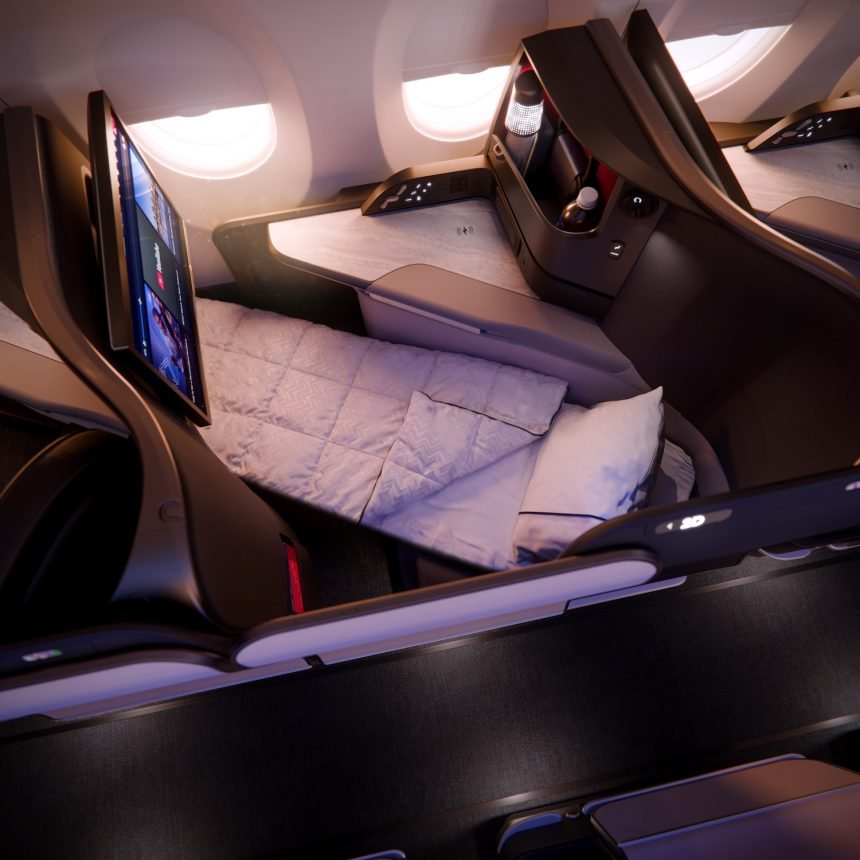
Airlines keep finding new ways to carve up premium cabins. Delta, at least for now, is not playing that game. I think that could give it a strong competitive advantage in the years ahead.
Delta Air Lines has confirmed it has no plans to add a “premium” business class seat at the front of its longhaul Delta One cabins, unlike American Airlines with its Flagship Suite Preferred product or United Airlines with Polaris Studio. That’s the case even though its new business class cabins allow for exactly that type of seating.
At first glance, that might look like Delta falling behind. Many have been made that explicit argument.
I don’t think it is.
Delta Is Making A Different Bet
American and United are both moving toward a multi-tier business class product. There’s standard business class, and then there is something better…for a price, or something worse…for slightly less.
Bigger seats. More space. Extra privacy. Sometimes premium lounge access. Sometimes not. It all depends on how much more you are willing to pay.
That is one strategy.
Delta appears to be taking another, at least when it comes to onboard service.
Instead of carving out a “better” product within business class, Delta can argue that Delta One is already the premium experience…for everyone sitting in it.
It just does not sit well to pay several thousand dollars for a business class ticket and then be told, in effect, that you did not quite pay enough. We are already seeing this with “basic” business class fares that strip out seat assignments or lounge access unless you pay more.
United has already moved in that direction. Delta has warned it is coming as well.
But if Delta chooses not to layer on a second tier of seats within the cabin, it has an opportunity to draw a clearer line.
Buy Delta One, and you get the product: not most of the product and not a downgraded version, but the product.
I see huge branding potential here. Delta can position itself as the airline that does not nickel and dime premium customers. Period.
You paid for business class. You get business class.
That may sound obvious, but it is becoming less so.
United has effectively told customers that even within business class, there are winners and losers based on how much extra they are willing to spend. There should not be “losers” in business class.
I would be refreshing to see Delta avoid that. It can still reward its most loyal customers by prioritizing bulkhead seats for Diamond Medallions or Delta 360 members, which adds a true loyalty benefit.
But that is very different from carving out a separate, higher-priced mini-cabin within business class or charging extra to assign a seat, access a lounge, or change a ticket.
Consistency Still Matters
Airlines love to talk about “premium experiences” and “brand loyalty,” but loyalty is built on consistency as much as it is on aspiration. If customers feel like they are constantly being upsold or segmented after they have already bought in, that creates resentment (I’ve heard it for years when clients book British Airways business class and find out they have to pay $200 each way per-person for an advance seat assignment).
Delta has an opportunity to say something different: we mean it when we say this is our premium product.
CONCLUSION
Delta’s decision not to introduce a “business class plus” product is not a sign of weakness. It may be a deliberate choice to keep its premium cabin simple and coherent. At a time when competitors are slicing business class into a wide range of products (Lufthansa is the largest offender with its Allegris cabins), there is value in restraint.
Shortly, Delta plans to introduce “basic” business class. But maybe it should reconsider?
If Delta can resist the temptation to nickel and dime premium passengers, it has a credible argument that it offers the best overall experience, not because it has the biggest seat in row one, but because it treats everyone in the cabin like they are valued and that is the way brand loyalty is truly built.