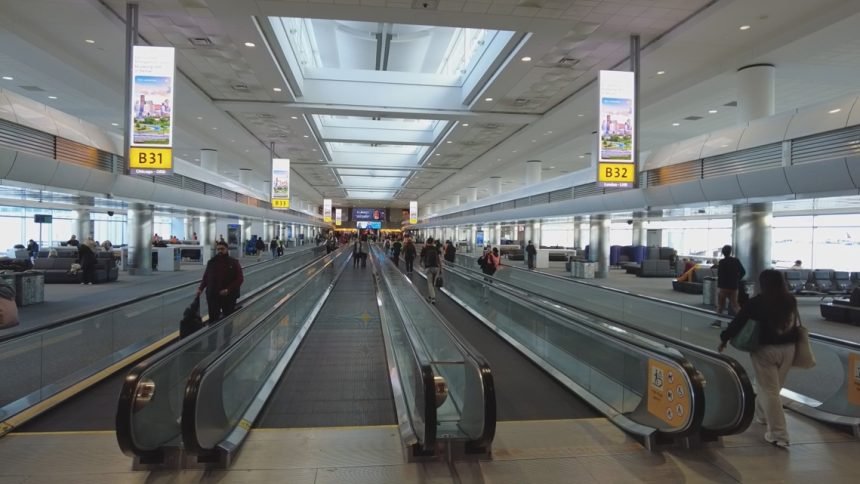
Every business that sells products inside Denver International Airport is subject to a policy little known by the public – an attempt to keep prices down for the passengers traveling through. Items inside the airport shouldn’t be marked up more than 15% from their street price.
But an investigation by Steve On Your Side found many items that appeared to be marked up higher than that 15% when compared to similar items off airport property. Our review also found an airport policy with wide latitude, allowing retailers to set those higher prices, and one retailer simply ignoring the policy with the airport’s blessing.
The head of concessions at the airport told Steve On Your Side most of the high markups we found were prices that were approved by the airport under its policy.
Street pricing rules became common in airports following the terror attacks of Sept. 11, 2001, when airport security tightened, keeping passengers inside the airport longer — wandering through concourses that are increasingly becoming more like shopping malls.
“These airports are getting billions and billions of dollars in federal taxpayer money to subsidize the construction of new concourses, subsidize new routes, subsidize improvements and salary increases for executives,” said Alex Jaquez, the chief of policy for Groundwork Collaborative, a progressive think tank pushing for more adherence to street pricing policy at airports and other venues built with public money. “We don’t think it’s too much to ask, to expect, just a little bit of benefit, a little bit of breathing room on prices on the other side.”
But increasing pressure from the businesses that run airport concessions over growing business costs has forced some airports to either abandon their street pricing policies altogether or allow a bigger markup. DIA decided in 2022 to increase its allowable markup from 10% to 15%.
What we found
What we found
On a Wednesday in early January, 9NEWS consumer investigator Steve Staeger and consumer producer Anna Hewson spent hours inside DIA’s B concourse, logging prices on food and other items. Steve On Your Side then searched for those same or similar items for sale in the Denver metro area.
We determined the street price for those items using a description in the handbook available to concessionaires, which says any nationally or locally branded items shouldn’t be marked up more than 15% from the price of the same item at the closest off-airport location of that brand that sells the item.
Our analysis logged prices for more than 80 items and found 73% of those items appeared to be marked up more than the 15% allowed in the policy.
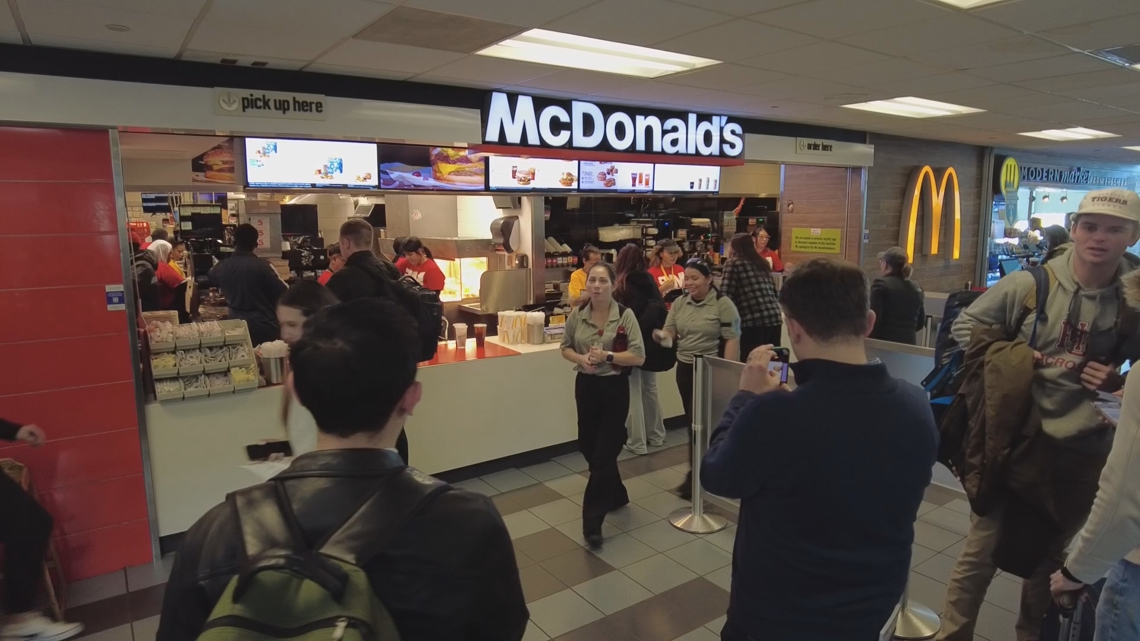
For instance, the McDonald’s restaurant inside the B concourse had markups ranging from 14% to 114%.
- A Big Mac meal cost $11.53 inside the B concourse, a 24% markup from the $9.29 price tag at the restaurant’s nearest location near 64th Avenue and Tower Road.
- A medium cup of coffee was $3.02 inside the airport and $1.49 at the airport — a 102% markup.
- And a soft drink or sweet tea each sold for $2.98 inside, marked up by 114% from the $1.39 price at the drive through closest to the airport.
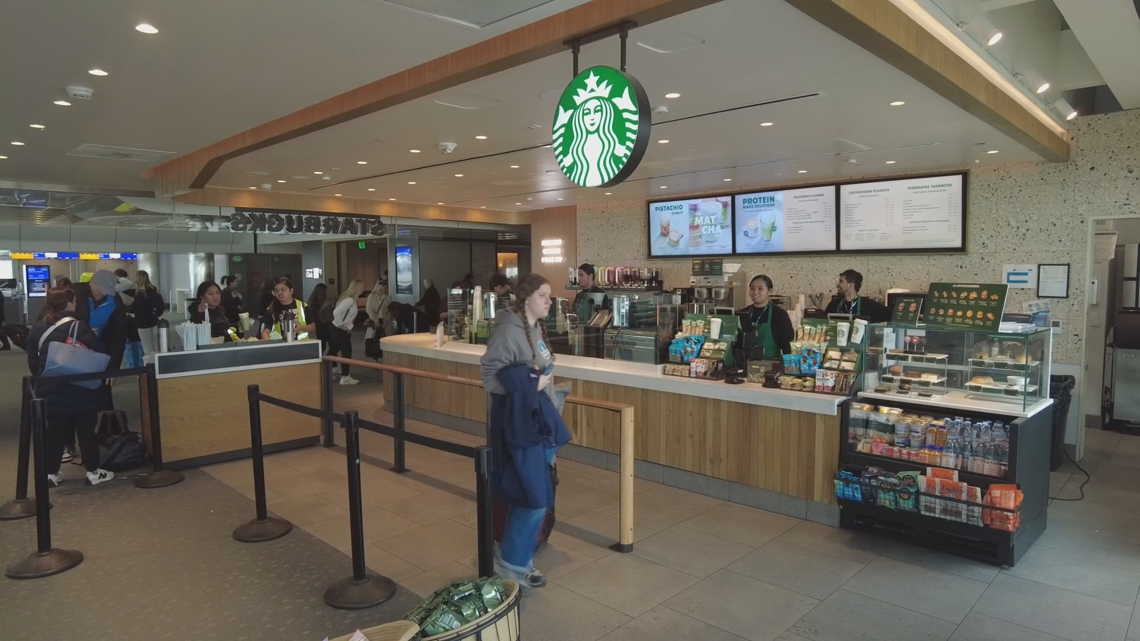
Starbucks customers paid 31% to 54% more for their food and beverages at the airport.
- A black coffee was $4.55 at the airport Starbucks – marked up from $2.95 at the nearest Starbucks at 104th Avenue and Tower Road in Commerce City.
- A grilled cheese sandwich at Starbucks sold for $9.45 inside the airport and $6.65 outside – a 42% markup.
- A cafe latte was $7.55 at DIA and $4.95 outside.
Inside the shops, we found similar large markups.
- At High Land Mercantile, a bag of Sahale cashews is marked at $9.99 — marked up 110% at the airport. The same bag is available for $4.74 at Walmart
- Also at High Land Mercantile, a bag of Gardetto’s snack mix sat on the shelf for $5.99, while Walgreens sells it for $3.79 — a 58% markup.
- At Sky Market, a bag of Red Vines is marked up 129% and a bag of Dot’s pretzels is marked up 108% — both from their prices at Walmart.
- Also at Sky Market, 20-ounce bottles of Coke and Pepsi are selling for 32% more than what they sold for at Walgreens.
We did track 21 items that were at or below a 15% markup.
All of the locally-branded restaurants we checked were well within that range — including Snooze, where the Snooze Classic Breakfast was only marked up 4%. At Brother’s BBQ in the A concourse, the Southern Salad wasn’t marked up at all.
If travelers are looking for a quick breakfast without a massive markup, Einstein Brothers Bagels did pretty well in the survey. A classic bagel was only 4% more than the bagels at the nearest location, and a bagel sandwich with bacon, eggs and cheddar was 7% more.
Why the airport approved these higher prices
Why the airport approved these higher prices
If you ask the airport’s administration about these findings, they’ll classify the results differently.
“I’m glad that you did the study, because it gave us an opportunity to stop and have a look,” Pamela Dechant, senior VP of concessions at DEN, told Steve On Your Side. “93% of the items surveyed in this project are compliant. That’s pretty darn good.”
How could demonstrably higher prices be compliant under the airport’s street-price-plus-15% policy? It all boils down to how the airport determines the street price.
While the concessionaire’s handbook states vendors must compare their prices to the nearest off-airport location selling the same product, Dechant said some vendors are under older contracts that still allow them to use three comparable prices within the region.
Steve On Your Side got comparables for all of the establishments we surveyed. It’s how we were able to piece together some of the McDonald’s pricing differences.
While the handbook states vendors must use the closest off-airport location for their comparisons, McDonald’s submitted three of their stores in the Denver metro area – one close to the airport in Henderson, another near 40th and Wadsworth in Wheat Ridge and a third location near Belleview and Kipling in Jefferson County.
For the Big Mac meal, the comparison price from this summer was $9.69 at the Henderson location and $10.19 at both the Jefferson County and Wheat Ridge locations — which drove the average up and allowed the vendor to charge the $11.53 price.
But for soft drinks and coffee, which we found marked up 114% and 102% respectively, McDonald’s didn’t even compare to a McDonald’s price. They compared the price of coffee to Panera, Caribou Coffee and Dunkin Donuts locations in the region and soft drinks to Arby’s, Popeye’s and Burger King locations in the Denver metro area.
Stores that sell snacks, drinks and other trinkets are allowed to submit three comparable prices for items as well. Our comparisons used prices from nearby Walmart, Walgreens, King Soopers and Safeway stores, to name a few. But to reach their higher prices, we found some of the shops inside DIA using prices at higher end grocery stores like Marczyk, Tony’s, Leevers Locavore, Clark’s Market and Spinelli’s.
Dechant said our comparisons to big box stores didn’t add up.
“When you compare an airport retail store to say, a Walmart, we can’t forget what’s included in the Walmart’s business model, right,” she said. “We don’t know the tax breaks, the low percent rent and most importantly, the operations and logistics.”
“By the time the bag of pretzels is sold at Walmart, the concessionaire is still waiting in line to have the product screened, and that doesn’t even start the beginning of the long and arduous journey that concessionaires take,” she said.
Dechant said 7% of the items we tracked were still under investigation by airport authorities.
Dechant said her team requires all concessionaires to submit pricing surveys each year and regularly audits the prices. But when Steve On Your Side asked for any records of actions taken with vendors who weren’t complying with the street pricing policy, the airport responded that it had no such records.
“We don’t wait for letters to be sent, et cetera,” Dechant said. “We go straight to the business. We talk about it first, we verify if the pricing is approved or not, but we take care of it immediately.”
“We trust them that they’re going to follow the contract that they signed, and in the rare case that they don’t, we handle it immediately.”
Starbucks doesn’t have to play by the rule
Starbucks doesn’t have to play by the rule
The airport doesn’t require at least one vendor to play by its street pricing rules: Starbucks, where we logged markups ranging from 31% to 54% from in-town prices.
Starbucks doesn’t use its in-town pricing for comparisons at the airport.
For its pricing comparison, Starbucks sent only one list of prices — a list of corporate prices the company has set for its retail locations in U.S. airports.
In a 2023 letter to airport authorities across the country, Starbucks senior national account executive Henry Klein said the corporate prices are based on market conditions including operating costs, capital investment requirements and competitive premium retail coffee pricing.

“We believe this approach supports our licensee’s ability to deliver an exceptional customer experience and promotes the long-term health of the business,” Klein wrote.
But using a corporate price rather than a street price is in stark contrast with DIA’s desire to keep prices within 15% of street price.
“We, along with all the other airports in America, have approved this because our customers want Starbucks and they’re willing to pay the prices,” Dechant told Steve On Your Side.
That approval seems to be a very recent development. In an initial response to an open records request in January seeking price comparisons, the airport noted it couldn’t find a recent pricing approval for Starbucks, and the pricing survey the airport eventually provided was dated after Steve On Your Side requested the record.
Portland’s airport markets a strict street pricing policy
Portland’s airport markets a strict street pricing policy
But not all airports take Starbucks’ price request seriously.
The Starbucks inside Portland International Airport sells a cup of regular coffee for $3.40 — $1.15 cheaper than the $4.55 corporate price the company recommends for its airport locations. In fact, that same cup of regular coffee is a nickel cheaper than the nearest Starbucks location to Portland’s airport.
This is because Portland International Airport (PDX) has a strict street pricing policy, meaning anything you find inside that airport shouldn’t be more expensive than it is on the street anywhere in Portland.
“If they have one restaurant here at the airport and one restaurant on the street, it’s like for like,” said Chris Czarnecki, director of aviation business for the Port of Portland, which operates PDX.
“Customer satisfaction here at PDX — our scores are high, the satisfaction is high, and people love the experience they have here,” Czarnecki said.
PDX has ranked in the top 10 for customer satisfaction for large airports three of the last four years, according to a survey by JD Power. Czarnecki said the policy helps drive revenue at the airport.
“Because when you know that you’re paying street prices for food and beverage, you’re more willing to go buy a gift for somebody on your trip,” he said. “If the price is fair on the food, people will go buy T-shirts and other gifts too, because they know they’re not getting gouged.”
Czarnecki said it’s a delicate balance with vendors to make the program work, and the airport always gets pressured to change the policy, but he said it is a key part of PDX’s values to keep prices low.
“We work with them in other ways to offset those costs or partner with them and help with their efficiency of their business here,” he said.
Czarnecki said the policy is pretty well known within the community, and if travelers didn’t know, they’re bound to find out through advertising posted all around the airport reminding passengers the prices should be low.
Back in Denver, only one of the many passengers Steve On Your Side spoke to in the concourses at DIA knew the airport had a street pricing plus 15% policy.
Dechant didn’t seem eager for her airport to consider a strict street pricing policy like the one in Portland.
“The important thing to consider is every airport is different,” she said. “We don’t know what’s behind Portland’s street pricing strategy, if you will, what’s driving revenues in other areas behind the curtain.”
Legislating ‘captive consumer’ environments
Legislating ‘captive consumer’ environments
Dechant said Starbucks sold about 10 million cups of coffee last year inside DIA. And the airport has a financial stake in all of those transactions.
“If we were to say to Starbucks or any other company, ‘let’s take it down because we want it to match the street locations,’ a few things could happen,” Dechant said. “They wouldn’t be able to meet their margins, and furthermore, we would make less money from the 10 million cups of coffee sold.”
“It would hurt us. But again, we care more about the guests than we do dollars, dollars, dollars. But it is our job to make money,” she said.
Jaquez, with Groundwork Collaborative, said that motive creates a conflict of interest in enforcing any street pricing policy.
“The airports are trying to drive up revenue as high as they can in most places, and then the airports, of course, are often the ones who are charged with regulating those same businesses that are inside trying to drive those revenues up,” he said. “That’s why we have encouraged more state consumer protection agencies and competition agencies to get more involved in these issues.”
This legislative session, State Rep. Yara Zokaie, D-Fort Collins, has proposed a bill that would ban retailers from charging higher prices in so-called ‘captive consumer’ environments like airports, stadiums, hospitals and prisons.
“This bill idea in particular actually did come to me in the airport, buying snacks for my kids, and spending about $100 to do so,” she said. “When we don’t have competition and we are essentially held captive or trapped in a setting we are exploited and taken advantage of. This bill is saying that you cannot, in those settings, charge an excessive price.”
Zokaie said the bill would give the attorney general the authority to say a price is excessive and potentially use consumer protection laws to pursue legal action against the business.
“Those corporations can come back and explain why they haven’t, but it is giving our AG’s office that empowerment to go after price gouging,” she said.
Zokaie said most of the opposition to the bill has been inside the building — lobbyists for businesses inside some of those environments pushing back.
“The major pushback against this bill is that if people can’t afford to do these things, that they should not do them,” she said. “And I reject that notion. The idea that fun or travel is reserved for the wealthy is not an economy that I’m willing to accept.”
Her bill has its first committee hearing later this month.
Dechant disagrees that consumers inside DIA are captive.
“Our passengers are not as locked in as we may think, when we think of an airport setting,” she said. “We don’t have a master concessionaire. We don’t have one operator. In that case, I might start to wonder if I were truly locked in to set prices.”
Jaquez agrees that many people don’t understand these policies and have become numb to paying more at the airport.
“I think once consumers, once passengers get wind of just how egregious some of these price hikes are, that will be the impetus for the airport to start cracking down. They’re not going to want to see their passengers mad,” he said.
Steve Staeger is the consumer investigator for 9NEWS. Anna Hewson is the consumer investigative producer. Contact Steve On Your Side with your stories of expensive things at the airport or other consumer problems.