




Each fall, the U.S. Census Bureau releases new American Community Survey (ACS) estimates, showing how the nation’s demographic, social, economic, and housing characteristics have changed relative to the previous year. The ’25 data, released in October, includes estimates for Houston and other major metro areas. In this issue of Glance, the Partnership examines some of the ways the region has changed over the past decade. A subsequent edition of Glance will look at the same ACS data in greater detail, comparing Houston to its peer metropolitan areas.
Race and Ethnicity
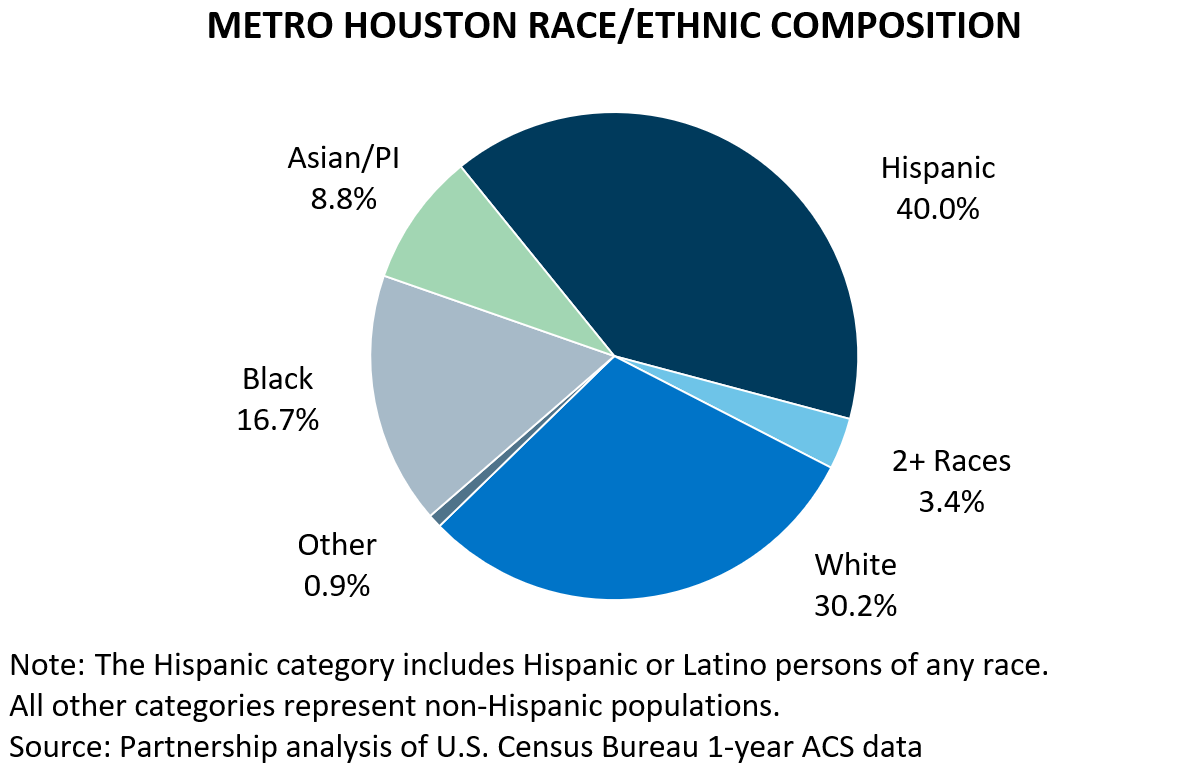
Houston, already one of the nation’s most ethnically and racially diverse metros, has grown even more diverse over the past decade. Since ‘15, the region’s Hispanic or Latino population has increased by over 730,000, while non-Hispanic Black and Asian/Pacific Islander populations have added approximately 200,000 residents each. The non-Hispanic white population has declined slightly, though part of this change may be due to the growing number of residents who now identify with more than one race—a group that has nearly tripled during the same period.
Hispanic or Latino residents make up the largest racial/ethnic group in the region, followed by non-Hispanic white residents. But, as has been the case since the late ‘90s, no single group constitutes a majority.
Age
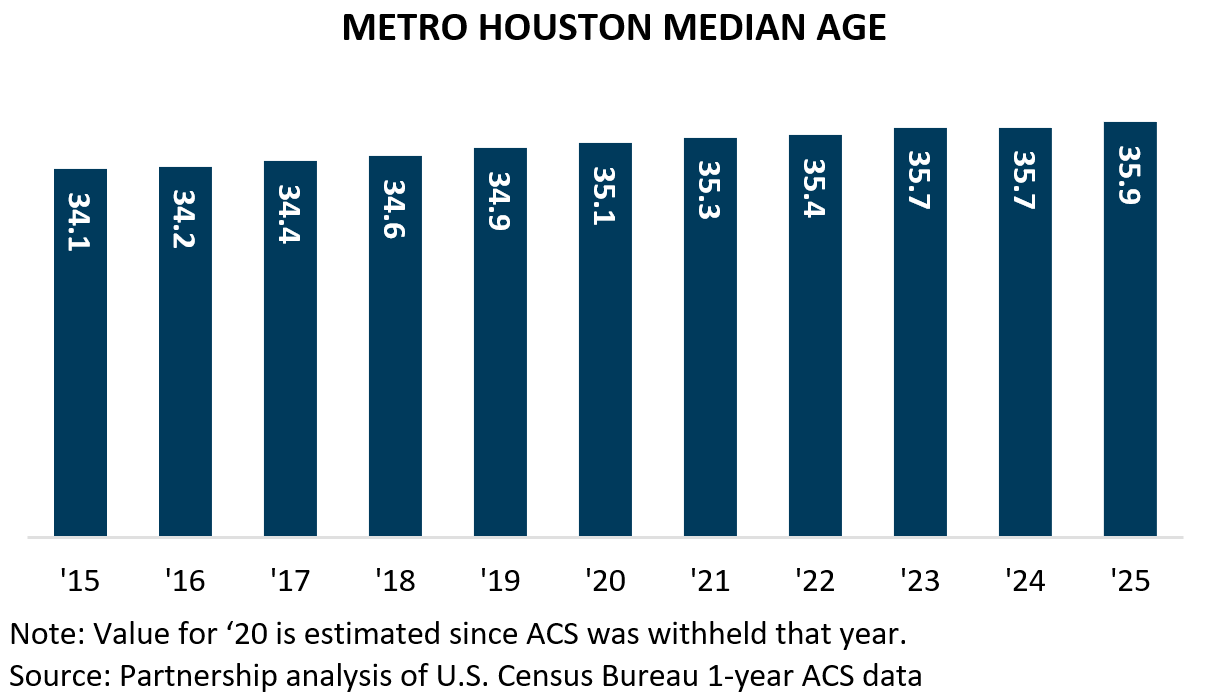
Houston continues to be younger than the nation as a whole, with a median age of 35.9 years old compared to the U.S. median of 39.4. The region’s population is aging, but at a gradual pace. The median age has increased by one year and ten months since ’15 – but its pace of increase has been modest in recent years.
Improved healthcare technology and declines in harmful behaviors such as smoking have extended life expectancies and helped expand Houston’s senior population. A decade ago, residents aged 65 and older made up about one in ten Houstonians, but last year they accounted for roughly one in seven.
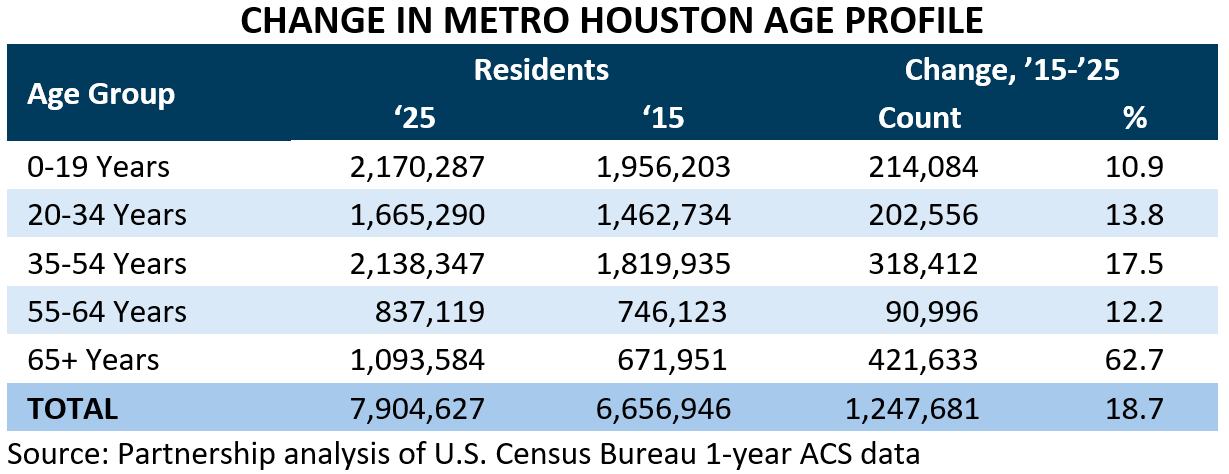
Relatively high birth rates and an influx of families with young children ensure that Houston’s population of minors and young adults continues to grow. Residents under 20 years old are the region’s largest age cohort, representing 27.4 percent of the overall population. Their number has increased by almost a quarter of a million during the previous ten years.
Educational Attainment
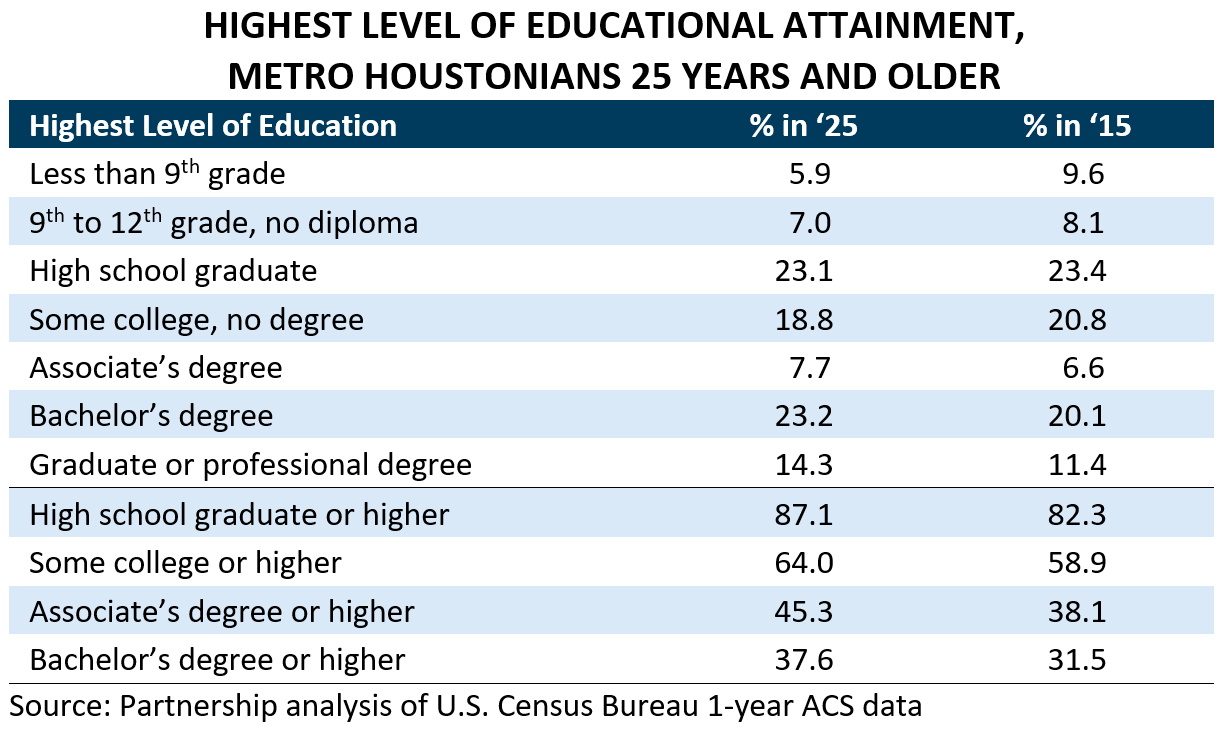
Houstonians are achieving higher levels of education to meet the demands of an increasingly technical workforce. Among residents aged 25 and older, more than 87.1 percent are high school graduates, up from 82.3 percent in ‘15. Nearly two-thirds have some college experience, with marked growth among those holding an associate degree or higher (45.3 percent in ‘25 vs. 38.1 percent in ‘15) and those holding a bachelor’s degree or higher (37.6 percent in ‘25 vs. 31.5 percent in ‘15).
Foreign-Born Population
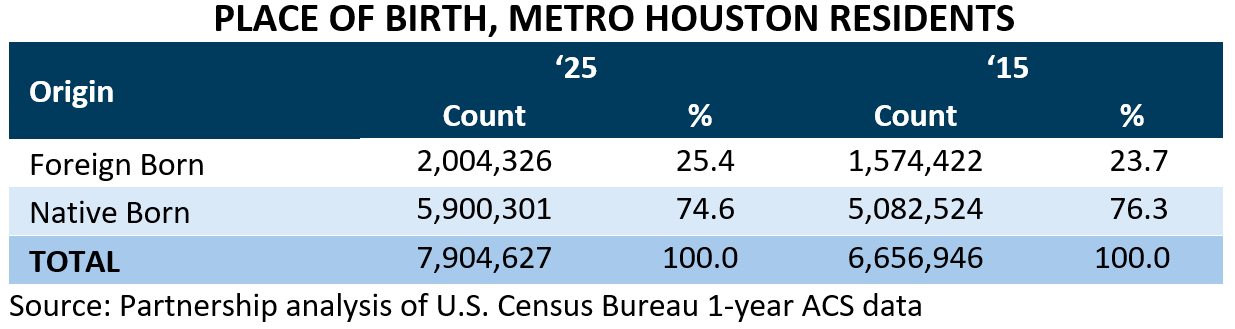
More than one in four Houstonians was born outside the United States. In ‘25, 25.4 percent of the metro area’s residents were born outside the U.S., up from 23.7 percent in ‘15. Nationwide, the share of foreign-born residents was significantly lower at 14.7 percent.
Houston added more than 425,000 foreign-born residents over the decade, with international migration representing the region’s largest source of population growth. Metro Houston’s foreign-born population now exceeds the total populations of 12 states (Alaska, Delaware, Hawaii, Maine, Montana, New Hampshire, North Dakota, Rhode Island, South Dakota, Vermont, West Virginia, Wyoming) and the District of Columbia.
Houston’s foreign-born residents come from all corners of the globe. Just under half (43.9 percent) come from Central America (defined by the Census Bureau to include Mexico), 26.7 percent come from Asia, 10.7 percent from South America, 6.7 percent from Africa, 6.4 percent from the Caribbean, 4.3 percent from Europe, 1.1 per¬cent from North America, and 0.2 percent from Oceania.
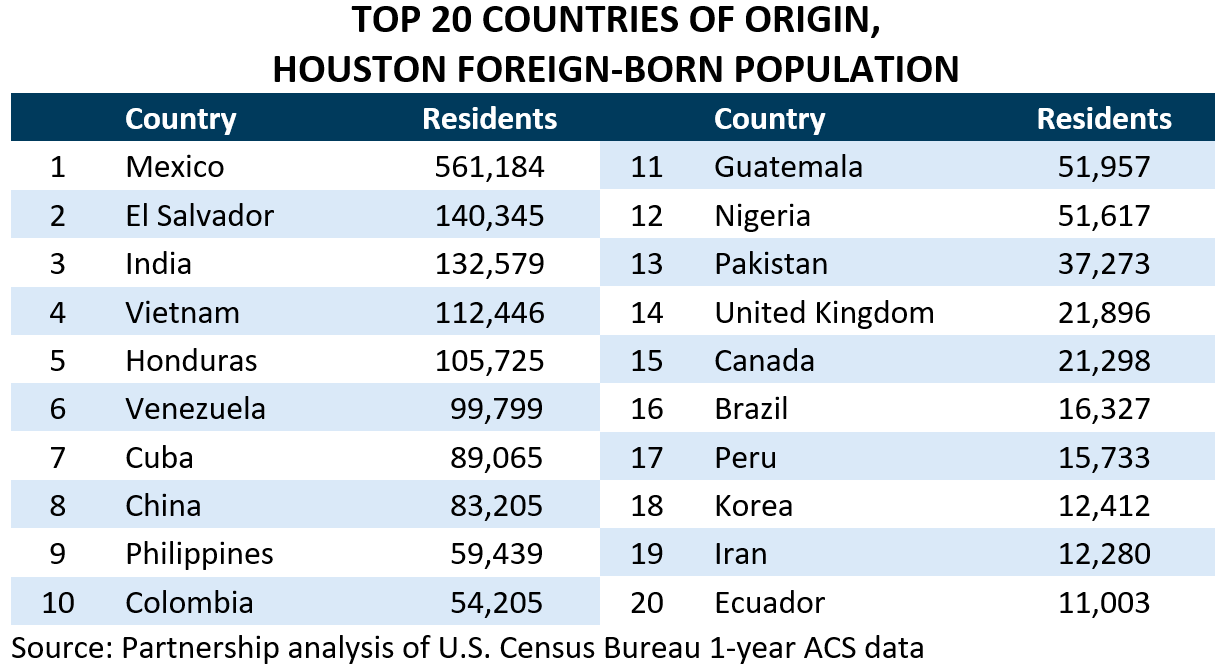
The two Central American countries of Mexico, El Salvador, are the most common places of birth for the region’s foreign-born population, but the Asian countries of India and Vietnam are not far behind, with over 100,000 residents each. Honduras rounds out the top five with over 100,00 residents itself. Together these five countries of origin represent the majority (52.5 percent) of Houston’s foreign-born population.