



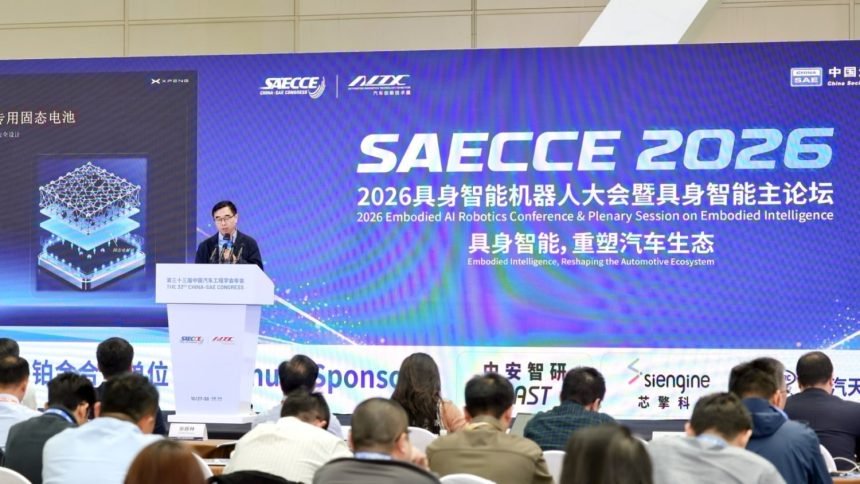
Engineers named the top ten automotive technology trends in China for 2027 during the 33rd China Society of Automotive Engineers Annual Congress (China-SAE) in Suzhou. They mentioned 400 Wh/kg solid-state batteries, Vehicle-to-Grid systems, integrated die-cast magnesium alloy body elements, and other tech.
According to Zheng Yali, deputy secretary of the China-SAE, these ten trends mark innovations in performance and cost, implementation of new mass-production technologies, and a scale-up in application.
The first trend is solid-state batteries with a cell-level energy density of 400 Wh/kg. They will enter the pilot-production stage, offering higher safety and a broader operating temperature range. According to China-SAE, next year, industry leaders will conduct vehicle-level engineering validation of this technology.
The second trend is the microcontroller units (MCUs) built on the open-source RISC-V processor architecture with scalable design. They will enter volume production, supporting customization for multiple control scenarios, including powertrain, braking, and other safety controls. This tech also makes it easier to work with architecture licensing.
The next trend is the adoption of integrated vehicle motion control technology. It will reportedly serve as a link between driving demands and performance capabilities. This system will also allow unified coordination of various systems like braking and steering, enhancing the driving experience.

The fourth technology on the list is the Vehicle-to-Grid (V2G) technology that allows a car to share its energy with the grid. It will reportedly allow bi-directional grid regulation capacity on the order of millions of kW daily. The rise of V2G tech will support the stable operation of the power systems and enhance the overall grid resilience.
Another important trend is the small-scale application of large integrated die-cast magnesium alloy vehicle body components. Previously, some automakers used such an alloy for drivetrains and other elements. Engineers expect large cast magnesium alloy elements, such as rear floor sections and tailgate structures, will lead to reducing vehicle weight by approximately 20%.

The sixth trend is high-level autonomous truck fleets beginning demonstration operations with thousands of vehicles reaching roads. It will make a boost to the freight industry, boosting the transportation capacity. China-SAE representatives say that autonomous truck fleets will begin demonstration operations in scenarios such as railway operations, mines, and ports.
Next, we have a wheel hub electric drive technology. According to engineers, this tech will optimize spatial layout and transmission efficiency through in-wheel design. It will further enhance steering vector control.
The eighth trend is the deployment of on-device AI models in cockpits of mass-produced vehicles with 14 billion parameters. It will reduce reliance on the cloud and enhance data privacy. The execution of complex tasks will also improve. By 2027, such a technology will gain significant traction, engineers said.
The ninth is the transition of connected assisted driving systems to small-scale pre-installation. Featuring the vehicle-cloud synergy, they will reportedly effectively enhance driving safety. And the last technology on the list is metal 3D printing, which will reportedly allow optimizing the design of vehicle body structures and the fabrication of complex components.
Everyone’s a China auto expert lately.
Trusted by industry professionals for 16 years. See the information you trust first: Add CarNewsChina as a preferred source on Google.
Most important news in your inbox.
Recaps
· scheduled
All you need, in one email.
Instant alerts
· real-time
Ping me when an article goes live.
of 27 topics selected