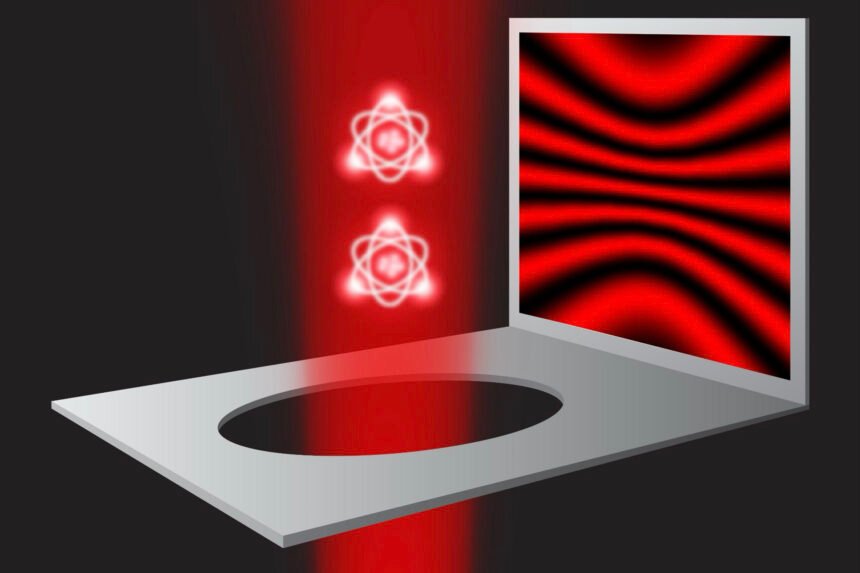
MIT physicists have performed an idealized version of one of the most famous experiments in quantum physics. Their findings demonstrate, with atomic-level precision, the dual yet evasive nature of light. They also happen to confirm that Albert Einstein was wrong about this particular quantum scenario.
The experiment in question is the double-slit experiment, which was first performed in 1801 by the British scholar Thomas Young to show how light behaves as a wave. Today, with the formulation of quantum mechanics, the double-slit experiment is now known for its surprisingly simple demonstration of a head-scratching reality: that light exists as both a particle and a wave. Stranger still, this duality cannot be simultaneously observed. Seeing light in the form of particles instantly obscures its wave-like nature, and vice versa.
The original experiment involved shining a beam of light through two parallel slits in a screen and observing the pattern that formed on a second, faraway screen. One might expect to see two overlapping spots of light, which would imply that light exists as particles, a.k.a. photons, like paintballs that follow a direct path. But instead, the light produces alternating bright and dark stripes on the screen, in an interference pattern similar to what happens when two ripples in a pond meet. This suggests light behaves as a wave. Even weirder, when one tries to measure which slit the light is traveling through, the light suddenly behaves as particles and the interference pattern disappears.
The double-slit experiment is taught today in most high school physics classes as a simple way to illustrate the fundamental principle of quantum mechanics: that all physical objects, including light, are simultaneously particles and waves.
Nearly a century ago, the experiment was at the center of a friendly debate between physicists Albert Einstein and Niels Bohr. In 1927, Einstein argued that a photon particle should pass through just one of the two slits and in the process generate a slight force on that slit, like a bird rustling a leaf as it flies by. He proposed that one could detect such a force while also observing an interference pattern, thereby catching light’s particle and wave nature at the same time. In response, Bohr applied the quantum mechanical uncertainty principle and showed that the detection of the photon’s path would wash out the interference pattern.
Scientists have since carried out multiple versions of the double-slit experiment, and they have all, to various degrees, confirmed the validity of the quantum theory formulated by Bohr. Now, MIT physicists have performed the most “idealized” version of the double-slit experiment to date. Their version strips down the experiment to its quantum essentials. They used individual atoms as slits, and used weak beams of light so that each atom scattered at most one photon. By preparing the atoms in different quantum states, they were able to modify what information the atoms obtained about the path of the photons. The researchers thus confirmed the predictions of quantum theory: The more information was obtained about the path (i.e. the particle nature) of light, the lower the visibility of the interference pattern was.
They demonstrated what Einstein got wrong. Whenever an atom is “rustled” by a passing photon, the wave interference is diminished.
“Einstein and Bohr would have never thought that this is possible, to perform such an experiment with single atoms and single photons,” says Wolfgang Ketterle, the John D. MacArthur Professor of Physics and leader of the MIT team. “What we have done is an idealized Gedanken experiment.”
Their results appear in the journal Physical Review Letters. Ketterle’s MIT co-authors include first author Vitaly Fedoseev, Hanzhen Lin, Yu-Kun Lu, Yoo Kyung Lee, and Jiahao Lyu, who all are affiliated with MIT’s Department of Physics, the Research Laboratory of Electronics, and the MIT-Harvard Center for Ultracold Atoms.
Cold confinement
Ketterle’s group at MIT experiments with atoms and molecules that they super-cool to temperatures just above absolute zero and arrange in configurations that they confine with laser light. Within these ultracold, carefully tuned clouds, exotic phenomena that only occur at the quantum, single-atom scale can emerge.
In a recent experiment, the team was investigating a seemingly unrelated question, studying how light scattering can reveal the properties of materials built from ultracold atoms.
“We realized we can quantify the degree to which this scattering process is like a particle or a wave, and we quickly realized we can apply this new method to realize this famous experiment in a very idealized way,” Fedoseev says.
In their new study, the team worked with more than 10,000 atoms, which they cooled to microkelvin temperatures. They used an array of laser beams to arrange the frozen atoms into an evenly spaced, crystal-like lattice configuration. In this arrangement, each atom is far enough away from any other atom that each can effectively be considered a single, isolated and identical atom. And 10,000 such atoms can produce a signal that is more easily detected, compared to a single atom or two.
The group reasoned that with this arrangement, they might shine a weak beam of light through the atoms and observe how a single photon scatters off two adjacent atoms, as a wave or a particle. This would be similar to how, in the original double-slit experiment, light passes through two slits.
“What we have done can be regarded as a new variant to the double-slit experiment,” Ketterle says. “These single atoms are like the smallest slits you could possibly build.”
Tuning fuzz
Working at the level of single photons required repeating the experiment many times and using an ultrasensitive detector to record the pattern of light scattered off the atoms. From the intensity of the detected light, the researchers could directly infer whether the light behaved as a particle or a wave.
They were particularly interested in the situation where half the photons they sent in behaved as waves, and half behaved as particles. They achieved this by using a method to tune the probability that a photon will appear as a wave versus a particle, by adjusting an atom’s “fuzziness,” or the certainty of its location. In their experiment, each of the 10,000 atoms is held in place by laser light that can be adjusted to tighten or loosen the light’s hold. The more loosely an atom is held, the fuzzier, or more “spatially extensive,” it appears. The fuzzier atom rustles more easily and records the path of the photon. Therefore, in tuning up an atom’s fuzziness, researchers can increase the probability that a photon will exhibit particle-like behavior. Their observations were in full agreement with the theoretical description.
Springs away
In their experiment, the group tested Einstein’s idea about how to detect the path of the photon. Conceptually, if each slit were cut into an extremely thin sheet of paper that was suspended in the air by a spring, a photon passing through one slit should shake the corresponding spring by a certain degree that would be a signal of the photon’s particle nature. In previous realizations of the double slit experiment, physicists have incorporated such a spring-like ingredient, and the spring played a major role in describing the photon’s dual nature.
But Ketterle and his colleagues were able to perform the experiment without the proverbial springs. The team’s cloud of atoms is initially held in place by laser light, similar to Einstein’s conception of a slit suspended by a spring. The researchers reasoned that if they were to do away with their “spring,” and observe exactly the same phenomenon, then it would show that the spring has no effect on a photon’s wave/particle duality.
This, too, was what they found. Over multiple runs, they turned off the spring-like laser holding the atoms in place and then quickly took a measurement in a millionth of a second, before the atoms became more fuzzy and eventually fell down due to gravity. In this tiny amount of time, the atoms were effectively floating in free space. In this spring-free scenario, the team observed the same phenomenon: A photon’s wave and particle nature could not be observed simultaneously.
“In many descriptions, the springs play a major role. But we show, no, the springs do not matter here; what matters is only the fuzziness of the atoms,” Fedoseev says. “Therefore, one has to use a more profound description, which uses quantum correlations between photons and atoms.”
The researchers note that the year 2025 has been declared by the United Nations as the International Year of Quantum Science and Technology, celebrating the formulation of quantum mechanics 100 years ago. The discussion between Bohr and Einstein about the double-slit experiment took place only two years later.
“It’s a wonderful coincidence that we could help clarify this historic controversy in the same year we celebrate quantum physics,” says co-author Lee.
This work was supported, in part, by the National Science Foundation, the U.S. Department of Defense, and the Gordon and Betty Moore Foundation.