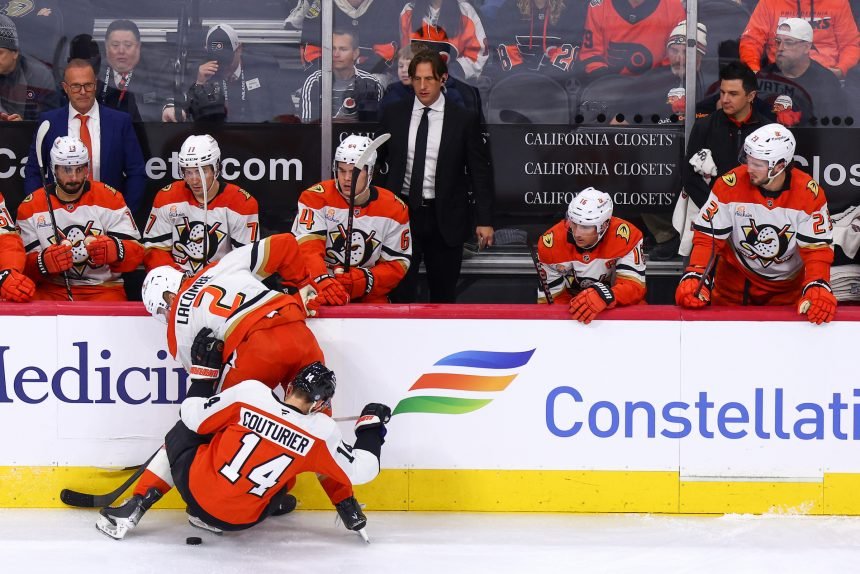
The Philadelphia Flyers shook up the hockey world when they tendered a five-year, $90 million offer sheet to Leo Carlsson earlier this month. Of course, the Anaheim Ducks went on to match the offer sheet to retain their restricted free agent, but it didn’t go without Pat Verbeek feeling some pressure.
Verbeek had to overpay to re-sign another RFA in Pavel Mintyukov, giving him an average annual value (AAV) of $7.2 million for five seasons, which was a million or two higher than projected. They also still have to pay Cutter Gauthier, who doesn’t have arbitration rights and cannot be signed to an offer sheet this summer.
The Flyers used Anaheim’s unique financial situation to put the pressure on with an offer sheet to Carlsson, and while the Ducks matched the record-breaking contract, it’s also looked at as one of the worst deals in the league.
Carlsson’s contract ranked one of worst in NHL
The Athletic’s Dom Luszczyszyn ranks the NHL’s 10 worst contracts annually, and Carlsson made the list this year at number four.
Here’s what Luszczyszyn had to say about the contract:
“The Anaheim Ducks matched Philadelphia’s offer sheet on Leo Carlsson, and his placement on this list is exactly why the decision might’ve been legitimately difficult. Carlsson has a ton of growth potential, obviously, but $18 million is still a high-end rate reserved for the absolute best players in the world. Carlsson could get there, but even if that’s by Year 4 or 5, that’s a lot of cash to pay in the first three seasons for a maybe. If that. Over the total deal, the odds of Carlsson adding $90 million of value to Anaheim’s bottom line are low.
Still, it’s something the Ducks had to do because the draft pick compensation they would receive in return was an even worse bet. A bunch of mid-to-late firsts for a potential superstar in his prime? Meh, no thanks.
In the sense that the Ducks got to keep Carlsson around, it’s a win. But the contract efficiency aspect is a massive loss that will likely limit Anaheim’s ceiling over the length of Carlsson’s deal. Or at least until he becomes an $18 million player, which doesn’t feel likely anytime soon.“
Luszczyszyn gives the contract a surplus value of -$25 million, and a positive value probability of just six percent.
While it’s easy to laugh at the Ducks for being forced to sign Carlsson to this deal, it’s also important to acknowledge that Danny Briere and the Flyers were the ones to give the 21-year-old center these terms. Therefore, if the Ducks didn’t match the deal, the Flyers would then have one of the worst contracts in the NHL.
I’ll remain steadfast in my belief that this isn’t necessarily a huge overpay for Carlsson, though. The salary cap is rising, and $18 million for a player of Carlsson’s ilk isn’t going to be too farfetched in the coming years. While Conor Bedard signed for $15 million AAV in Chicago, and general managers may ignore Carlsson’s contract as a comparable for now, it’s bound to get there in a few years.
The Flyers were also in a position to take the hit of one bad contract to land a franchise-changing center. Carlsson would be the only Flyers player making more than $9.125 million per season, and Briere hasn’t handed out many contracts that will weigh them down. In fact, he was able to trade some away in recent years in order to create this cap space to make a big move.
As far as Anaheim is concerned, the Ducks must ponder how to create the cap space to sign Gauthier, as they have multiple veterans with a cap hit of $6.25 million or higher. And that Gauthier contract could very well find its way onto a similar list after it is signed.
Sean Couturier’s contract just misses the cut
The Flyers had one of the NHL’s 10 worst contracts in last year’s article, with Sean Couturier’s $7.75 million AAV coming in as the sixth-worst deal in the league. However, with the salary cap rising and an important second half from the captain, he was able to move down into the honorable mentions section this time around.
Couturier put up 36 points (12 goals, 24 assists) in 78 games last season, his lowest total in a full season in over a decade. He embraced a lower role down in the lineup in the second half, putting up 10 points in 22 games as a key cog on the fourth line.
The captain’s contract is certainly aging poorly, and it’s one that Briere & Co. may have to work around, but that second half helped him avoid any conversation of a buyout this summer.
Couturier is under contract until 2030 at his $7.75 million AAV, and it’s very possible that his play regresses in the coming years. A buyout could be more palatable as each year passes, though, or the rising cap could help Couturier fit in as a leader in the bottom six.
If the Flyers were to buy out Couturier’s contract next offseason, they’d save $1 million in each of the following three seasons while costing them $500,000 in the first three years of the 2030s. And then two years each if bought out the following year, and so on.