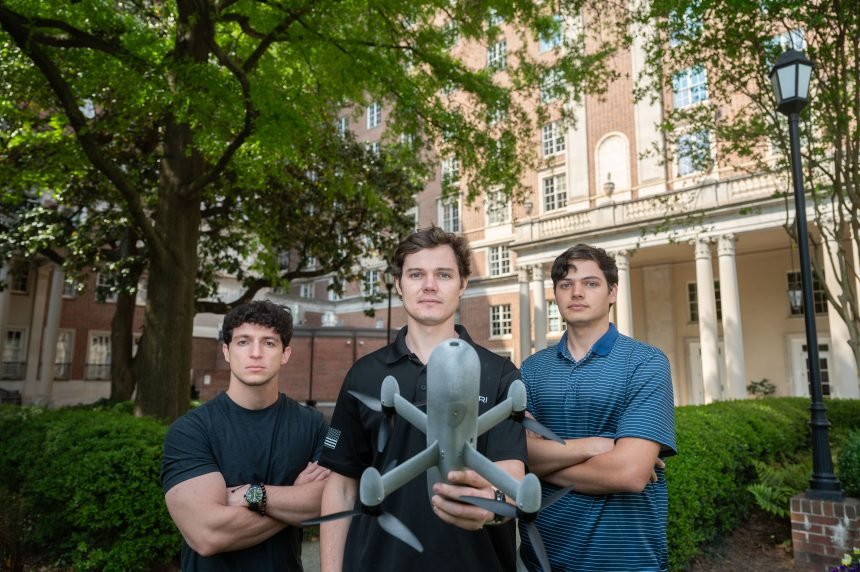
When Robbie van Zyl first started working with drones, it was not for defense. It started with curiosity.
As a high school student, van Zyl spent summers in a Georgia Tech aerospace lab, where he was introduced to rotorcraft and autonomous systems. By the time he enrolled at Georgia Tech, that early exposure had grown into a deeper interest. He became a competitive drone racer, gaining hands-on experience with the technology.
But even then, he recognized a growing risk.
“I was using this technology to have fun,” said van Zyl, founder and CEO of Askari. “But I also recognized it could equally be used to do very malicious things.”
That realization became the foundation for Askari, a counter-drone defense company developing systems designed to detect, track, and stop hostile drones.
A Real-World Problem Comes Into Focus
Van Zyl first pitched the idea for Askari as a first-year student through Georgia Tech’s CREATE-X Startup Launch, an accelerator that empowers students to launch successful startups. At the time, the concept of counter-drone defense was not widely seen as urgent. However, that perspective shifted as global conflicts began to demonstrate the impact of low-cost, unmanned systems.
The widespread use of drones in Ukraine revealed how inexpensive and accessible technologies could reshape modern warfare. Unmanned systems now account for a significant share of battlefield activity, exposing new vulnerabilities across defense and infrastructure.
“That was the first moment I could point to and say this is real,” van Zyl said. “This is not theoretical anymore.”
From Student Idea to Scalable Solution
Askari is building autonomous systems that can identify and neutralize drone threats in real time. The company’s technology is designed to distinguish among objects such as drones, people, and the surrounding environment, allowing it to respond with precision.
“We are building systems that can understand what they are looking at,” van Zyl said. “They can tell the difference between a drone, a person, or a tree, and act accordingly.”
Unlike traditional defense systems that rely on expensive infrastructure, Askari is focused on developing solutions that are scalable and accessible to a wider range of users, including frontline operators and security teams. The goal is to provide a faster, more adaptable approach to this challenge.
The company has raised approximately $1.7 million in early funding and is already working with U.S. Department of Defense customers, with growing demand for counter-drone solutions. The team has expanded to 10 people and is scaling to meet that demand.
The Role of CREATE-X and Georgia Tech
Georgia Tech’s commercialization ecosystem played a critical role in Askari’s development.
Through CREATE-X, van Zyl was able to test and refine his idea while gaining exposure to the fundamentals of building a company. He also gained access to a community of founders, mentors, defense leaders, and builders who helped him navigate early-stage challenges. The experience provided an environment to pressure-test the concept and receive feedback, helping him better understand how it could function in real-world scenarios. At the time, the idea was still taking shape, but it helped clarify how it could evolve into a viable solution.
After gaining experience in the robotics and defense sectors, van Zyl reengaged with Georgia Tech, where the Institute’s network of mentors, resources, and programs helped accelerate the company’s growth.
“Georgia Tech has been instrumental,” van Zyl said. “We would not be where we are today without it.”
Today, Askari operates out of The Biltmore, home to CREATE-X and part of Georgia Tech’s innovation ecosystem in Tech Square, placing the company back within the same environment where the idea first began.
“Askari is a strong example of what we aim to do,” said Rahul Saxena, CREATE-X director. “Students building companies that address real, emerging challenges. It reflects the kind of thinking we want to encourage early on, paired with the ability to continue developing an idea as the need becomes clearer. That progression is a critical part of how students move from concept to company.”
Returning to Atlanta to Build
After graduating, van Zyl gained experience working in robotics and autonomous systems, including in Silicon Valley. He also spent time building the company outside of Atlanta before ultimately returning.
The decision to come back was both strategic and mission-driven.
Many of Askari’s customers, including Department of Defense organizations, are based in the Southeast. Being in Atlanta allows the company to remain close to those partners while continuing to build within Georgia Tech’s ecosystem. The company’s return also reflects its deep ties to Georgia Tech’s talent pipeline. van Zyl’s co-founders include his younger brother, Marc van Zyl, a Georgia Tech computer science student, and Benjamin Airdo, a close friend and mechanical engineering graduate. Eight of the company’s 10 team members are connected to the Institute as current students, graduates, or researchers.
A Broader Vision for Security
While Askari’s current focus is counter-drone technology, van Zyl sees the startup’s mission as part of a larger shift in how modern warfare is evolving.
For the first time, autonomous systems powered by artificial intelligence are moving beyond the digital world into physical environments. That transition introduces new risks that extend beyond traditional defense scenarios.
“This is not just a drone problem,” van Zyl said. “It is the broader proliferation of robotics in real-world environments.”
From Campus to Impact
Askari’s trajectory reflects how Georgia Tech’s commercialization ecosystem supports founders as they move from early ideas to companies.
From its start in CREATE-X to its return to The Biltmore, the company remains closely tied to the Institute while building technology focused on real-world deployment and impact.
“We want to build systems that help protect people,” van Zyl said. As Askari continues to grow, that focus remains central to its mission.