


A board member, a teacher and members of the audience suggested during a Hazleton Area School Board meeting that there might be a better way to teach nearly 4,000 students in the district who are learning English.
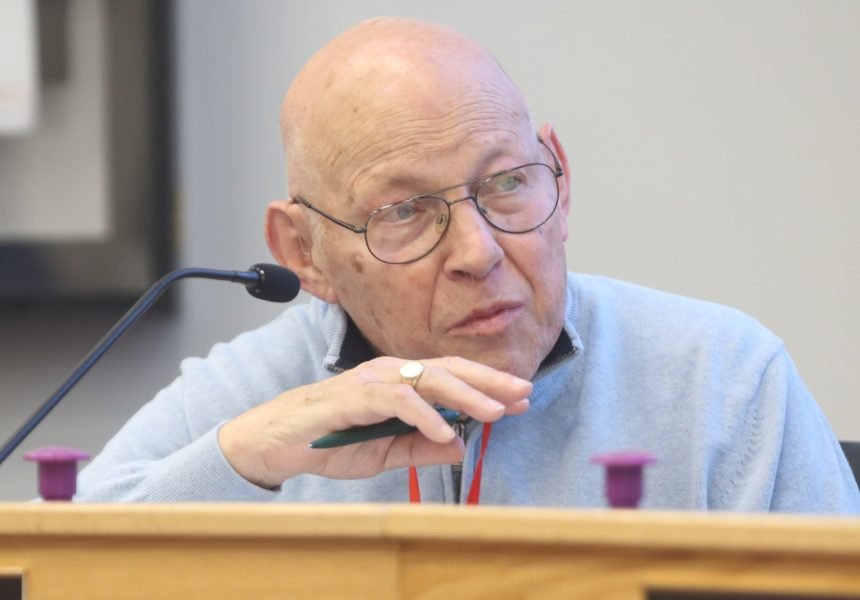
Board member Dr. Robert Childs said at the Oct. 22 meeting that he, favors bilingual education, which means providing lessons in both English and Spanish, the native language of many of the students.
He pointed to a 2015 study at Stanford University that found students in bilingual education tended to perform better in all subjects including math and science later in elementary school. He said students in Hazleton Area’s Newcomer Center have achieved good progress after studying with bilingual instructors and small classes.
Students immersed in English, he said, don’t perform as well. The Stanford study said they have an initial advantage in English but tail off in other subjects later. Childs underlined the point by saying elementary and middle school students in Hazleton’s city schools with a higher concentration of Hispanic students don’t score as well as students in suburban schools on state tests and on the admissions test for the Hazleton Area Academy of Sciences.
Superintendent Brian Uplinger said bilingual education has its place but there’s also benefit to immersing students in English.
“If I were trying to learn Spanish and everyone around me spoke English all day, I would likely struggle to develop fluency because I would have limited opportunities to hear, practice and use Spanish,” Uplinger said in an email addressing points raised at the meeting.
He said the Newcomer Center serves students who have been in the country for one year and speak little English. They score at Level 1, the lowest of four levels within the English learning curriculum, and less than 4% of the English learners are at that level.
The Stanford study, Uplinger said didn’t compare newly arrived students with limited English proficiency to students immersed in English so “caution should be exercised when attempting to apply it’s conclusions directly to our program.”
Uplinger said there are verisions of the Newcomer Academy program for middle school and high school but they require “classroom space, staffing and resources.”
If it’s hard to find bilingual teachers, start with paraprofessionals, Childs wife, Ivelisse Eufracio Childs, said at the meeting.
She worked in New York City schools that followed bilingual method and also was a bilingual paraprofessional at Heights-Terrace Elementary/Middle School in Hazleton, although she pointed out that Hazleton Area doesn’t pay well enough to retain its paraprofessionals.
Joyce Gombeda, president of Hazleton Area Education Support Professional Association, the union representing a variety of school workers including paraprofessionals, said at the meeting that the members are considering a proposal to develop bilingual staff. The union’s contract expires on June 30 and negotiations for a new contract are in early stages.
Aurora Felix, who was a bilingual paraprofesional at McAdoo-Kelayres Elementary/Middle School, told the board that students and parents confided in her because she spoke their language.
“I was the one the family would trust. More bilingualism is needed in the district,” she said.
After the meeting, Felix the schools needs more Spanish speakers.
“Most kids are so behind,” she said.
The language barrier also causes misperceptions that put students in a bad light.
“The lack of language, the lack of communication, sometimes they are targeted,” Felix said of students heard speaking Spanish. “It’s interpreted by teachers as offensive.”
Uplinger said when concerns were raised months ago, an investigation “did not substantiate claims that students were disciplined or belittled for speaking Spanish.”
Childs, a retired pediatrician, and Uplinger, who has a doctorate in educational leadership, point to efforts lower language barriers,
This year, 30 school workers are taking classes after school in Spanish while about 100 parents are learning English in after-school classes.
Childs mentioned other ways to involve Spanish-speaking parents in their children’s education. Earlier this month in a letter to Uplinger that he shared with the Standard-Speaker, Childs suggested having parents judge art contest or adding an international pot-luck meals to events like the Nov. 21 dance called “El Carnaval,” or paring parents who just moved to the area with parents from the same country who have been in Hazleton longer.
A Hazleton Area survey last year found students hail from 30 countries.
In addition to Spanish, languages spoken in homes include French, Hindi, Indian, Urdu, Gujarati, Italian, Filipino, Romanian, Hungarian, Polish and Hatian Creole.
Childs also wrote that the district would benefit from having ” a more cordial and intimate relationship” with Hazleton Integration Project, which offers after-school programs and community meals and whose staff “seem to have figured out how to gain the trust of the Latinos while helping them adapt to our society.”
Rossanna Gabriel, executive director at HIP, said at the board meeting that after working with children from other countries her option is that they need support in Spanish.
She said if she had been immersed in English, taking classes in subjects like math would have been frustrating.