The Trump administration has been trying to build up the U.S. battery supply chain and reduce its reliance on China. But the funding it has set aside for the effort is small compared with what would be needed to substantially loosen China’s grip on the industry, according to analysts and executives who spoke with CNBC.
The Department of Energy awarded $500 million this August to seven companies related to battery minerals or materials, manufacturing or recycling. It is part of a much larger push by the administration to secure critical minerals and other materials. It also follows the cancellation of many Biden-era policies that supported battery manufacturing and funding for electric vehicles — by far the largest market globally for battery tech.
This is the first round of funding by the Trump administration under two $3 billion DOE battery technology and materials programs that were created through the Biden-era Infrastructure Investment and Jobs Act. Boosting the U.S. battery supply chain had been a high priority for the Biden administration, said Richard Wang, CEO of Voya Energy, a battery technology company.
“A lot of those policies have reversed themselves under the Trump administration and/or shifted,” he said.
The efforts come as China has a majority of the global share of several points along the battery supply chain — from raw minerals and chemicals all the way to finished products like electric vehicles and energy storage systems.
“It takes decades and tens, if not hundreds of billions of dollars” to achieve the kind of comprehensive scale across the supply chain that China now has, said Tu Le, founder and managing director of Sino Auto Insights. “We don’t have decades. We have five, six, seven years to try to become competitive.”
China’s dominance in refining
China is a major supplier of several critical minerals used in batteries, including graphite. But its real strength is in refining and processing. The country’s share of mineral refining has grown since 2020, according to the International Energy Agency.
China used that position as leverage in 2025, when it imposed strict export controls on rare earths and a range of other minerals and processing equipment.
Several companies receiving DOE funds target spots where China has a strong presence. Coreshell Technologies, which was awarded $50 million by the department, makes battery anodes — an essential battery component — from domestically sourced silicon, rather than Chinese-sourced graphite.
Lilac Solutions, meanwhile, received $100 million. That company has a method for extracting lithium from salt water brine, skipping a common refining process typically needed to get the material from hard rock.
The global lithium market grew from about 150,000 metric tons in 2015 to 1.5 million metric tons in 2025, said Raef Sully, CEO of Lilac Solutions. The bulk of that growth came from lithium extracted from hard rock mines in the form of a mineral called spodumene. That rock needs to be processed to extract lithium, and 95% of spodumene processing happens in China, Sully said.
“If you use our technology, you’re producing battery grade lithium carbonate or hydroxide at the site of production,” Sully said. “And you’re bypassing that important step, that processing step that China has a chokehold on today.”
China’s dominance continues further down the supply chain. It produces about 85% of the world’s EV battery cathode active material and more than 90% of anode active material, according to the IEA. Then it makes 80% of the world’s battery cells.
The IEA said the lack of investment in these midstream stages in countries like the U.S. “poses a growing risk to global supply security.”
Scale is one of China’s biggest advantages, said Wang, pointing to CATL, the world’s largest EV and energy storage battery manufacturer, which is based in China.
“They have built up an incredible lead in terms of technology and manufacturing capabilities across the world,” he said. “They are one of the only battery companies in the world that’s not only high in revenue, but is significantly profitable because of how strong their manufacturing and supply chain capabilities are.”
That is the competition that any U.S. firm faces.
“We have a ton of innovation coming out of the United States,” Le said. “These small fledgling companies are super innovative, but getting and building prototypes of what they’re trying to sell is one thing. Being able to mass produce them at a high quality level, repeatably in the millions of units is another thing entirely.”
Batteries and EVs
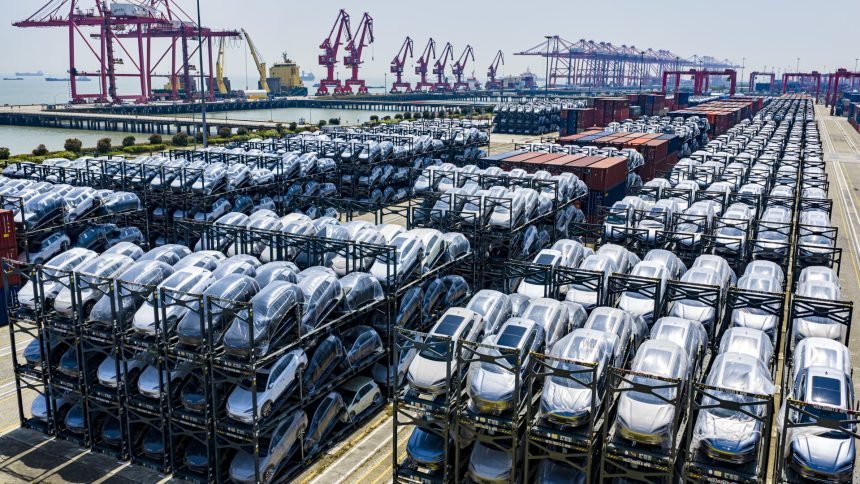
EVs are prepared for export overseas through frame transportation in Taicang Port Area, Suzhou Port, Jiangsu Province, China, on May 11, 2026.
Costfoto | Nurphoto | Getty Images
Batteries have become important to China as it has focused on scaling EVs domestically and started exporting more of those vehicles overseas.
“New energy vehicles,” which include hybrids, EVs and extended-range EVs, were 65% of China’s new car sales in July, according to the China Passenger Car Association.
The U.S. hasn’t seen that same level of interest, as EVs, hybrids and plug-ins accounted for about 24% of sales in the U.S. in the second quarter of 2026, according to the Energy Information Administration. The U.S.’s total new car sales volume in 2025 was about 16.3 million, according to Cox Automotive, compared with 23.7 million in China.
Despite the DOE grants that have been putting some money in the battery space, the Trump administration ended federal tax credits for EVs and other funding for those vehicles and batteries.
Since January 2025, when Trump took office, nearly $24 billion in announced battery projects have been canceled, according to Atlas Public Policy, a think tank.
“When you look at China, they are incredibly dominant in EVs at a time when the U.S. is slowing down its EV development,” Voya Energy’s Wang said. “What this is really jeopardizing is the ability of U.S. automakers to compete globally, where China is taking the lion’s share of all the growth globally.”
Energy storage demand is growing, averaging 70% growth since 2022, according to the EIA. EVs still account for more than 70% of total lithium-ion battery deployment, the IEA said.
Sully, of Lilac Solutions, said even though China has a big lead, he thinks the U.S. needs to start somewhere.
Over the next decade, he said, the U.S. could see more domestic lithium, cathode material and battery cell production.
“So early days, but a step in the right direction,” he said.