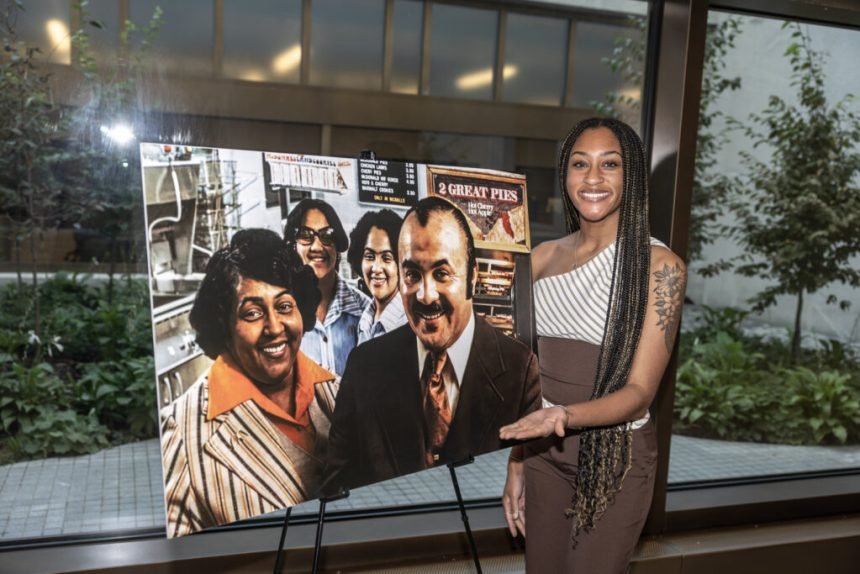
Nearly six decades after Herman Petty made business history on Chicago’s South Side, his family recently gathered with McDonald’s executives and Black franchise operators to celebrate a new tribute bearing his name at the Obama Presidential Center.
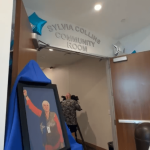
Petty, who became McDonald’s first Black owner-operator in 1968, is being honored with the Herman Petty Program Room, a space in the lower-level Democracy in Action Lab of the Center’s Forum. The room was made possible through support from McDonald’s Corporation and is intended to recognize Petty’s legacy of entrepreneurship and community investment.
Family members recently visited the space during a private dedication attended by representatives of McDonald’s, the Black McDonald’s Operators Association and the Obama Foundation.
Among those attending were Petty’s daughter, Patrice Petty-Orr; his granddaughter, Latrice Orr; McDonald’s Chairman and CEO Chris Kempczinski; BMOA Chicago President Derrick Taylor; and Tanya Hill-Holliday, president of the National Black McDonald’s Operators Association.
The dedication connects one of Chicago’s most important Black business stories with a center being built only blocks from where Petty made history.
On December 21, 1968, Petty became McDonald’s first Black franchise owner when he took over the restaurant at 6560 S. Stony Island Ave., near Jackson Park in the Woodlawn community. Petty, who had worked as a barber and Chicago Transit Authority bus driver, entered the franchise business during a turbulent period following the assassination of Dr. Martin Luther King Jr.
His success would have implications far beyond one South Side restaurant.
By the end of 1969, 12 Blackowned and operated McDonald’s restaurants were operating, primarily in the Midwest, according to the National Black McDonald’s Operators Asso-
ciation. As more Black operators entered the system, they began meeting to discuss common business challenges and opportunities.
Those relationships eventually led to the establishment of the National Black McDonald’s Operators Association in 1972. Petty presided over the organization’s first convention and became an important figure in developing a network of Black entrepreneurs within one of the nation’s largest restaurant companies.
The organization remains active more than five decades later. McDonald’s describes the NBMOA as the largest organization of established African American entrepreneurs in the world.
Petty’s breakthrough also came when access to capital and major franchise opportunities remained particularly difficult for Black entrepreneurs. His entry into the McDonald’s system helped demonstrate that Black franchisees could successfully own and operate restaurants serving predominantly Black communities.
That history remains relevant today.
McDonald’s reports that it has more than 2,000 franchisees in the United States. In its 2023 diversity data, the company reported that 12 percent of its approved U.S. owner-operators were Black, while 33 percent collectively were Asian, Black or Hispanic. Nearly 95 percent of McDonald’s restaurants worldwide are now operated by independent franchisees.
Petty eventually expanded beyond his original restaurant and became a multi-unit operator. His first location remains part of his legacy. Current owner-operator Yolanda Travis, who took over the restaurant in 2007, incorporated photographs, historical information and other displays recognizing Petty and the contributions of Black McDonald’s operators.
Chicago added another permanent recognition in May 2022 when a section of Marquette Road between Stony Island and Dorchester avenues was designated “Honorary Herman Petty Way.”
The Obama Presidential Center tribute now places Petty’s name in a space intended for another generation of emerging leaders.
According to the Obama Foundation, the Democracy in Action Lab will serve as a place for innovation and learning for emerging leaders and “global changemakers” seeking to make an impact in their communities.
For Petty’s family and the Black McDonald’s operators who followed him, the dedication represents more than recognition of the first Black man to own a McDonald’s franchise. It preserves a chapter of Chicago Black business history in the community where that history began.
Sharon Fountain contributed to this report.