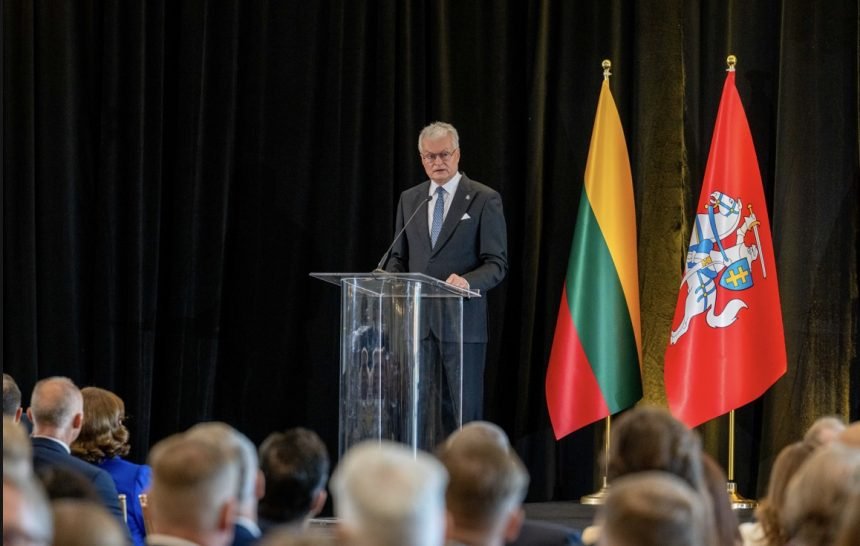
In the European Union, Lithuania stands out as the country that issues the most licenses for fintech companies and as a growing hub for diverse tech ventures. In the US, Miami shines as a center for fintech, especially for companies doing business across the Americas.
Opportunities for tech collaboration help explain why a hefty delegation from Lithuania, led by the president of the Baltic nation, visited the Miami area from Sept. 23-25. The group offered a half-day presentation on Lithuania-US business at the Trump National Doral Golf Club and met with top local leaders from Miami-Dade County, Miami Fintech Club and many other groups. President Gitanas Nauseda [pictured above] visited after speaking to the U.N. General Assembly in New York, joined by 40-plus people in the largest Lithuanian business mission ever to Miami.
“Lithuanian companies are expanding their presence in the U.S., while American companies are finding new opportunities in Lithuania. We want to turn this momentum into even deeper economic ties,” Nauseda wrote from Miami on the social media channel X.
Lithuania: a fintech powerhouse in Europe
A highly-developed nation of nearly 3 million people, just the size of West Virginia and perhaps best known in the US for its basketball players and tech unicorn Nord VPN, Lithuania has emerged in the last decade as a fintech powerhouse. The country’s government decided in 2017 to transform the nation into a fintech gateway to the European Union (EU). It sped up the process to obtain licenses for fintechs that can operate anywhere among the 27 member states in the EU. Its central bank also made payments immediate from Lithuania to EU markets.
“The best strategy is when you work combined,” with government and business collaborating, said Milda Petkauskaitė-Neverė, head of policy affairs at the Lithuanian Fintech Association.
Today, more than 240 fintechs operate in Lithuania, contributing more than 4 billion euros to the economy yearly, more than quadrupling their economic impact over the past decade, according to data from the Association. The group includes several ventures valued at more than $1 billion, including U.S-based Ria Money Transfer, which has been active in Lithuania since 2020 and also operates in Miami.
Liutauras Tarabrinas, Ria’s CEO in Lithuania, said he joined the delegation to Miami mainly to spread the word about what his small northern nation offers investors and business partners.
“Lithuania’s potential is far greater than its global visibility,” he told Refresh Miami. He said because no other nation speaks Lithuanian, residents are multilingual, with English widely spoken. And those residents have some of the highest education rates in the EU, offering cost-effective talent for international business. Ria has been hiring steadily in Lithuania, now employing 45 people and likely to reach 60 there soon, more than initially planned, said Tarabrinas.
Lithuania growing in cybersecurity, defense tech and beyond
Of course, Lithuania’s tech sector includes more than fintech, extending into cybersecurity, e-commerce, defense tech and other areas. In all, the information and communications tech (ICT) sector now makes up about 5 percent of Lithuania’s economy, double the share a decade ago, said Simonas Cerniauskas, CEO of Infobalt, a leading digital technology association in Lithuania and the Baltic States since 1994.
✓
A large AI data-center is soon to be built in Lithuania, and in June 2027, Lithuania’s capital of Vilnius will host an EU Digitech Summit that is open to US participants, Cerniauskas added.
During the Miami visit, some members of the delegation attended a Generative Gatherings event by eMerge Americas/Miami AI Hub, Miami’s largest AI community, last week at The LAB Miami.
Beyond tech, Lithuania’s delegation also forged other business links during its Miami visit. The country’s Port of Klaipeda signed a Sister Seaports agreement with PortMiami to deepen ties, Miami-Dade Mayor Daniella Levine Cava said. Lithuania already serves as a gateway for vehicles moving from PortMiami to northern Europe, county leaders said.
Lithuanian leaders also signed a critical-minerals agreement with the US government during their US visit and inked an accord for California-based defense tech manufacturer Mach Industries to start up in Lithuania. The Baltic nation shares its neighborhood with Russia and Ukraine.
“The agreement with Mach Industries would enable the production of advanced defense systems in Lithuania .. and would strengthen the capabilities of Lithuania and NATO’s eastern flank and help Ukraine defend itself,” said Lithuanian Minister of Economy and Innovation Edvinas Grikšas. He said most US direct investment into Lithuania has gone into manufacturing.
Still, short term, the biggest potential for Lithuania-Miami links may well be fintech. Said Petkauskaitė-Neverė of the Lithuanian Fintech Association: “We want to use Miami as a gateway to the Americas, and to combine that, with our positioning as a gateway to Europe and create a channel for companies to come to Lithuania and vice versa.”
READ MORE IN REFRESH MIAMI:

Doreen Hemlock is a journalist who worked years with the South Florida SunSentinel newspaper and before that, in the U.S. Virgin Islands, Peru, Venezuela and Puerto Rico. She holds an MBA from Columbia University, thanks in part to a Knight-Bagehot fellowship. Reach her at doreenhemlock@gmail.com.