



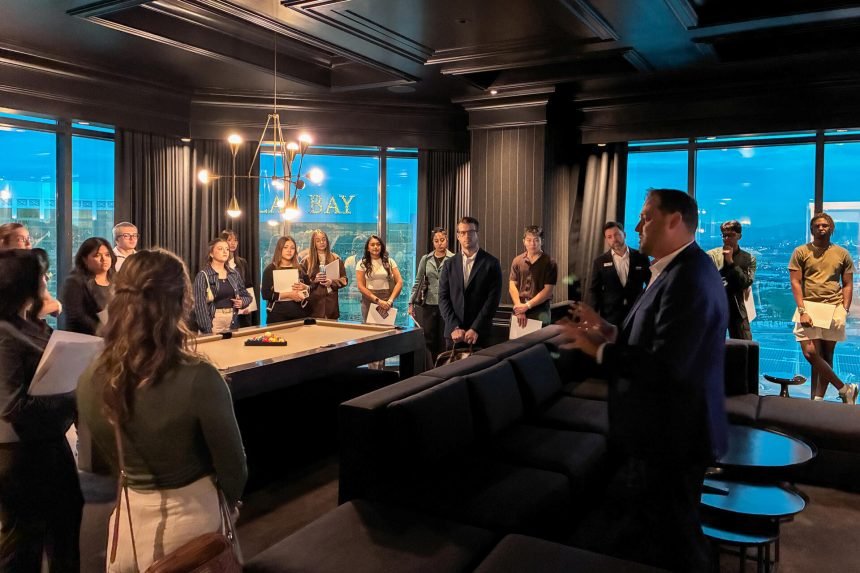
Eighteen Honors College students gathered in a conference room at the Mandalay Bay Resort, unaware that something remarkable lay hidden behind a set of blackout shades. As Mandalay Bay President Travis Lunn welcomed the class, he paused to give a subtle cue to a team member.
The shades rose, flooding the room in a wash of blue light as massive sharks glided past the glass. A chorus of gasps followed. Only then did the students realize they were sitting beside the resort’s famed Shark Reef Aquarium.
It was a “wow” moment made for Vegas: bold, theatrical, and unforgettable. And it served as a fitting metaphor for their entire semester in HON 410: The Future of Hospitality & Gaming, a course designed to pull back the curtain on the unseen workings of the industry for students outside of hospitality.
More than Hospitality Majors
UNLV is home to the world-renowned William F. Harrah College of Hospitality, where corporate partnerships with major resorts are a centerpiece of the experience for hospitality majors. This Honors College seminar stands out because it offers a taste of that industry immersion to Honors students across all majors, from biology and nursing to finance, psychology, and architecture.
The course emerged from conversations between MGM Resorts and the Honors College about access to an industry that touches nearly every discipline.
“When MGM’s workforce development team pitched the idea for this class, I didn’t have to think twice,” said Honors College Dean Lisa Menegatos. “With more than 1,200 students from majors across UNLV, the Honors College is the perfect place for this type of innovative, interdisciplinary course.”
Instructor Brian McDermott, senior manager of talent development at MGM Resorts International, hopes the HON 410 course has challenged assumptions about the industry.
“Most people think of front desk agents or dealers,” he said, “but there are scuba divers maintaining attractions, sustainability managers focused on convention practices, global development teams figuring out answers to questions like, ‘How many eggs will this property need, and where do we get them?’ I want students to see how many different kinds of work live under one roof.”
Lunn echoed that sentiment during the property tour.
“We’re not exclusively a hotel business or a gaming business,” Lunn said. “If you’re interested in technology, marketing, entertainment, we offer career paths in all of those disciplines.”
The class also exposes students to large-scale problem-solving, systems thinking, and leadership in a real-world context.
Learning the Industry by Solving Its Problems
The course was designed around navigating the real challenges that shape the industry. Weekly case studies connect directly to MGM’s strategic decisions in sustainability, digital transformation, workforce planning, and global expansion.
“Each student brings a different lens to the issues we discuss,” McDermott said. “A biology major thinks differently from a marketing major, and an architecture major sees the world differently from a finance major. When they look at a resort, those perspectives collide in powerful ways.”
He also pushes students to think about where hospitality is headed next.
“They get to hear where the industry is going, what challenges are ahead, and what opportunities exist for the future,” he said. “All of those insights help them think creatively about how their own skills could fit into this world.”
Throughout the semester, the class met directly with MGM executives who lead divisions in marketing, sustainability, entertainment, corporate strategy, digital gaming, and more. These weren’t guest lectures pulled from a corporate playbook. They were candid, often technical, conversations with the people shaping the future of MGM’s brands.
“Every speaker has had a different story and a different view of what hospitality is,” said Elaine Gumenyuk, a finance major. “Hearing all those perspectives helped me understand how much thought goes into every detail.”
Inside the Properties, Behind the Curtain
The class visited ARIA, Bellagio, and Mandalay Bay, where they toured back-of-house corridors, sustainability systems, exhibition floors in mid-setup, luxury suites, and event spaces normally off-limits to the public. They saw how properties coordinate millions of square feet of operations and how even small decisions ripple across an ecosystem that runs around the clock.
During the visit to Mandalay Bay, Lunn and several members of his leadership team stayed with the class for the entire two-hour tour, leading the discussion and answering questions.
“He wasn’t speaking in business jargon,” said Deione Cox, an architecture major. “He talked to us like people, and that made it easy to ask questions. He really wanted to share how the company works and why community matters.”
Students also discovered how much happens behind the scenes at a major resort.
“I always thought of Mandalay Bay as the place with the aquarium,” said Abdullah Ahmed, a biology major. “I didn’t realize how many different things are going on at once. There’s a whole world you don’t see.”
A Partnership Rooted in Community
MGM Resorts has long been a philanthropic supporter of UNLV, including significant contributions to Honors College scholarships. The decision to co-create this unique HON 410 seminar reflects the company’s broader commitment to education, community engagement, and the future of Southern Nevada.
“It’s not just about being a profitable business inside four walls,” Lunn told the students. “We want people to know we invest in the community, whether that’s partnering with education and delivering meals to in-need schools, or running coat drives in the winter.”
The message resonated.
“One thing I took away is that MGM isn’t just a bunch of hotels,” Cox reflected. “It’s taking care of the community and giving opportunities to the people who live here. I really admire that.”
For Menegatos, the seminar underscores the importance of close ties between higher education and the region’s major industries.
“We’re grateful for this collaborative opportunity to provide our students with such a unique learning experience,” she said. “I hope to see more partnerships like this that connect Honors College students with business leaders across our community.”
Perhaps more than anything, the course reframed the way these students see their city. The towering resorts now stand out as vibrant ecosystems shaped by fellow Las Vegans — many of whom also proudly attended UNLV.
As marketing major Milly Colbert put it, “I’ll never look at these hotels the same way again.”