



Each day that Lincoln Palsgrove IV walks through the front doors of Guild Hall, he sees an inscription painted in gold leaf under the entranceway’s center arch.
“The purpose of the Guild Hall is to cultivate and encourage a taste for the arts through the presentation of drama and music”; it reads, “to provide galleries for the display of objects of artistic or historic interest; to furnish a meeting-place for committees and organizations of this village; to promote and encourage a finer type of citizenship.”
It serves as a reminder to every person who comes through the doors, explained Palsgrove, whose great-grandparents, Mary and Lorenzo Woodhouse, founded the East Hampton institution nearly 100 years ago. Today, he follows in their footsteps as its director of marketing and communications, carrying on the message they began.
“A lot of elements that are rooted in our original founding charter, so to speak, and our mission still very much ring true today,” he said. “I think there’s a sense of community and connecting in real life that was certainly important in 1931 and, now, is just as important in very different ways.”
Guild Hall’s mission is one shared by many East End cultural and historical organizations, from the Southampton African American Museum to the Montauk Historical Society and various nonprofits in between. They each value fostering year-round community here through exhibitions, storytelling and creative partnerships designed to bridge demographic gaps while celebrating local culture by bringing people together.
“As the world has been divided with ICE and everything else that’s come our way, I think as always, the arts really are trying to lift people — always,” Bay Street Theater Executive Director Tracy Mitchell said, “whether it’s in good times, but especially in bad.”
The Sag Harbor theater serves as a beacon for the community during the summer on-season and particularly during the off-season, Mitchell explained. “We’re truly here to serve them year-round,” she said. “That’s our goal, and that’s what we aspire to do always.”
That may be through music, comedy and theater shows, as well as the annual “Literature Live!” initiative, which provides free, professional theatrical performances of renowned literary works for students.
“The percentage of students who have never seen a live production never ceases to amaze me,” Mitchell said. “It’s a large number of kids that you’re introducing to live theater. The next Lin-Manuel Miranda or the next prop master may be from that group of people, or just someone who’s inspired enough to do what they want to do and really push their own lives forward.”
This past year, admission was free for all at the Southampton Arts Center thanks to a major gift from The Singer Fund — and Executive Director Christina Strassfield believes the same will be true in 2027.
“No one pays to come into the gallery, which is a wonderful thing,” she said. “So people can pop in at any time and just enjoy the art, and that’s something that means a lot to me. I’m really very, very happy about that.”
The work the Southampton Arts Center does is rooted in the community, Strassfield explained. This past winter, it showed a piece of art by every single student in the Southampton School District who wished to participate, she said. In its ninth iteration of “East End Collected” the gallery displayed work by artists who have not yet exhibited there. And many drawing and photography classes are taught by local teachers, she said.
But programming doesn’t start and end with the fine arts. It spans theater, film and partnerships with organizations that reach veterans, the BIPOC community, people with disabilities and more.
“We try to reach out to everyone here on a large basis,” Strassfield said. “When I start talking about it, I’m like, oh my God, we hit just about every demographic.”
When reflecting on community partnerships, The Church Executive Director Sheri Pasquarella could list a dozen just off the top of her head, ranging from Hamptons Community Outreach and OLA of Eastern Long Island to local food pantries and farther-afield organizations like the Smithsonian Institution.
“We’re constantly thinking about who are the different people that make up our community and learning every single day that it’s a richly dynamic and diverse community demographic,” she said. “And we really sincerely are trying to touch everybody through creativity.”
In any given year, The Church hosts 150 programs, from art and theater to dance and music, about a quarter of which are workshops that help visitors directly engage with the work, Pasquarella said. All exhibitions at the Sag Harbor arts center are free and open to the public, she said — and she hopes that creates an accessible, inviting environment.
“People sometimes even don’t know the people living right next door to them,” she said. “So spaces like The Church are really important in order to provide people a place to come together, and it’s a way of even exploring what’s going on in the world together through creativity and through the exchange of ideas.
“Oftentimes, bringing together people through the experience of art is uniting people through an experience of joy or a positive emotion, and experiencing that positive emotion together as a community is really helpful in creating strong, healthy communities that can tackle all kinds of challenges that make us feel divided,” she continued, “and art can be very uniting and unifying in this way.”
Juneteenth and Black history programming, hosted by the Southampton African American Museum, or SAAM, are central to its mission and purpose, explained Executive Director Brenda Simmons. In commemoration of the 250th anniversary of the United States, the nonprofit put on an event themed “Unfinished Business,” featuring storyteller Andrew Keitt, who will return next year for another Juneteenth event.
It will celebrate the 200th anniversary of New York’s emancipation, Simmons said.
“We have such a collaboration with the Southampton schools,” she said. “Not only do they come and participate in the Black history program, but now I go in and do their Juneteenth program, too. This was the second year in a row.”
Over the summer, the nonprofit presented the group exhibition “Echoes of Origin: The Human Thread,” which brought together contemporary Zimbabwean artists whose work explored identity, ancestry, resilience and shared humanity, she said. SAAM also partnered with the Southampton Arts Center for “Art & Soul: Hamptons,” an annual festival that celebrated Black art, culture, wellness and community.
“We’ve also reached out to the Latino community for the Hamptons Business Expo, which showcases businesses that are run by members of the Latino community and gives them voice in our area, as well,” Strassfield said.
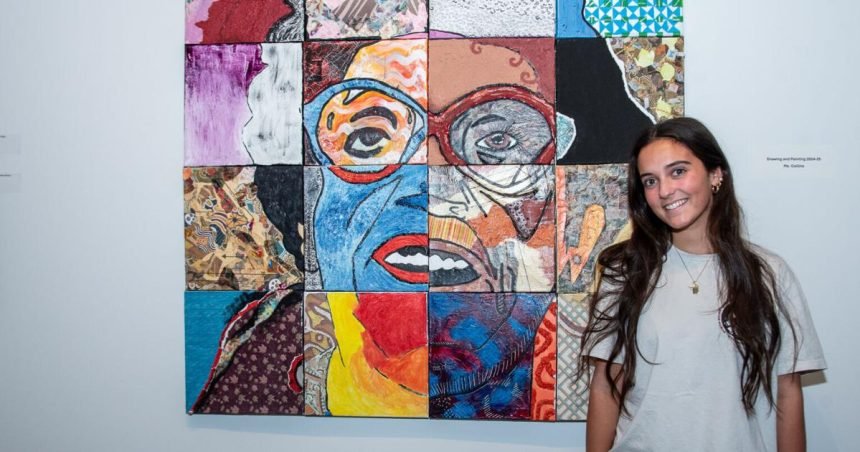
At Guild Hall, there is a real sense of intergenerational connection, explained Palsgrove, pointing to Family Day at the museum, participation in the Teen Arts Council and the annual Student Art Festival, which has celebrated the creativity of children in kindergarten through 12th grade on the East End. There is also a robust volunteer group that attracts retirees and a wide swath of adult-centered programming and long-standing traditions, like the Clothesline Art Sale.
Gallery admission is also free, Palsgrove said.
“That hopefully will reduce a barrier of anyone feeling like they don’t want to come see what art is on the walls — and hopefully they’ll come and bring friends,” he said. “The walls are very porous for us in many ways, and I think that carries through in the kinds of programs we do and the mission we serve.”
While most of the local arts organizations focus on the entire East End, the Montauk Historical Society centers on one geographic region — and that, in some ways, is a gift, explained Executive Director Mia Certic. It makes use of oral histories and photographs received from local residents and is constantly seeking them out, as well as opinions and ideas for future programming.
“We can’t do what the big museums do, but we can do something that they can’t do,” she said. “We have the luxury of being able to focus on this one place.”
In past exhibitions, the historical society has grounded Montauk’s local history in the regional, national and global perspectives of any given time, whether it was rum-running in the 1920s, Leisurama in the 1960s or life during the American Revolution in the 1700s.
“The similarities between Montauk now and Montauk then, obviously, we have many more people and it’s a whole different era in terms of what’s available to us. But at the same time, there are some things that remain the same,” Certic said. “Local people understand that there is still a sense of isolation in the wintertime. There’s still a sense of being cut off from the west when there’s a big storm. So we try to look for those commonalities and differences to make it real for our local people.”
Among the arts and historical organizations themselves, the leadership teams often come together and collaborate, sharing ideas when possible and looking for commonality, Pasquarella said.
“I believe that a rising tide raises all ships,” she said, “and so if we all can continue to invest in the places and the people with whom we share values and that we believe in, I do personally deeply and truly believe that we can create a better world.”