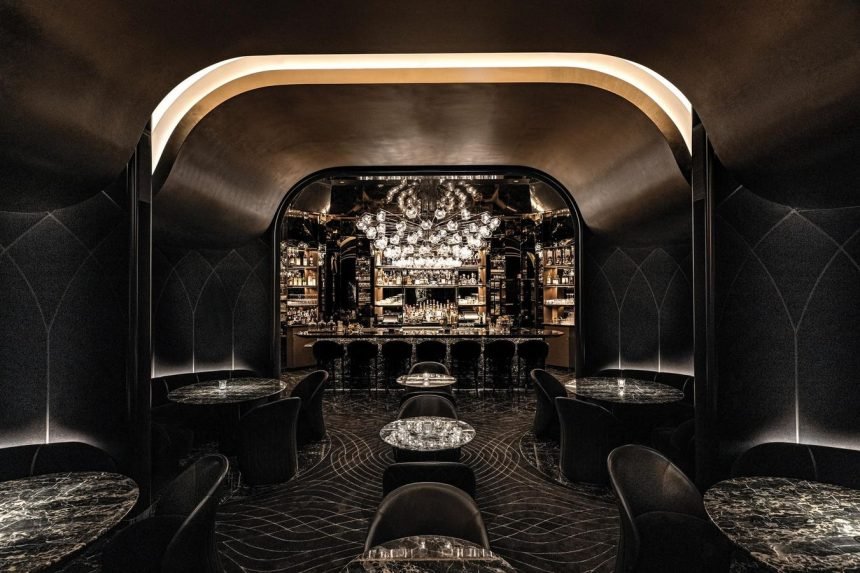
“The dining experience has evolved,” Ari Kastrati, Chief Content, Hospitality and Development Officer, MGM Resorts International, told me in an interview inside the Vault, an invite-only cocktail lounge seating roughly a dozen people at a time, its menu rooted in rare vintage spirits. “The word ‘lifestyle’ has been thrown around for quite a bit now. What it means for us is blending what a fully immersive environment actually means, through design, food, service, uniforms, lighting. Those are all the elements that we try to incorporate in a venue that not only transports you but actually becomes memorable.”
Bellagio
Every hour on the hour, the sauna inside the 75,000-square-foot Lapis Spa at Fontainebleau Las Vegas fills up, quickly. That’s not because the guests have all discovered sauna culture at the same time. It’s because they know they’re in for a rare show, at least as far as U.S. sauna culture goes.
Once everyone’s settled on two rows of benches before a television screen mounted against the opposite wall, an aufguss master saunters into the space, warning those on the top benches that it will be hottest there before handing out eucalyptus-soaked towels and tuning the music. Then it starts, the showman tossing herb-infused ice onto the rocks, swirling towels to whip hot air into participants’ flushed faces. It’s not at all meditative. It’s hokey, a little weird, but entirely on brand. In Vegas, even a sauna can be an entertainment venue.
Every hour on the hour, the sauna inside the 75,000-square-foot Lapis Spa at Fontainebleau Las Vegas fills up, quickly. That’s not because the guests have all discovered sauna culture at the same time. It’s because they know they’re in for a rare show, at least as far as U.S. sauna culture goes.
Mark Medina
Ever since the Strip came to dominate Las Vegas, hotels there have levied a one-two-three punch of booze, gaming and logistics to keep their guests in one place. Traveling even to a different Strip hotel could be bewildering, so tourists worn out by a day of wandering, people-watching and drinking didn’t seem to mind mediocre restaurants, content to stumble off to bed after a few turns at the tables.
Then came social media, ride-sharing apps and Google Maps, and in today’s Las Vegas, tourists are on the move. Travelers are increasingly bored with vacations built only around drinking, gambling and sitting by the pool. An ever-evolving food culture sends gourmands from one new restaurant to the next, which has produced new energy in neighborhoods far from the Strip and real pressure among the hotels lining Las Vegas Boulevard to keep up.
Ever since the Strip came to dominate Las Vegas, hotels there have levied a one-two-three punch of booze, gaming and logistics to keep their guests in one place. Traveling even to a different Strip hotel could be bewildering, so tourists worn out by a day of wandering, people-watching and drinking didn’t seem to mind mediocre restaurants, content to stumble off to bed after a few turns at the tables.
English Hotel
If You Build It, They Might Come
While the internet and the culture of “everyone’s a foodie” can take credit for inspiring Vegas visitors to abandon their hotel comfort zones, so can sports. In 2017, the Golden Knights arrived, and anyone who may have doubted whether the desert would support an ice hockey team quickly had those doubts erased. The team reached the Stanley Cup Finals in their inaugural season, and a city still reeling from the Route 91 Harvest festival shooting just months earlier found something to bond over.
Before hockey, “I would listen to sports talk radio, and there would be a bunch of grumpy dudes still talking about the ‘90s UNLV team,” Robert Flicker of the public relations firm Kirvin Doak told me during an interview at the Bellagio. “There are 2 million people who live here. They want something to get behind, and they’d never had their own thing. It was the first time I could go to a grocery store and some grandma is standing in front of me in line, and I’m like, ‘Hey, how about the Knights last night?’ And she’s like, ‘Oh, yeah.’ Everyone had a common thing that everybody was rooting for.”
Then came football and the Raiders. Then Formula 1, debuting the Las Vegas Grand Prix in 2023, which immediately became one of the circuit’s marquee events, the Strip itself serving as the track. In February 2024, Vegas hosted its first Super Bowl, drawing more than 330,000 visitors. In 2028, the city will welcome the NCAA Men’s Final Four to Allegiant Stadium, the first time the tournament has ever come to Las Vegas. That same year, the Oakland A’s are set to open a new stadium across from MGM Grand, after years of failed negotiations to keep the franchise in California.
The effect on the city’s internal rhythm has been hard to miss, Flicker says. “Nowadays, the whole Vegas calendar revolves around sports. When we’re talking about construction updates, different openings and stuff, it’s never, ‘Oh, this is gonna open by Q3.’ It’s, ‘This has to open by football season.’”
The English Hotel, a boutique property built by developer Weina Zhang, who broke ground in 2026 on a mixed-use development nearby that will bring 1,100 new condominiums and retail shops to the area. the English Hotel, a boutique property built by developer Weina Zhang, who broke ground in 2026 on a mixed-use development nearby that will bring 1,100 new condominiums and retail shops to the area.
Photo Fusion Media
Off the Strip, a New City Rises From a Vacant Lot
As sports infuses Vegas with some new civic pride, a different kind of transformation is underway a few miles from the Strip in the Arts District, and now just next door to that, in a new neighborhood called Midtown.
When Kim Owens left her corporate restaurant job in 2017, after 12 years and 200 days a year on the road, she knew she wanted a change. She spent months looking at locations across the Las Vegas Valley before landing on a former furniture store on Main Street, in what was then a neighborhood of two bars, a handful of coffee shops, two restaurants and plenty of boarded-up storefronts.
“I knew the city had done work to try to build this area up,” she told me at the restaurant. “They’d made Main Street one way. They broadened the sidewalks. They put in the bistro lights. They put in the big wrought-iron lampposts. They planted trees. So they had only done that, but I kept falling in love with it more and more.”
She gutted the building, kept the original wood trusses from 1914 and a cinder block wall from 1947, and opened Main Street Provisions: New American cuisine with an emphasis on steaks and chops. Five years in, she’s in her dining room five or six nights a week, working the floor. She figures her crowd runs about half locals, half conventioneers, the latter returning year after year whenever they’re in town.
“I didn’t build a restaurant to sit in,” she says. “I think that’s what separates a restaurant from a dining experience. They’re just two different things.”
A few blocks away, the neighborhood called Midtown is rising from the corridor near Charleston Boulevard, just north of the Arts District’s original core. The anchor is The English Hotel, a boutique property built by developer Weina Zhang, who broke ground in 2026 on a mixed-use development nearby that will bring 1,100 new condominiums and retail shops to the area. KJ’s, the on-property restaurant, opened to guests in April. “None of this was here seven years ago,” Zhang told me in an interview at the hotel. “I thought this could be the future. This is our best place. But you have to create a neighborhood, a community.”
Tamba, which reopened in December 2024 in a sleek new space at Town Square after nearly 20 years on the Strip, is reinventing what Indian food should taste like.
Winston Ross
Food Culture Forces An Evolution
Further off the Strip, the dining landscape is evolving. For decades, Lotus of Siam has been one of the best reasons to leave the hotel. Chef Saipin Chutima’s Northern Thai cooking has drawn serious diners to her location on East Flamingo Road since 1999, her coconut-free curries and generations-old family recipes earning her a James Beard Award for Best Chef: Southwest in 2003.
Now there’s much more to off-Strip dining than Lotus of Siam. Tamba, which reopened in December 2024 in a sleek new space at Town Square after nearly 20 years on the Strip, is reinventing what Indian food should taste like. Executive chef Anand Singh, born in the Himalayan foothills and trained across six countries, runs a menu that moves between Indian live-fire cooking traditions and influences from Japan, China and Thailand. The sushi program, led by Korean-born, French-trained chef Sung Park, is infused with Indian spices. The restaurant earned a 2026 James Beard Foundation nomination for Best New Restaurant. And it sits between a PF Chang’s and an Apple Store.
Chef Winston Matsuuchi runs a five-course omakase in a format that moves between traditional omakase and kaiseki-style dining, with paper-pot shabu and wagyu skewers appearing alongside high-end sashimi.
Omakase Kyara Sake Bar
A few miles northwest of the Strip, Omakase Kyara Sake Bar operates out of another humble facade on South Jones Boulevard, the kind of location you’d drive right past if you didn’t know better. Chef Winston Matsuuchi runs a five-course omakase in a format that moves between traditional omakase and kaiseki-style dining, with paper-pot shabu and wagyu skewers appearing alongside high-end sashimi. After 9 p.m. the restaurant shifts into an izakaya, with Japanese tapas and a sake list serious enough to justify the detour on its own. The restaurant has been open since 2023.
Fontainebleau Las Vegas opened in late 2023, after years of construction delays, and quickly took its place as a resort built for a different kind of Vegas visitor.
Connie Zhou
The Strip Responds
None of this new competition has gone unnoticed on Las Vegas Boulevard.
Fontainebleau Las Vegas opened in late 2023, after years of construction delays, and quickly took its place as a resort built for a different kind of Vegas visitor. The hotel’s steakhouse, Don’s Prime, has established itself in a crowded field with a menu focused on prime-grade American beef, an extensive raw bar and a wine program that runs to several hundred labels. The spa, with its hourly aufguss performances, serves up European wellness culture with Vegas flair. Komodo Las Vegas, the Southeast Asian-inspired restaurant from Miami’s Groot Hospitality group, draws a scene-driven crowd with a menu of shareable dishes ranging from Peking duck to lobster dynamite, in a room that feels imported whole from South Beach.
The Bellagio has set the tone for Strip luxury for nearly 30 years.
Bellagio
Then there’s Bellagio, which has set the tone for Strip luxury for nearly 30 years. MGM Resorts has spent the past two and a half years remodeling each of the property’s nearly 4,000 rooms and suites, moving toward what its design team describes as a more residential feel: layered, warm and less generically hotel-like.
The more visible changes are in food and beverage. The Picasso restaurant, which occupied prime real estate on the lake for nearly 27 years and earned two Michelin stars, is now Carbone Riviera, a collaboration with the Major Food Group and designer Martin Brudnizki. For the first time in the property’s history, the restaurant extends out onto the lake itself, drawing on the floating dining decks common around the Italian village of Bellagio that inspired the resort’s original design. The hotel also acquired a Riva motorboat, one of 18 of its kind in the world, that ferries guests on lake cruises before returning to the Carbone Riviera dock.
“The dining experience has evolved,” Ari Kastrati, Chief Content, Hospitality and Development Officer, MGM Resorts International, told me in an interview inside The Vault, an invite-only cocktail lounge seating roughly a dozen people at a time, its menu rooted in rare vintage spirits. “The word ‘lifestyle’ has been thrown around for quite a bit now. What it means for us is blending what a fully immersive environment actually means, through design, food, service, uniforms, lighting. Those are all the elements that we try to incorporate in a venue that not only transports you but actually becomes memorable.”
In a city where scale and spectacle tend to dominate, the Vault is quiet and exclusive. Next door is Pinky Ring, a small live entertainment venue co-designed and curated by Bruno Mars, who set out to build the kind of place in Las Vegas he’d actually want to spend a night. The inspiration is the Rat Pack era and the intimacy of the original Sands, rendered in contemporary materials and lighting. Sometimes Mars himself shows up and performs, in a room that seats no more than 70.
Las Vegas spent half a century perfecting the art of keeping people inside. The question now isn’t whether visitors will wander. They will, and the city has bet billions on it. The question is whether a place so good at manufacturing desire can build something more durable: a city people actually want to come back to.