The NHL contractual environment in which the Blackhawks are now operating has never before looked like it does now.
Salaries for superstars are skyrocketing, as are the long-term salary-cap projections. The cap is now projected to jump to $127.5 million in 2028-29, marking a 53% increase in just five years (since 2023-24).
General managers have responded with an increasing willingness to make sizable commitments — in terms of both term and salary — to unproven young players, just to get them locked in at semi-reasonable cap hits and avoid the extreme boom scenarios.
Sportsnet’s Elliotte Friedman has termed this 2026-27 season as “Year 1 AC — After Carlsson,” referring to Ducks forward Leo Carlsson’s whopping offer sheet this summer that ignited this salary boom. It’s clever, and true.
Ducks GM Pat Verbeek has certainly changed his ways dramatically since the bombshell, if the $43.2 million contract he just gave defenseman Tristan Luneau (boasting all of 14 games of NHL experience) is any indication.
And Hawks GM Kyle Davidson has been awed by the speed of change as much as anyone. He shared some fairly unfiltered thoughts about it Tuesday in Las Vegas.
“The Leo Carlsson contract certainly felt like a little bit of — or a lot of — a land shift,” Davidson said. “We didn’t see that coming. You hear rumblings, but you hear rumblings every year on stuff like that. It changed things, and you have to crank the dial a little bit and figure out what this new world means — and try to stay ahead of it, to some extent.
“It’s just the nature of it. These things happen, and you have to react. You can’t be stuck in the past in many respects because you’ll be…left behind. I think we did alter our thinking a little bit and got some contracts in.
“But I think it’s a constant adjustment. The pendulum seems to have swung. I don’t know if that will swing back or if it’ll keep pushing out. It remains to be seen.”
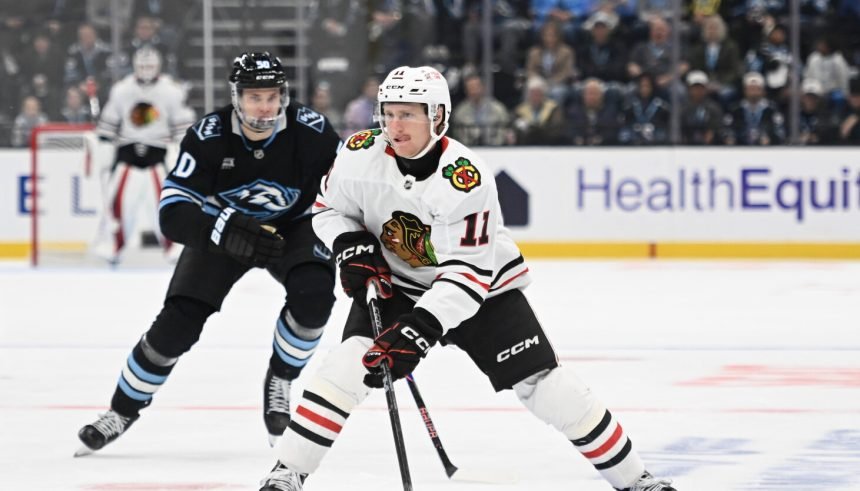
In Oliver Moore’s case, the Hawks decided it worthwhile to act quickly. Despite having seen just 60 NHL games of the speedy forward, they signed him to a five-year contract with a $4.25 million cap hit before this season began.
If Moore busts, he’ll be overpaid. But if he breaks out for, say, 50 points this season, he would have been much more expensive to sign as a restricted free agent next summer.
“Sometimes you get into conversations and there’s traction and it just culminates in a deal,” Davidson said. “A lot of times, it doesn’t and you kick the can down the road. This one did. It’s a combination of us really believing in the player and…he loves being a Blackhawk. He wanted to commit.”
That’s one pending 2027 RFA down and four notable ones left for the Hawks. Forward Ryan Greene and defensemen Artyom Levshunov, Sam Rinzel and Wyatt Kaiser all fall in that bucket, too.
If unsigned by July 1, Kaiser will have arbitration rights coming off his second contract, but the other three — coming off their entry-level deals — will not.
Davidson said he has “had some soft conversations the last little while” with those players, adding he’s “always open to doing something.”
That’s only if the price is right, though. And it makes sense why the Hawks might not feel as much urgency to get pen to paper in those situations.
Greene, while a smart and reliable player, doesn’t seem likely to boom into a major point producer, which caps his realistic salary potential. The same could be said of Kaiser.
On the other hand, Levshunov and Rinzel certainly have high upside and genuine boom potential, but they’ve been extremely inconsistent in the NHL so far. The Hawks might want to be more careful accumulating data on them before doing anything audacious.