When the expanded yellow tentacles of the sun coral began to appear on the Brazilian coastline, alarms rang. This species, also known as Tubastraea, was not supposed to be there. The movement of oil platforms and other shipping near Rio de Janeiro in the late 80s dragged the non-reef-building coral. Since then, it invaded and colonized reef habitats along the Brazilian coast.
The sun coral is quite unique: It can live practically anywhere and removing it can be challenging, as it regenerates rapidly—that’s why reducing its impact on the functioning of the natural systems can be difficult. However, researchers from the Institute for Systems and Computer Engineering, Technology and Science (INESC TEC) developed a technology to monitor this invasive species. How? With the help of underwater robotics technology.
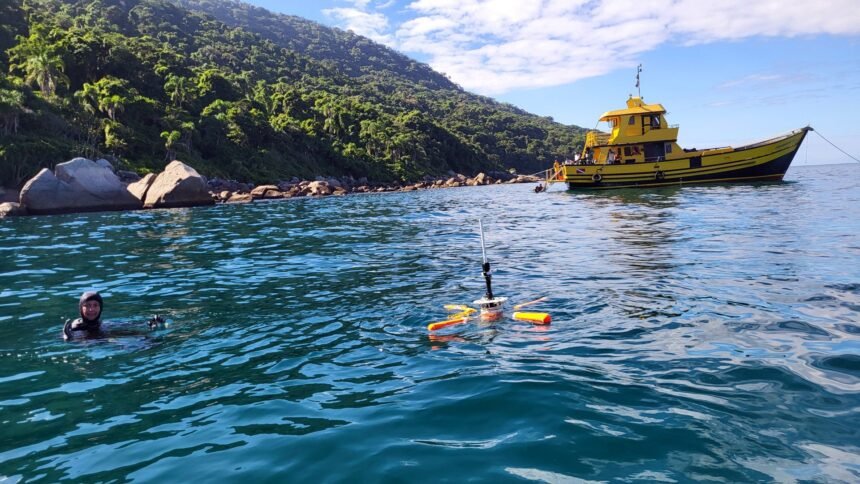
The researchers traveled to Brazil to test it with a Research Laboratory of the Federal University of Santa Catarina (LASUB). The results are “promising,” explained Nuno Cruz, a researcher at INESC TEC. The researchers placed buoys a few hundred meters away from the diving zone, and the divers took an emitter device so the operations team could see their location at any time, and work out where the corals were located. Since GPS or radio signals do not work underwater, the test was done with acoustic signals.
The Portuguese researchers adapted the systems they use in underwater robots to track the divers and understand the locations of the sun corals. The technology developed featured a device that locates underwater objects, a set of buoys that were connected to the GPS, and a cylinder—which was placed on the diver’s back, emitting sound signals to the buoys.
The goal was to decrease the margin of error in the location of the corals that influence Brazil’s marine fauna. This was possible through triangulation, since the buoys determined the relative position of the underwater object and, together with the GPS, provided an accurate location.
For the two-day trial, INESC TEC shipped to Brazil a device capable of generating acoustic signals (a “pinger” that makes it easier to relocate an underwater site or equipment) and three localization buoys.
“The cylinder, carried by the diver, is a synchronized acoustic pinger. It emits a periodic signal, once every second, that is detected by the buoys,” indicated Nuno Cruz. The cylinder is always emitting a periodic signal, one time per second. The tube contains rechargeable batteries, to enable many hours of diving and an acoustic transmitter that sends the underwater acoustic “pings.”
This internal atomic clock is a crucial component. “It ensures that signals are transmitted in very precise instants, a fundamental aspect to guarantee an accurate estimation of the pinger position,” says Cruz.
The buoys detected the pinger’s sound, knew when it was emitted, and calculated the time it took to travel, providing data about how far the pinger was. This information was then transmitted via radio to the support boat, where a computer compiled the measures and activities through trilateration, allowing monitoring, in real-time, of the diver who carried the pinger.
“Besides the purely passive monitoring, we altered the device to signal specific events, like an ‘underwater switch’ that the divers trigger anytime they want to flag a special location; in this case, the coral sighting.
“With the use of this technology, we confirmed that it is possible to know quite accurately—a margin of error smaller than 1m—the position where the corals were found and removed, which makes it possible to monitor this process with great reliability. This allows us to understand a certain colony’s evolution, or absence, and the correlation with environmental conditions, e.g., sunlight, currents, water temperature, acidification, etc.”, Cruz added.
Saving time and saving corals
Without this kind of technology relying on trackers and robots, the monitoring was no simple task—and more time-consuming. It was done only by divers, who upon finding an area with corals, marked it, returned to the surface, took photographs of the surrounding area, and passed them on to the crew of a GPS boat that was nearby and recorded the approximate location.
The margin of error could reach several meters. The device developed by the INESC TEC team, and the triangulation between the GPS and the buoys, allowed them to overcome this issue. With these tools, divers can dedicate all their diving time to the search and identification of the corals.
And it’s important to know the location with more certainty. Monitoring the expansion may not fully repair the now orange and yellow-covered reefs; it can, however, help stop further colonization of the Brazilian coast and the disappearance of native coral.
An additional advantage of the tested method is that all the data (both the route taken during the dive and the specific points marked) is automatically recorded digitally in a dive report. This makes it easier to compare results with previous dives.
“There is sun coral in other regions, where it is native and in balance with the ecosystem; however, on the American continent, it is an invasive species. The LASUB researchers are experts in mechanics and are currently developing tools for the removal of these corals,” pointed out the Portuguese researcher.
The technology is back in Portugal for more tests by the INESC TEC team. However, although the sun coral species is one of the biggest concerns, Brazilian researchers are already thinking of new ways to use the same systems to accurately mark other habitats.
Provided by
INESC Brussels HUB
Citation:
How technology and robotics are helping Brazil monitor and control an invasive coral species (2024, July 31)
retrieved 2 August 2024
from https://phys.org/news/2024-07-technology-robotics-brazil-invasive-coral.html
This document is subject to copyright. Apart from any fair dealing for the purpose of private study or research, no
part may be reproduced without the written permission. The content is provided for information purposes only.