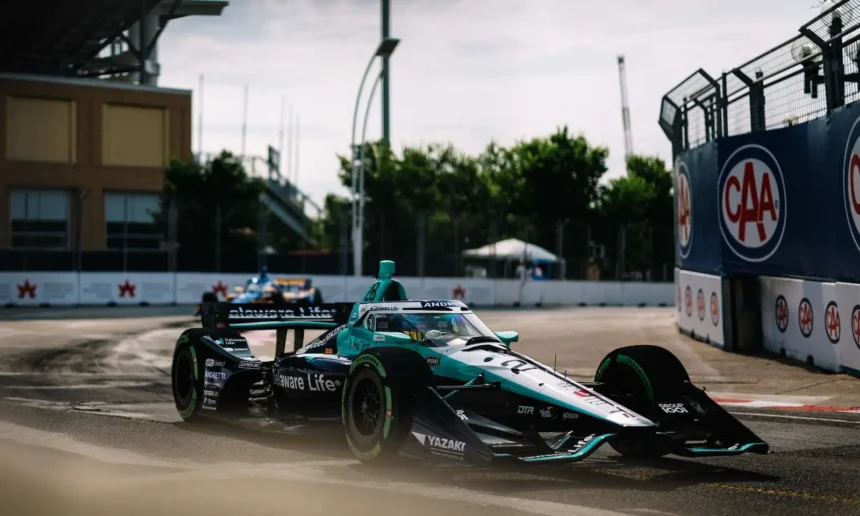
In 2018, the FIA made mandatory the “halo,” a flip-flop strap-style safety device designed to protect the heads of open-wheel racers in Formula 1. But the halo wasn’t F1’s only option for head protection — in fact, one of the rejected technologies, the aeroscreen, made its way to IndyCar.
Both the aeroscreen and the halo are designed to offer head protection in the case of an accident, but there are crucial differences between each that explain why their respective series selected that protection device.
Aeroscreen v. Halo: F1’s big decision
Ahead of the 2018 season, the FIA had a decision to make. Formula 1 needed an increase in head protection after several high-profile crashes and deaths, but simply closing off the cockpit would nullify the series’ open-cockpit ethos.
Into that void came two proposals, which came to be known as the halo and the aeroscreen.
The halo appeared to be the simplest concept, at least in terms of the materials required to build it. A titanium bar was placed in the center of the front of the cockpit, connected to a rounded bar that curves down to the chassis.
Though that center bar does restrict some visibility, the fact that the halo is otherwise “open” means the addition of that bar is the only impediment to sight.
The aeroscreen, by contrast, features a base structure similar to that of the halo, but it features a polycarbonate laminate screen that wraps around the cockpit.
Ferrari also introduced something called the “shield,” which was a clear windscreen that would have likely protected drivers from head-on collisions, but not any top-down collisions. It was considered briefly but ultimately scrapped.
F1 and the FIA tested both the aeroscreen and halo concepts before ultimately deciding on the latter. The halo was lighter (20 lbs, compared to the aeroscreen’s 40), and it was thought to prevent fewer visibility problems, as any screen introduced reflective issues.
More from the motorsport technology archives:
👉 The first-ever F1 turbocharger that changed the sport forever
👉 The Story of the Williams FW14B: A revolutionary technological masterpiece
The aeroscreen concept, though, didn’t just disappear when Formula 1 made its decision. Instead, the designer of the aeroscreen — Red Bull Advanced Technologies — brought the tech to IndyCar in 2020.
While both the aeroscreen and the halo feature similar basic shapes, the aeroscreen features a thinner middle bar and projects much higher above the driver than the halo. Early issues with weight, air flow, and reflections have been slowly resolved over the past four years.
But the technology has been a massive success. In IndyCar, where drivers race in older chassis and compete on high-speed ovals, the additional protection afforded by the windscreen has proven to be a life saver for several drivers — including several in the 2024 season alone.
At the second race in Iowa, A. J. Foyt Racing driver Sting Ray Robb clipped the rear of Alexander Rossi’s slowing Arrow McLaren and launched into the air. There, it flipped twice before the car landed upside down, sliding down the pavement.
In the melee, Kyle Kirkwood and Ed Carpenter also collided, with one of Carpenter’s rear tires resting on top of Kirkwood’s Andretti Honda.
The presence of the aeroscreen likely saved both Robb and Kirkwood’s lives. Robb’s head was protected from making significant contact with the ground. In Kirkwood’s case, Carpenter’s tire rested on his aeroscreen; without it, that tire would have been on Kirkwood’s head.
For IndyCar, the aeroscreen was the right call, in much the same way that the halo was right for F1. We’ve seen the halo protect F1 drivers like Zhou Guanyu from facing serious injury, but the nimble machines needed that lighter weight head protection solution. IndyCar could afford to be a little more robust.
F1 might have rejected the aeroscreen — but it’s been a welcome addition to the IndyCar series.
Read next: F1 points system and cost cap update with big pre-season switch confirmed