The use of temporary foreign workers in Canada’s cannabis sector has become an increasingly visible and contentious issue. While the program has long been a cornerstone of Canadian agriculture, cannabis seemingly does not fit neatly into the same model that governs many other crops.
As critics raise concerns about wage suppression and job displacement, operators, labour advocates, and human resources professionals are left navigating a system that was created long before legal cannabis existed.
At the heart of the debate is a fundamental question: is cannabis more like agriculture, or more like year-round manufacturing and retail? Or both?
Canada’s Temporary Foreign Worker Program predates the modern legal cannabis industry by decades, and was designed as a broad economic tool.
The TWFP was established in 1973 by the federal government to address labour shortages in the Canadian economy. This was done by allowing employers to hire foreign nationals on a temporary basis when qualified Canadians and permanent residents weren’t available.
The TFWP focuses on bringing in workers to fill specific roles for limited periods, often in agriculture or other fields where skills are scarce domestically.
To access the program, employers need to demonstrate that they cannot find Canadians to do the required work and must apply for a Labour Market Impact Assessment (LMIA) to show that hiring a temporary foreign worker will have a neutral or positive impact on the Canadian labour market.
But how does cannabis fit this model?
For smaller and mid-sized cannabis farms, labour challenges are often highly specific and skill-dependent. According to Andrew Nunez, Chairperson of the Board at the Federation of Cannabis Farmers (FCF), the assumption that cannabis labour can be treated the same as general agricultural labour overlooks the realities of production.
“From personal experience in the industry, the demand for labour in smaller to medium size cannabis farms is of an entirely different skill level than what general agricultural farmers may look for,” Nunez said. In many cases, farms are not simply seeking seasonal help, but “skilled contract labourers who have experience in specific departments of production, like post-harvest or mother/propagation.”
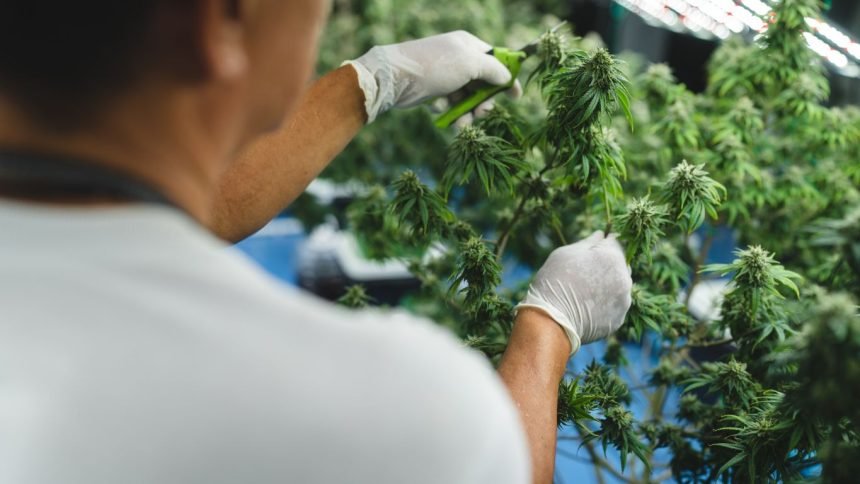
Few areas illustrate this difference more clearly than trimming. “Consider a flower room filled with 500 plants. Eight general labourers at an entry-level wage with no experience hand trimming cannabis could take a couple weeks at the most (we hope) to hand trim the flower of the 500-plant room. Eight skilled labourers at +$21/hour could hand-trim the whole room in a few days.”
For producers operating on tight harvest schedules, speed and quality are not luxuries, they are essential to maintaining product integrity and meeting market demand. “The speed and quality of work that skilled cannabis farm labourers provide in the industry is a necessity for efficiency and maintaining a tight farm production schedule,” Nunez said.
Canada’s agricultural sector has many ventures that rely on federal programs such as the Seasonal Agricultural Worker Program (SAWP) and the Temporary Foreign Worker program to access labour. Cannabis, as a federally regulated agricultural commodity, has been included within this framework.
“In many mature agricultural commodities, accessing and training labourers isn’t the challenge,” Nunez said. “With the federal TFW programs supporting ag farmers with accessing labourers, the challenge becomes finding and retaining the right team of TFW labourers who are consistent, reliable, can complete the farm work required, and align with the farm’s work culture.”
However, cannabis farming presents distinct challenges, particularly in rural areas where many cultivation facilities are located. “Growing quality cannabis commercially is hard work,” Nunez said, adding that “proximity to the cannabis farms is often a challenge to retain local cannabis farm labourers.”
One perceived advantage of seasonal labour programs is the housing requirement. “The TFW programs require farmers to provide housing for the seasonal workers, and with enough preparation and coordination, there could be an opportunity to position housing near the cannabis farm,” Nunez said.
Despite these benefits, he acknowledged that reliance on temporary labour is not a shortcut. “Training TFW takes time and resources from any farming operation,” he said, noting that some producers opt for higher-paid, experienced contract labour instead. Still, he argued that long-term success depends on investing in people. “Producers who have a long-term vision for their operation will see value in investing and upskilling their farmers.”
Retailers push back on misuse narratives
While cultivation often dominates discussions around TFWs, retail cannabis has also come under scrutiny, particularly as store counts have grown rapidly in some provinces.
High Tide Inc., one of Canada’s largest cannabis retailers, says its use of the program is both limited and declining. “High Tide uses the Temporary Foreign Worker Program in a limited and responsible manner, and always in full compliance with federal and provincial regulations,” said Omar Khan, the company’s Chief Communications and Public Affairs Officer.
“Currently, TFWs account for approximately 10% of our total Canadian workforce, and that share continues to decline as work permits expire and extensions are increasingly denied by federal authorities,” Khan said.
According to Khan, the program is used only in markets where local recruitment has consistently failed. “Our use of the Program is focused exclusively on chronically understaffed markets where it has proven demonstrably difficult to recruit certified and trained Canadian citizens or permanent residents, despite sustained recruitment efforts,” he said.
Hiring Canadians remains the priority, he added. “High Tide employs nearly two thousand Canadians nationwide and makes extensive efforts to recruit locally before turning to the TFW Program. The program is used only when those efforts are unsuccessful and only through government-approved processes.”
Khan also pushed back against claims that TFWs are used to suppress wages. “We remain committed to offering competitive wages, benefits, and meaningful career development opportunities to attract and retain Canadian talent,” he said.
From a human resources and policy perspective, the cannabis sector’s reliance on TFWs exposes broader flaws in how the program is structured.
HR leader Sarah Seale, Founder of Sarah Seale Inc., believes policymakers have struggled to strike the right balance. “I think that the policy makers misunderstand the need to set limits on these types of programs, and they leave the criteria too broad, which leads to it being abused,” she said.
Seale pointed to the slow pace of reform as a recurring issue. “In Ontario, this was first established in 1973, the restrictions were put in place in 2024. It seems to take years of problems on these programs before corrections can be made.”
A key challenge, she said, is that cannabis is often lumped into inappropriate categories. “Some of the misunderstanding on the cannabis industry side stems from policy makers lumping us in with agriculture or general manufacturing.”
While the TFW program works well for truly seasonal industries, Seale argued that much of cannabis production does not follow that model. “The temporary foreign worker program works well for the seasonal cycle in agriculture, allowing for a large number of temporary low income staff to be brought in at critical times like the annual harvest,” she said.
“In an LP the difference is, unless there is an outside grow, harvests happen every 8–12 weeks,” Seale added. “This is a normal course of business that should require full-time staff and not this program’s model.”
Critics, she noted, have raised concerns that misuse of the program can suppress wage growth and limit full-time employment opportunities for Canadian workers.
Despite differing perspectives, there is broad agreement that the current framework is imperfect. Cannabis sits at the intersection of agriculture, manufacturing, and retail, and policy has yet to fully catch up.
Whether cannabis can find its place within that system, without repeating the mistakes that have drawn criticism elsewhere, remains an open question. What is clear is that a one-size-fits-all labour policy is unlikely to work for an industry that continues to evolve far beyond its original agricultural roots.
*It should be noted that StratCann contacted a number of LPs, some of whom are known to use TFWs, and did not receive a response.