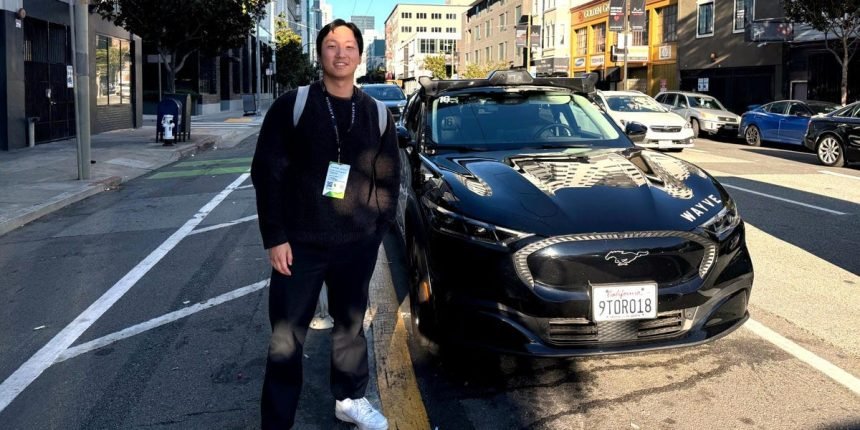
Let’s put aside the Tesla vs. Waymo debate and talk about Wayve.
The UK-based startup, founded in 2017, is yet another company that has autonomous-driving technology ambitions, but it’s not building a robotaxi platform like Waymo. Nor is it a car or robotics manufacturer like Tesla.
Wayve’s goal is to develop a highly capable Advanced Driver Assistance System (ADAS) that it can license to other automakers. Think a flexible version of Tesla’s Full Self-Driving (Supervised) that can be plugged into any automaker’s cars.
The startup is working on fully driverless systems, but it also sees an untapped market in licensing supervised self-driving technology.
I tried a demo of an ADAS system powered by Wayve’s AV2.0 AI driver in San Francisco, taking a nearly hourlong ride inside a Ford Mustang Mach-E. The car was retrofitted with five cameras, a radar, and Wayve’s AI driver.
Two Wayve spokespeople joined me for the ride to answer questions I had about the technology, along with a “vehicle safety operator” who was behind the wheel in case he had to intervene during the ride.
In some ways, it reminded me of a Tesla robotaxi, a ride-hailing service that — in SF — operates with a safety monitor behind the wheel.
My experience with Wayve didn’t diminish my impression of Tesla’s FSD. However, it did raise questions: How much of the advantage that Tesla claims — from complete software ownership to the billions of miles of driving data it says it has on hand — ultimately matters in developing a competent, assisted driving system? How long will it take for Wayve to catch up? And, if Wayve does, could Tesla truly corner the ADAS market if it’s still only thinking about licensing its software?
A Tesla spokesperson did not respond to a request for comment.
The Wayve approach
Like Tesla, Wayve has built an “end-to-end” AI system, which means the software learns to drive directly from data rather than relying on engineers to hand-code rules.
The AI driver scans the road using sensors — whether with cameras only or a combination of radar and lidar — and determines how to steer or accelerate based on what it has learned from real-world and simulated driving experiences.
Leveraging the adaptability of an end-to-end system, Wayve wants to distinguish itself by providing a “hardware agnostic” software.
Lloyd Lee/BI
The company says it means Wayve has software that automakers could plug-and-play into all kinds of cars, from personally-owned vehicles to commercial trucks, no matter what sensor stack it has.
If an OEM only has cameras, Wayve says its AI driver will work. If a car has more redundant sensors outside of cameras, the AI driver should be able to support higher levels of automation, a Wayve spokesperson said.
Related stories
Business Insider tells the innovative stories you want to know
Business Insider tells the innovative stories you want to know
Business Insider tells the innovative stories you want to know
Business Insider tells the innovative stories you want to know
The proposition to automakers is that there are no additional hardware costs.
“We can integrate on any camera or sensor setup, on any system or chip, which is quite appealing to OEMs because there’s no additional hardware or core costs or CapEx on their side,” the spokesperson said.
Wayve chauffeur
There’s a lot more tech underlying Wayve’s ADAS system, but most consumers will likely only want to know: How does it drive?
My demo began near Moscone Center in San Francisco’s South of Market neighborhood during 5 o’clock rush hour. We zig-zagged through the city for a few miles before we circled back to Moscone Center. The 30-minute demonstration ended up being a nearly hourlong ride due to traffic conditions.
Throughout the ride, Wayve was capable of stopping for jaywalking pedestrians and maneuvering around drivers who stood too close to the road as they opened their car doors. On Mission and 6th, a car was blocking the intersection when our light turned green. The AI driver still waited for the car to move out of the way before it proceeded.
There were two or three moments where AV2.0 braked harder than usual, especially when it was inching along heavy traffic. It’s a curious behavior that I’ve noticed in other self-driving cars.
Lloyd Lee/BI
There were no moments of intervention from the safety monitor outside of taking over to park the car.
A Wayve spokesperson informed me that I experienced an automated driving level that falls somewhat between what the Society of Automotive Engineers (SAE) labels as L2 and L3. L2 means that some level of driving is automated, but it is under constant human supervision. L3 is when a car can drive itself under certain conditions without human supervision unless the car requests the driver to take over.
The spokesperson said that the safety operator did not have his foot on the brakes, pedal, or steering wheel.
The ADAS race
This is not a one-to-one comparison of Tesla’s technology or progress to Wayve’s.
I experienced Wayve’s AV2.0 in a single, supervised demonstration. Wayve’s AI driver may not be in cars until 2027.
Anyone can go buy a Tesla and experience FSD today.
Tesla is also conducting robotaxi trials without a human directly behind the wheel in Austin. Although a safety monitor remains in the front passenger seat.
Wayve announced in June that it would begin testing fully autonomous driving in London with Uber in the spring of 2026.
The company was co-founded by Alex Kendall in 2017, when Alphabet was nearly a decade into robotaxi development and around two years after Tesla released Autopilot, a stripped-down version of FSD (Supervised).
Tesla boasts 6 billion miles of real-world driving data collected from its vehicle fleet. Wayve collects data from multiple sources, including its own fleet of test vehicles, OEM data, and simulated driving.
In March, the startup said Wayve’s AV2.0 — first accustomed to the UK’s right-hand driving — was able to adapt to US roads with about 500 hours of “US-specific training data.”
Wayve announced in April a partnership with Nissan to incorporate its assisted driving technology into mass-produced vehicles.
Tesla CEO Elon Musk has publicly said that the company is in talks to license FSD to major automakers.
Still, purely from the driving experience, it was hard for me to pinpoint where a passenger might distinguish between FSD and Wayve’s AV2.0 system.