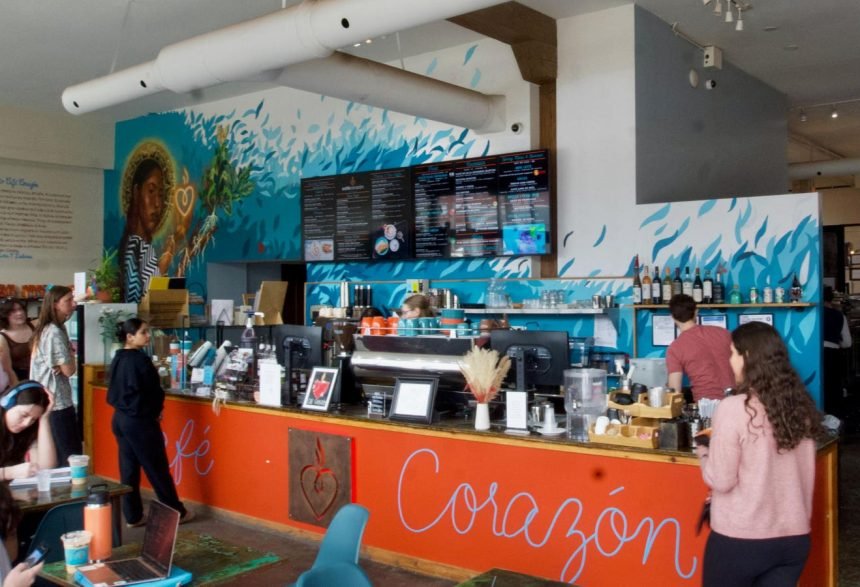
Inside Kansas City’s Café Corazón, where Latin American and Indigenous traditions shape a gathering place and raise larger questions about hospitality and community responsibility.
Stephanie Gravalese
After a car crashed through the storefront that would become Café Corazón’s first Kansas City location, the owner agreed to rent the damaged space to Dulcinea Herrera’s family on the condition that they repair it themselves. They did, and they also made the tables.
Herrera calls her family “fixer uppers,” and much of the first café came together through their labor. The coffee shop drew from the Latin American and Indigenous traditions in her family.
Years later, Herrera still calls those original tables her “day ones” and her “ride or dies.” Around them, she has watched people meet for first dates and business meetings, discuss marriage, and sign divorce papers.
At the original location, an older Mexican woman stopped to read the family’s story on the wall and began to cry. She told Herrera, “I finally have a coffee shop, a place to go meet with my kids, my family, do my work, and I feel like home. I don’t feel like I’m going to be judged. I feel safe here.” Herrera started crying too. “That’s worth more than money in my eyes,” she says.
What happens inside Café Corazón
Café Corazón draws from Herrera’s family history. She co-founded the café with her mother, Miel Castagna-Herrera, who is Argentinian, and her father, Curtis Herrera, who is Mexican and Mescalero Apache from New Mexico. “Mexican is so different than Argentinian, and the Mescalero Apache Tribe is very different than all of the two,” she says. “It’s been nice to create a space that’s everything.”
Her father began working on farms with his family when he was six, sometimes holding a hoe for so long that his hands became stuck around it. That history shaped how the family approached coffee.
“We started with the concept of, let’s share our cultura. Let’s have people enjoy it,” Herrera says. “We want you to feel like you’re walking into your grandma’s house, but also still honor the farm and the people who are working, giving people that voice, because they don’t usually get it.”
“There might be a guy who comes in says, what’s an empanada? And there might be a woman that’s like, oh, I haven’t had Argentinian empanadas in years, but I love them,” Herrera says. The menu runs across Central and South America alongside Indigenous foods like tamales and atole, and staff taste all of it before they’re hired.
“You don’t know how to talk to somebody about the product until you’ve had it,” Herrera says. Coffee is only part of what brings people through the door. Cafecitón, the café’s monthly daytime club, can draw around 300 people for bachata, reggaeton, and perreo. First Fridays may bring a night market; meditation and healing circles happen in a back room, with Indigenous practices led by Indigenous people.
“It fills my heart when we have an event or something here, and I see little girls in Mexican dresses dancing, or we’ll have a powwow in here,” Herrera says. Later, she adds, “We’ve created a space where everybody can feel very welcome, all ages, all demographics.”
Later in the day, younger customers arrive after school or work on college essays, while regulars share the café with people coming in for the first time.
What protecting the space requires
During past election cycles, Herrera says people entered Café Corazón and told employees they could not speak Spanish there, that it was not their country, and to “go back to where you come from.”
The cafés have also dealt with break-ins, broken windows, and racist writing left on the property. When customers harassed staff, managers and regulars sometimes intervened immediately and told them to leave.
“Our people have been protected, and that’s the most important thing,” Herrera says. Still, she says, “It happens all the time, and you have to be careful.” Herrera does not separate the welcoming part from the enforcing part. “Gotta call people out,” she says.
Officers had not entered Café Corazón at the time of the interview, but Herrera says immigration enforcement in nearby communities led her to prepare the staff in case they did. “We had to train our entire staff,” she says. “Luckily, our staff is trained. Our people know what to do if something like that was to happen. That was really important for us.”
Finding instructions for a business was harder. Herrera says the groups doing this work were focused on individuals and families. “They’re great, but they are focusing so much on the people, and it’s not their fault,” she says. “They’re just really busy.”
“There isn’t hardly any help as to businesses on what to do in that matter,” she says. “So I had to make whole documents. I had to get with lawyers, see, like, what are we supposed to do? What are we supposed to say?” Herrera consulted lawyers, created written guidance, and shared the information with other businesses she knew. “Sometimes you just got to step up,” she says.
Café Corazón’s concerns sit within an industry deeply shaped by immigrant labor. Nearly one in four restaurant and foodservice employees were born outside the United States, according to the National Restaurant Association, while three in ten speak a language other than English at home. For culturally rooted businesses, questions of language and immigration can become part of how workplace safety is handled every day.
At Café Corazón, being a community space extends to what happens when an employee is harassed and whether the staff knows what to do if immigration officers come through the door.
Welcome is the part of Café Corazón that customers can see. What it takes to keep that welcome intact, once people have come to depend on it, may be the larger part of the job.