



Stay up to date with our Up First newsletter, sent every weekday morning.
Shares in the artificial intelligence giant Anthropic soared in their market debut after the company raised more than $100 billion in a record-breaking initial public offering and private placement that valued it at around $1.5 trillion.
It’s a remarkably rapid ascent for the five-year-old AI company, and a sign of strong investor appetite despite growing concern about a possible AI bubble.
Anthropic sold 956 million shares — far more than originally planned — at an IPO price of $83 per share, it announced on Wednesday. That price exceeded its targeted range of $70 to $78 per share.
The company’s seven founders also sold more than 23 million shares as part of the IPO. On top of that, Anthropic’s prospectus included plans to put an additional $26 billion worth of shares into the market through private placements with companies including Google, Microsoft and Nvidia.
The total haul is more than $107 billion.
The amount of money raised makes Anthropic’s IPO the biggest in history, after Elon Musk’s mega-conglomerate SpaceX landed $75 billion when it listed in June.
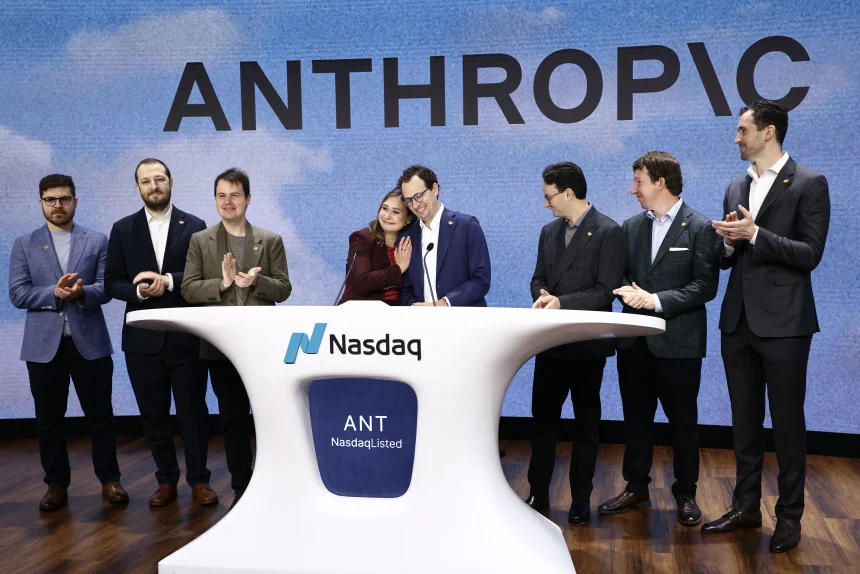
Anthropic’s shares opened trading on the Nasdaq under the ticker symbol ANT at $111.50, a whopping 34% above the IPO price. They eased over the trading day to end 17% higher at $97.17.
A breakaway beginning
Anthropic’s rise has been meteoric.
“We’ve never seen a company that’s able to grow this fast [and] be this dominant,” said Andrew Rocco, a stock analyst at the financial research firm Zacks.
Anthropic got its start in 2021 as a breakaway group of researchers who once worked for ChatGPT-maker OpenAI. Led by now-CEO Dario Amodei, the Anthropic founders were concerned that OpenAI, run by Sam Altman, was not on a path to develop AI safely.
Amodei and the others quickly raised hundreds of millions of dollars and set out to develop AI models in a way that the company said focused on safety and “alignment,” or the idea that AI should be harmless and act in ways that jibe with human values and intent.
Anthropic launched Claude in early 2023, just months after OpenAI released ChatGPT. Ever since, the two companies have been neck-and-neck competitors in cutting-edge artificial intelligence, known as “frontier AI.” The Claude family of AI models, including the Claude chatbot and Claude Code, are among the most popular and powerful in the world, and have helped transform everything from online search to software engineering.
They are also the San Francisco-based company’s main source of income, according to its IPO prospectus, which said revenue in the first half of the year skyrocketed 1,300% at $16.3 billion, while its adjusted operating income — a measure of potential profitability — hit $1.6 billion during the period, versus a loss of $1.8 billion the year before.
Opportunities and risks
The IPO comes at a time when shares in tech companies linked to the AI boom have been volatile. Investors have vacillated between enthusiasm for what many believe will be a revolutionary technology and concern that the vast sums of money being poured into it may be hard to justify.
“It’s going to be a test of investor sentiment towards the AI trade,” said Janice Quek, an equity analyst at the investment research firm CFRA. “We’ve seen in recent weeks that there has been a lot of pressure and really market sell-offs on the AI ecosystem just because a lot of people are worried about the AI bubble, for example, or the concerns around AI financing and whether there’s a return on investment on AI.”
The tech-heavy Nasdaq is down more than 11% since early October.
Altimeter Capital CEO Brad Gerstner, an early Anthropic investor, told a Semafor conference on Monday the IPO is one of the best ways to invest in AI applications. He said his firm had trimmed its exposure to AI infrastructure — companies involved in things like manufacturing semiconductors and building data centers — but that Altimeter had requested an allotment of Anthropic stock worth $5 billion.
“I’ve been waiting for it,” he said of the IPO. “We put in for the largest request in the 20-year history of our firm.”
There is indirect evidence in Anthropic’s prospectus that businesses, rather than individual subscribers, are its biggest source of revenue. Malik Ahmed Khan, an equity analyst at Morningstar, says the company’s long-term success may hinge on those companies’ pace of adoption of AI technologies, but it’s unclear how fast that will be.
“Radios went from like 10% penetration to 90% penetration in the U.S. within a decade. Washing machines, to reach that level of penetration, took a multi-decade period,” he said. “So when we’re thinking about Anthropic and broadly AI in the enterprise setting, what does that adoption curve look like?”
Conflict with the Pentagon, and “pacing the frontier”
Anthropic has not been without controversy. Earlier this year it became embroiled in a conflict with the Pentagon over how its models can be used. The Pentagon wanted the military to be able to deploy Anthropic’s models without restriction, but Amodei drew a line at fully autonomous weapons and mass surveillance of Americans. The Pentagon subsequently labeled Anthropic a “supply chain risk,” a designation previously reserved for foreign adversaries.
And skeptics have criticized Amodei’s rapid push to develop AI despite his own dire warnings about the technology’s risks. In September, Amodei wrote an essay urging his AI competitors to “pace the frontier,” or to slow down development of the most cutting-edge models and make sure that safety incidents are being reported and scrutinized by third-party auditors.
On Thursday, Amodei said the company’s principles would not change.
“To state it unequivocally, we will pace the training and deployment of AI systems, taking as long as is necessary to have confidence that they are safe and will remain under human control,” he said at the opening bell ceremony to start the Nasdaq exchange’s trading day. “We will not bend to either business nor political pressure. Today puts the company in a stronger financial position, and in doing so, only strengthens our resolve to do the right thing.”
That essay followed a summer when AI agents from Anthropic’s lab, as well as OpenAI and other competitors, were revealed to have hacked other companies, setting off a frenzy of concern about the risks of rogue agents. This week, California sued OpenAI over its agents that hacked into Hugging Face, an open-source software platform.
Anthropic’s IPO prospectus dedicated dozens of pages to potential risks, including the possibility that people could lose control of AI, or that AI could take harmful actions on its own.
The company also flagged the risk of heightened scrutiny or political backlash. Indeed, the IPO comes just weeks after midterm elections in the United States, which analysts say likely herald a period of elevated scrutiny and oversight for AI firms. Data centers became a hot-button issue this election cycle, and tech stocks sank after the election as investors anticipated that the incoming Congress would crack down on the industry.
Still, Anthropic’s prospectus was bullish about the development and spread of AI. “We believe this abundance of AI will rapidly transform every sector of the global economy in ways greater than the impact of industrialization, electricity, semiconductors, and the internet,” it said.
OpenAI had been on track to also list shares this year, but CEO Sam Altman postponed those plans, likely to next year, after the Hugging Face incident. At the Semafor conference on Monday Altman promised: “We will go public at some point.”
“The world as a whole would like exposure to this,” he continued. “And I think that’s, you know, directionally a good thing to do.”
Meanwhile, shares in SpaceX, the first of this year’s AI mega-IPOs, are trading near their initial price of $135. After the company’s June listing, the stock leapt to more than $200, then slid to as low as about $108 before recovering ground.
Anthropic is a financial supporter of NPR.
Transcript:
LEILA FADEL, HOST:
Shares in the artificial intelligence startup Anthropic started trading publicly this morning on the Nasdaq exchange.
A MARTÍNEZ, HOST:
The company raised more than $100 billion in a much-anticipated IPO that priced on Wednesday.
FADEL: NPR tech correspondent John Ruwitch is following it all. And he’s here to tell us more. Good morning, John.
JOHN RUWITCH, BYLINE: Good morning.
FADEL: So this is a giant IPO. And it seems like a milestone of sorts. How significant is this listing?
RUWITCH: Well, this is the biggest IPO in history. It beats Elon Musk’s SpaceX, which brought in $75 billion when it listed this summer. Anthropic sold nearly 1 billion shares. And the IPO raised more than $107 billion. That’s a combination of shares offered to the public and other tech companies and others that the company’s founders sold.
The IPO put Anthropic’s value at around $1.5 trillion, which is stunning, if you think about it. The company’s only 5 years old. But Anthropic is a clear leader in this fast-moving AI world. You know, Anthropic makes the Claude suite of AI models. They’re among the most popular and powerful out there. They’re used to do all kinds of things from scientific research to software engineering.
FADEL: When Anthropic filed the papers to go public, how did they make the case for this mega IPO?
RUWITCH: Well, they showed strong revenue growth. The IPO filing also had some very optimistic takes on the promise of AI. I mean, it said AI would have a bigger impact on the economy than industrialization, electricity, semiconductors and the internet. The paperwork also suggested that the addressable market for Anthropic’s products could be as big as $40 trillion a year. That’s bigger than the GDP of the United States. But they also pointed out some big risks, too.
FADEL: Are we talking about the idea of runaway AI agents doing bad things?
RUWITCH: Yeah, things like that. CEO Dario Amodei has been outspoken about risks around AI, things like AI threatening humanity or people losing control of AI. The prospectus also flags some political risks. You know, Anthropic’s been embroiled in a dispute with the Pentagon over how its models can be used. The Pentagon blacklisted it as a supply chain risk and Anthropic is suing. That’s ongoing.
And there are some technical challenges. You know, Anthropic’s success depends on creating new advanced AI models. And it needs more computational power to do that. The company’s committed around $900 billion in the coming years to that so-called compute. That is a lot of money to put on the line. The question is whether or not revenues can keep up.
FADEL: The IPO comes at a shaky time in the stock market. But it doesn’t seem like that hurt demand for shares, did it?
RUWITCH: No. There were more buyers than there were shares to sell. AI-related companies drove a phenomenal bull run in the stock market – right? – over the past few years. But we’ve seen a lot of nervousness about a possible AI bubble. The resignation of chipmaker Nvidia’s CEO Jensen Huang last week has also shaken investor confidence. Anthropic is the first major, pure AI company to hit the market. I mean, SpaceX has a big AI business, but it also does rockets and satellites. Janice Quek is an equity analyst at the investment research firm CFRA. And she says Anthropic’s IPO will be a test.
JANICE QUEK: It’s going to be a test of investor sentiment towards the AI trade ’cause, you know, we’ve seen in recent weeks that there has been a lot of pressure and, really, market sell-offs on the AI ecosystem.
RUWITCH: With SpaceX and Anthropic now on the market, and potentially OpenAI next year, the public is getting a ton of exposure to bets on this really new and potentially really disruptive technology.
FADEL: That’s NPR’s John Ruwitch. Thank you, John.
RUWITCH: You bet.
FADEL: And a note, Anthropic is a financial supporter of NPR.