¿Dónde están los mexicanos?
Where are the Mexicans?
This racially charged quip is something we often think about when walking around San Diego State University’s campus. Considering the university’s history, one would assume the Latinx culture would be larger. As Mexican-Americans from Latinx-dominated communities, we immediately noticed our cultures weren’t as prominent as we’d expected.
During orientation, we didn’t see faces that looked like ours or the Hispanic culture that the university prides itself on. We gravitated toward one another because we looked like one another. The lack of representation became blatant, from classes to residence halls. Our Latin roots feel buried on a campus that’s supposed to reflect our country’s diversity due to lack of resource promotion, program disappearances, and lack of transparency.
This begs the question: Is SDSU the Hispanic-Serving Institution they claim to be?
The Statistics
A CSU earns the HSI title when at least 25% of full-time undergraduates are Hispanic and half the student body is low-income. Under the HSI designation, universities gain access to federal grants and funding to expand student opportunities. SDSU exceeds this, with Hispanics and Latinos making up 35.3% of full-time undergraduates.
SDSU’s numbers come from the Office of Analytic Studies and Institutional Research, which relies heavily on what students report on their applications. Since California banned race-based considerations in 1996, applicants can select “Do Not State,” leaving large gaps in ethnicity data. To fill those gaps, the university uses voluntary surveys — a method that often produces response bias because only certain students choose to participate.
Federal OMB guidelines further complicate the picture. CSU campuses aren’t required to offer “Hispanic” or “Latino” as an ethnicity category, meaning some students only see options like “Other” or “Multi-ethnic.” Students with Hispanic heritage may not see themselves reflected in these limited categories and either misclassify themselves or skip the question entirely. As a result, the data used to define SDSU as an HSI may not fully capture the campus population.
If the numbers are blurred by incomplete reporting and voluntary responses, it raises a larger question: could this be why so many students feel a gap between SDSU’s HSI statistics and the reality they experience on campus?
Regardless of what the data shows, being an HSI is more than a percentage — the campus should feel Hispanic-serving.
The Student Opinions
We visited the Latinx Resource Center to ask students whether or not they think SDSU feels like an HSI. Most said the LRC’s location reflects the issue itself. Though its location is officially recognized as the first floor of the Love Library, the center is actually sub-ground in the basement. Windowless and hidden, the space leaves students feeling “swept away.”
A first-year general business major, who decided to remain anonymous to avoid administrative conflict, commented on this oddity.
“It was kinda weird that we’re all the way down here, like, stranded,” the student said.
A friend of the student, who wished to remain anonymous for the same reason, added, “It’s like we’re being hidden.”
A third-year finance major echoed that “no windows, no sunlight” contributed to feeling isolated. He chose to remain anonymous, similarly to avoid conflict. He didn’t even learn the LRC existed until his second year.
“I wasn’t told about this,” he said. “… I found out through people telling me.”
Students in the LRC agreed that the university doesn’t promote Hispanic resources well, despite them making up the largest percentage of SDSU’s undergraduate population. Many still feel underrepresented, like Yaneiry Morales-Medina, a first-year child development major, who shared her experience.
“I had to go out of my own way to look for more Hispanic groups.” she said.
While SDSU has Latinx focused groups like M.E.C.H.A., Ballet Folklorico, and Latin Student Union, many students are unaware of these organizations’ existence due to lack of promotion. Left to rely on word of mouth and self navigation, students find themselves discovering organizations from peers rather than the institution, thus missing out on opportunities.
Choosing to remain anonymous in his quotations to err on the side of caution with administration, another student shared this opinion in commenting that “the school doesn’t really promote [Hispanic resources].”
Events like the Carne Asada Cookout and the Pachanga are widely appreciated by students of all ethnicities on campus, but because they fall during Hispanic Heritage Month, students wonder: Are we only relevant from Sept. 15 – Oct. 15?
A second-year mechanical engineering major, who chose to remain anonymous to avoid tension with administration, said representation does exist.
“We have a whole center dedicated for Latinos,” she said.
Students agreed the LRC is a place of comfort, but all concluded the same: Outside the LRC, it isn’t enough.
The Allocation of Funds
HSI status brings funding meant to expand opportunities for Latinx students. SDSU received $3.8 million from a five-year federal grant in 2021. But where does that money go?
SDSU is required to be financially transparent, yet its budget documents are difficult to access and filled with jargon. Other HSIs, like CSU Dominguez Hills and CSU Northridge, use OpenBook, a clear, interactive transparency platform. SDSU’s financial information, by contrast, is buried and hard to interpret without a platform, opting to use a pdf instead.
This becomes concerning when essential resources remain unfunded — especially translation services. A first-generation student, who decided to stay anonymous out of a wariness of backlash, shared his orientation day experience.
“I kind of just assumed there would be some sort of translation,” he said. “… My parents don’t speak English all that well.”
After a 10-hour drive from Northern California, his parents were unable to understand the event they paid $80 to attend.
“Coming down to San Diego, I expected more of that [prioritizing bilingual representation],” he said.
Students often expect SDSU’s HSI title and location to reflect real inclusivity, only to find that representation lacking. If SDSU receives HSI funding, shouldn’t some support translators? With 35.3% Hispanic students — many with Spanish-speaking families — the need is obvious. Discrepancies like this make HSI status feel more financial than genuine.
The Inconsistencies
SDSU’s DEI page promises to advance “diversity, equity, inclusion, belongingness, and social and racial justice.” The campus has been recognized nationally for this, including the 2013 HEED Award. The HEED application, which is what universities submit to be considered for the national honor when they believe they’ve shown commitment to diversity, collects data on racial identity provided by a university. Participation is voluntary. Critics argue these metrics push universities toward indirect racial quotas, but SDSU maintains that they guide equitable opportunities. Still, many feel reduced to statistics rather than supported as students.
During our research, we found inconsistencies between SDSU’s stated commitment and its actual practices. The HSI Affairs page includes several tabs, but aside from “Programs,” most haven’t been updated since 2022.
The biggest gap is the HSI Student Advisory Board, created in 2021 to hold SDSU accountable. While active on social media, its official page only links to 2022 documents. Recommendations from 2022 intended to run through 2024 remain posted with no updates. La Colectiva — one outcome of those recommendations — isn’t listed anywhere on SDSU’s site and appears only in a buried Google folder. Even the 2024–2025 HSI report reuses verbatim content from the 2022 file.
Meanwhile, the Black Resource Center also has outdated sections, but overall has more current information, demonstrating uneven upkeep between diversity initiatives.
SDSU’s website is updated collaboratively, but each department maintains its own pages. This raises the question: Why has the HSI section fallen behind? As an institution that identifies as an Hispanic Serving Institution, Asian American, Native American Pacific Islander Serving Institution, and LGBTQ+ inclusive, accountability should be consistent.
The Solutions
There is a clear need for more Hispanic representation on campus. Students consistently cited poor promotion of Hispanic resources. Many didn’t know the LRC or related programs existed. Solutions are simple: more flyers, better social media presence, regular email updates, and accurate website information.
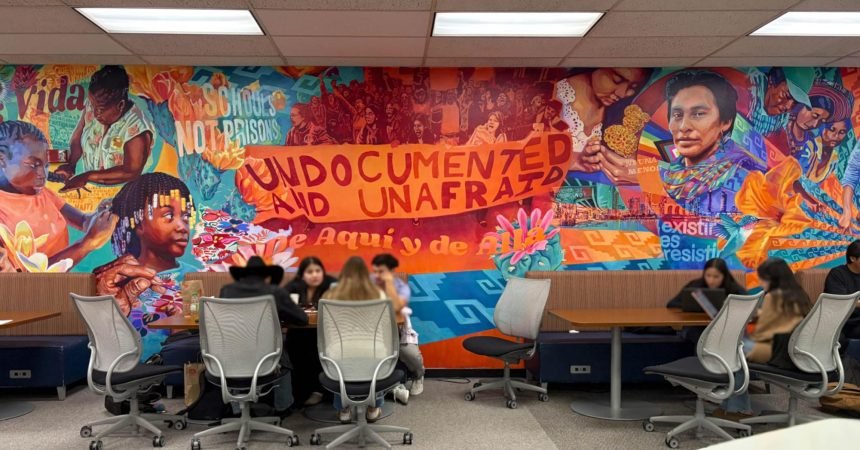
Two second-year students, Delilah Tadeo and Jazmin Sandoval, also suggested murals or a cultural hall, more acknowledgment of the land SDSU stands on and stronger education around the transborder community we belong to.
“What you guys are doing is definitely something we should be doing more,” Tadeo said.
These two students emphasized the need to shine light on our heritage and hearing from Latino voices all year around. SDSU does celebrate Hispanic Heritage Month, but Hispanic students shouldn’t only be recognized once a year.
We were drawn to this issue as Latinas and as freshmen searching for community. It was a shock not seeing faces like ours, especially at an institution that labels itself HSI, AANAPISI, and more in its title. Statistics say we’re represented, but the campus experience says otherwise.
We acknowledge the efforts of the LRC, the Monarch Unity Center and student-led Latinx organizations that work to connect us all. Events like the Pachanga and the supportive environment of the LRC matter. But we shouldn’t rely solely on them. SDSU, as an administrative whole, must commit to truly reflecting the students it claims to serve.