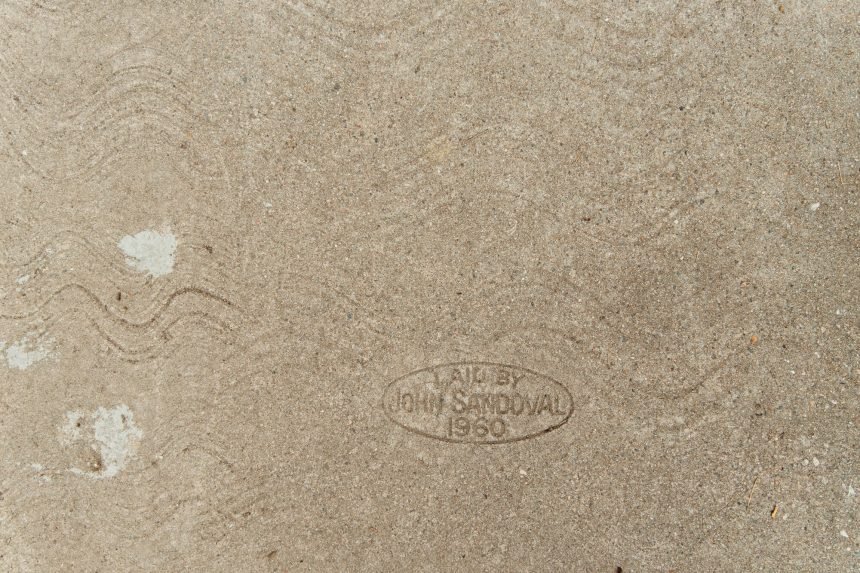
Sandoval’s signature brushstrokes atop the surface made his sidewalks stand out. Sandoval would take a broom and gently brush the pattern just as the concrete was drying to create a wave-like effect.
Rogers lives in a house partially built by his grandfather; the maroon steps outside — crafted by Sandoval in the mid-70s — are still in pristine shape.
“These sidewalks are, you know, 60 to 70 years old, and they’re still in place today,” Rogers said. “They’re not cracked, they’re not chipped, they look great, and millions of people walk over them every year, and they’re still here.”
Jennifer Cappeto, landmark preservation manager at the City and County of Denver, is also amazed that the stamps are still visible.
“A lot of them that you see are from the ’50s and ’60s, but someone told me that they had seen some from the teens or ’20s,” she said.
While Cappeto is involved in preservation of buildings across the city, her office doesn’t deal with sidewalk preservation. But Cappeto is still fascinated by the stamps. In 2017, 9News featured Cappeto in an article about sidewalk stamps. At the time, she had just moved from New York City and became fascinated with the stamps.
As a way to explore her new home, Cappeto started a blog called Masonry of Denver and documented the stamps she came across. A lot of what she learned about the stamps came from her own observations and emails from readers after 9News published its feature.
Despite the stamps’ longevity, their history is not as concrete.
Jason Hanson, History Colorado’s chief creative officer, knew little of their history but said he has been intrigued by the stamps for years. The state historian, Susan Schulten, said she didn’t know anything about them.
Tim Valdez, a former concrete mason and lifelong Denverite, said he vividly remembers pouring concrete and stamping the sidewalks decades ago.
“We had more than one, certainly. One was handheld, and it was an oval-shaped stamp,” Valdez said. “And then there was another brass-looking stamp that had a wooden handle on it that you could stand up and rock it, almost like a cookie cutter in a sense.”
Valdez was a teenager when he began working with the Martinez Brothers, who were also city sidewalk contractors.
“[Stamping] seemed like it was more pride than actually a requirement or a code, but it was definitely done. Even if we just replaced two or three squares,” said Valdez. “You put your stamp on it because it showed you were there, almost like our tag in a sense.”