
Hispanic Business TVHispanic Business TV
  • Featured
  • Popular Cities
    • Atlanta
    • Boston
    • Chicago
    • Dallas
    • Denver
    • Houston
    • Las Vegas
    • Los Angeles
    • Miami
    • New York
    • Phoenix
    • Salt Lake City
    • San Antonio
  • Business
    • HBTV Toolbox
      • Social Media Management
  • Politics
  • HBTV Sports
    • MLB
    • MMA
    • NCAAF
    • NBA
    • NCAAM
    • NFL
    • NHL
  • Entertainment
  • Living
    • Culture
    • Latino Lifestyle
    • Education
    • Cannabis
Reading: Key facts about Black Americans
Share
Sign In
Notification Show More
Font ResizerAa
Font ResizerAa
Hispanic Business TVHispanic Business TV
Search
  • Featured
  • Popular Cities
    • Atlanta
    • Boston
    • Chicago
    • Dallas
    • Denver
    • Houston
    • Las Vegas
    • Los Angeles
    • Miami
    • New York
    • Phoenix
    • Salt Lake City
    • San Antonio
  • Business
    • HBTV Toolbox
  • Politics
  • HBTV Sports
    • MLB
    • MMA
    • NCAAF
    • NBA
    • NCAAM
    • NFL
    • NHL
  • Entertainment
  • Living
    • Culture
    • Latino Lifestyle
    • Education
    • Cannabis
Have an existing account? Sign In
Follow US
© 2024 hispanicbusinesstv All Rights Reserved.
Hispanic Business TV > Education > Key facts about Black Americans
Education

Key facts about Black Americans

HBTV
Last updated: February 6, 2026 10:33 am
HBTV
Share
12 Min Read
SHARE


Lincoln University, a historically Black university in Pennsylvania, held its 164th commencement ceremony on May 7, 2023. (Lincoln University via Getty Images)

The number of Black people living in the United States reached a new high of 49.2 million in 2024. That’s up 36% since 2000, according to a Pew Research Center analysis of government data. This group is diverse, with an increasing number who say they are of two or more races.

Here are key facts about the nation’s Black population. This analysis includes three main groups: Americans who say their race is only Black and they are not Hispanic; those who say Black is one of two or more races in their identity and they are not Hispanic; and those who say they are Black alone or with other races and are also Hispanic or Latino.

About this research

This Pew Research Center analysis looks at how many Black people live in the United States and other key facts about this diverse group.

Why did we do this?

Pew Research Center does research to help the public, the media and decision-makers understand important topics. We have long studied changes in the U.S. population, including among Black Americans.

Learn more about Pew Research Center and our race and ethnicity research. 

How did we do this?

We used the Census Bureau’s 2024 American Community Survey (ACS). The University of Minnesota provides this data through its Integrated Public Use Microdata Series (IPUMS).

We defined the nation’s Black population based on how they identified themselves on the 2024 ACS. We counted people who identify as single-race non-Hispanic, multiracial non-Hispanic or Black Hispanic.

The way the census has asked about race and ethnicity has changed over time and may affect how people identify. One especially large change is that starting in 2000, Americans could select more than one racial category. Before that, many multiracial people were counted in only one category. Read “What Census Calls Us” for more details.

We could only look at spouses’ race and ethnicity for couples who live in the same household. Among married Black adults, 90% live with their spouse.

We rounded all numbers shown. But we calculated shares and percent changes using the unrounded numbers.

Terminology

U.S. Black population or total Black population refers to Americans who self-identify as Black. This includes:

  • Those who say their race is only Black and they are not Hispanic
  • Those who say Black is one of two or more races in their identity and they are not Hispanic
  • Those who say they are Black alone or with other races and are Hispanic or Latino

The terms Black population and Black people are used interchangeably.

Adults refers to people who are ages 18 and older.

The terms single-race, non-Hispanic Black and single-race Black are used interchangeably to refer to individuals who self-identify only as Black and not as Hispanic or Latino.

The terms multiracial, non-Hispanic Black and multiracial Black refer to people who self-identify as two or more races and not as Hispanic or Latino.

The term Black Hispanic refers to those who self-identify as Hispanic or Latino and as Black, either alone or with other races. This group is not the same as the Afro-Latino population: Not all Black Hispanics identify as Afro-Latino, and not all Afro-Latinos identify as Black or Hispanic.

The Black population in the U.S. has grown from 36.2 million in 2000 to 49.2 million in 2024. Notably, the number of Black people who are multiracial and not Hispanic has increased 295%, and the number who say they are Black and Hispanic has risen by 232%. This increase in racial diversity among Black Americans reflects broader growth in the number of multiracial Americans.

The arrival of immigrants from Africa, the Caribbean and elsewhere has also contributed to Black population growth.
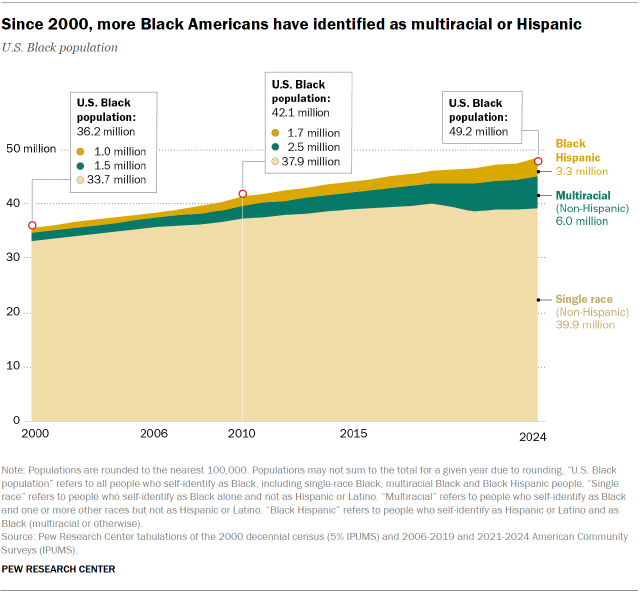
An area line chart showing that, since 2000, more Black Americans have identified as multiracial or Hispanic.

The Black population has grown fastest in states that historically have not had many Black residents. Utah saw the fastest growth in its Black population between 2010 and 2024, with an increase of 104%. The Black populations in Arizona (68%), Minnesota (67%) and Nevada (62%) also increased substantially during that span. Those were the next-fastest growth rates among states that had at least 25,000 Black residents in 2010.

The states that experienced the largest numerical increases in Black residents between 2010 and 2024 are also those with the largest Black populations: Texas (up 1.3 million), Florida (up 910,000) and Georgia (up 680,000).

Meanwhile, the Black population declined in Illinois (-2%), Mississippi (-1%) and the District of Columbia (-1%).
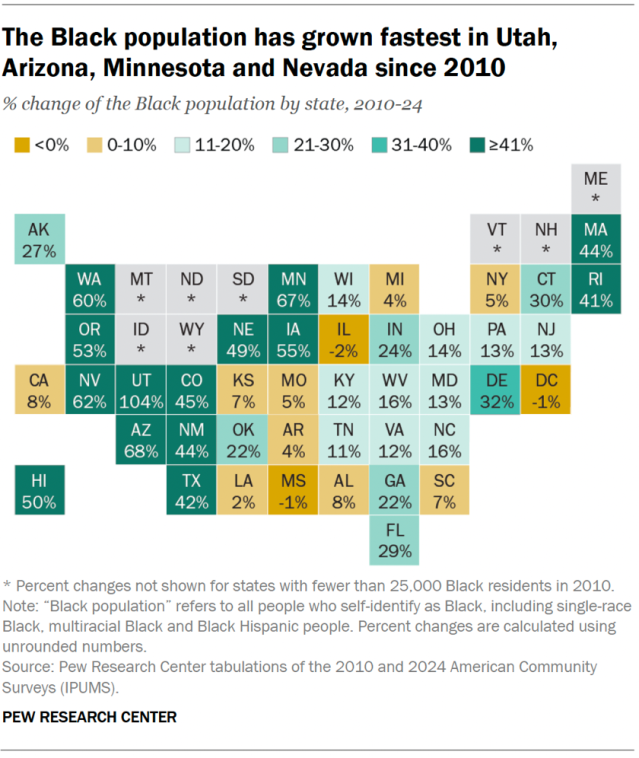
A map of the US showing that the Black population has grown fastest in Utah, Arizona, Minnesota and Nevada since 2010.

The New York City metropolitan area had more Black residents than any other metro area in 2024. About 3.9 million Black Americans lived in New York City that year. The metro areas with the next largest Black populations were Atlanta (2.4 million), Washington, D.C. (1.8 million) and Chicago (1.7 million).

The Atlanta area had a higher share of Black residents than any other metro area with at least 1 million Black residents. Nearly four-in-ten Atlanta metro area residents (37%) were Black.

Between 2010 and 2024, the metro areas with the largest percentage increases in Black residents were in Texas: Dallas (52%) and Houston (43%). In contrast, the Chicago area’s Black population declined by 3%.
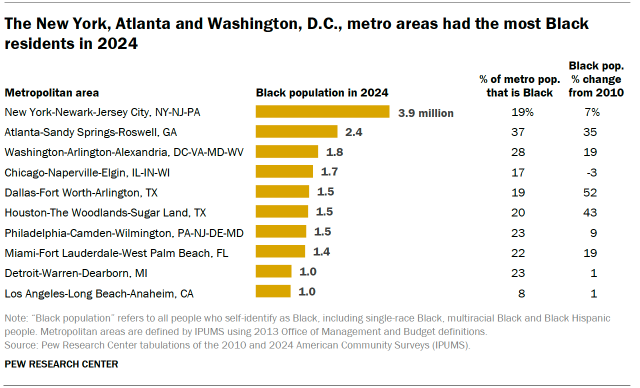
A bar chart showing that the New York, Atlanta and Washington, D.C., metro areas had the most Black residents in 2024.

The Black population tends to be younger than those who aren’t Black. In 2024, the median age of Black Americans was 33.7 years. That means half of the nation’s Black population was younger than that and half was older. By comparison, the median age of Americans who don’t identify as Black was 40.2.

In addition, 27% of all Black Americans were under 18. That was a higher share than among non-Black Americans (21%).

The median age varied somewhat among different groups of Black Americans:

  • Single-race, non-Hispanic: 36.7 years
  • Hispanic: 22.4
  • Multiracial, non-Hispanic: 21.1

Educational attainment among Black Americans continues to rise. In 2024, 27.7% of Black adults ages 25 and older – 8.6 million people – had earned at least a bachelor’s degree. That was up from 14.5% in 2000.

Growing shares of Black women and men alike have earned at least a bachelor’s degree. But Black women have made greater gains.

  • In 2024, 30.7% of Black women ages 25 and older had earned at least a bachelor’s degree. That was about double the share in 2000 (15.4%).
  • 24.3% of Black men in the same age range had earned at least a bachelor’s degree in 2024, up from 13.4% in 2000.
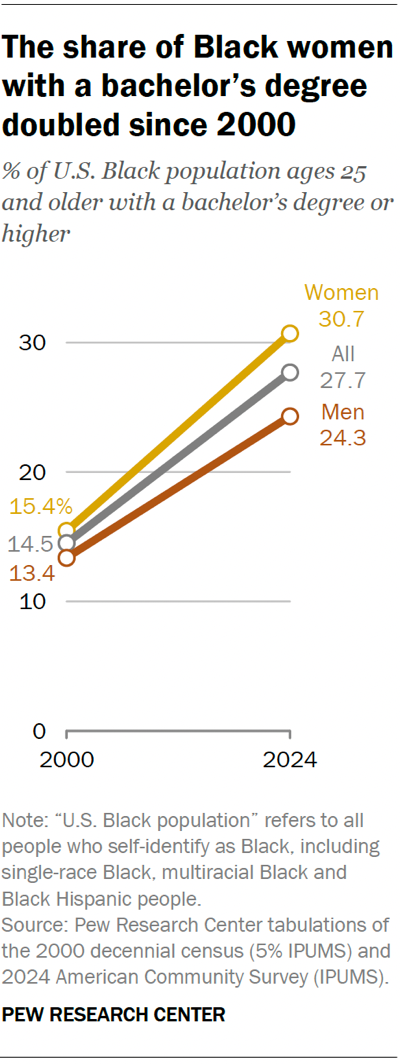
A line chart showing that the share of Black women with a bachelor’s degree doubled since 2000.

Black Americans are less likely than other Americans to be married. As of 2024, 48% of Black adults had never married, compared with 29% of non-Black adults.

Black men were more likely than Black women to be married (36% vs. 29%). In turn, Black women were more likely than Black men to be divorced, separated or widowed (25% vs. 15%).
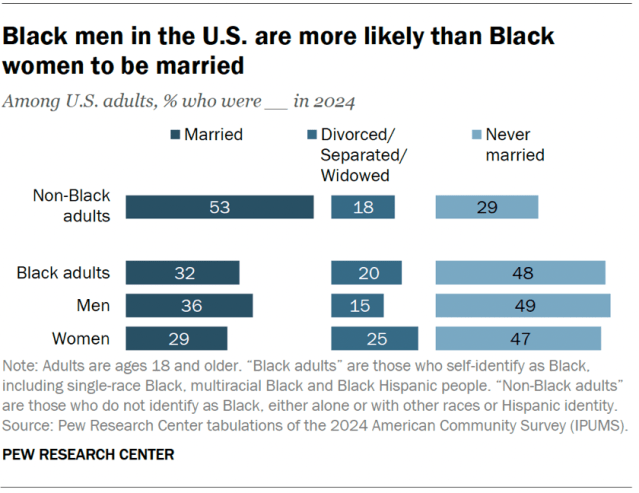
A bar chart showing that Black men in the U.S. are more likely than Black women to be married.

About two-in-ten married Black adults (18%) are married to someone who is not Black. This includes 22% of married Black men and 14% of married Black women. These shares only include those whose spouses live in the same households.

Married Black women were more likely than married Black men to have a Black spouse (86% vs. 78%). This includes spouses who are single-race Black, multiracial Black and Black Hispanic.
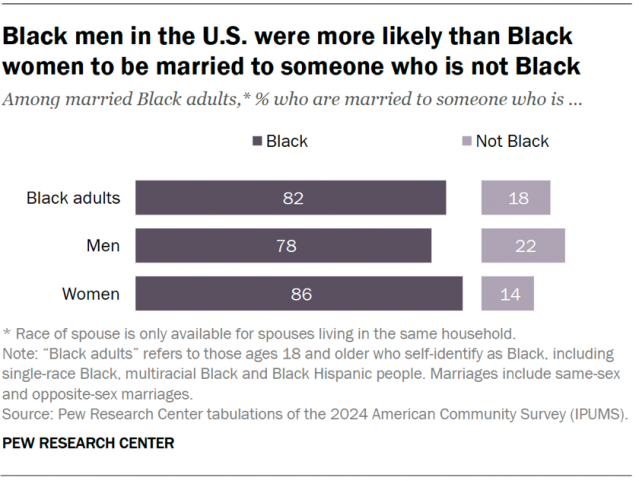
A bar chart showing that Black men in the U.S. were more likely than Black women to be married to someone who is not Black.

Black households had a median annual income of $57,200 in 2024. But income varied by group:

  • Single-race, non-Hispanic households: $56,000
  • Black Hispanic households: $63,300
  • Multiracial Black households: $67,000

Note: This is an update of a post originally published Feb. 10, 2023. That post was written by Director of Race and Ethnicity Research Mark Hugo Lopez, former Research Analyst Mohamad Moslimani, and former Research Assistant Gracie Martinez.


Correction of previous version

A previous version of this post, published Jan. 23, 2025, contained several data calculation errors for the 2023 Black population. Center researchers discovered the errors in early 2026 while preparing for a full revision and update of the post, and they were corrected Jan. 28, 2026:

  • The multiracial, non-Hispanic Black population for 2023 should have been 5.6 million.
  • The percent change in the Black population from 2010 to 2023 was incorrect for the following metropolitan areas: Washington, D.C. (should have been +16%), Chicago (-4%), Houston (+39%) and Philadelphia (+8%).

The current version (published Feb. 5, 2026) is a full revision of the post and includes 2024 population figures and corrected 2023 figures.


Source link

Sign Up For Daily Newsletter

Be keep up! Get the latest breaking news delivered straight to your inbox.

By signing up, you agree to our Terms of Use and acknowledge the data practices in our Privacy Policy. You may unsubscribe at any time.
Share This Article
Facebook Copy Link Print
Share
Previous Article Meet DFP Fall Fellow, Josearmando Torres, University of Pennsylvania –
Next Article Chris Del Conte addresses college football’s changing environment – The Daily Texan
Leave a Comment Leave a Comment

Leave a Reply Cancel reply

Your email address will not be published. Required fields are marked *

Stay Connected

FacebookLike
XFollow
InstagramFollow
- Advertisement -
Ad imageAd image

Latest News

Regulatory Affairs Attorney Scott Thomas Joins Dorsey in Phoenix | National Business News
Phoenix
May 4, 2026
Central High School starts HoPe Chapter | Local News
Education
May 4, 2026
Meet 2026 RBSI Scholar, Jayriel Kizer, Eastern Illinois University –
Latino Lifestyle
May 4, 2026
Resilient Structures Launches New Houston Utility Pole Plant
Houston
May 4, 2026

Advertise

  • Advertise With Us
  • Terms and Conditions
  • Privacy Policy
  • About Us
  • Contact

HispanicBusinessTV is your go-to source for the latest in Latino lifestyle, culture, and business news. Stay informed and inspired with our comprehensive coverage and in-depth stories.

Quick links

  • Advertise With Us
  • Terms and Conditions
  • Privacy Policy
  • About Us
  • Contact

Top Categories

  • Business
  • HBTV Sports
  • Entertainment
  • Culture

Sign Up for Our Newsletter

Subscribe to our newsletter to get our newest articles instantly!

© 2025 HispanicBusinessTV.com All Rights Reserved. A WooWho Network Digital Property.
Join Us!
Subscribe to our newsletter and never miss our latest news, podcasts etc..

Zero spam, Unsubscribe at any time.
Welcome Back!

Sign in to your account

Username or Email Address
Password

Lost your password?