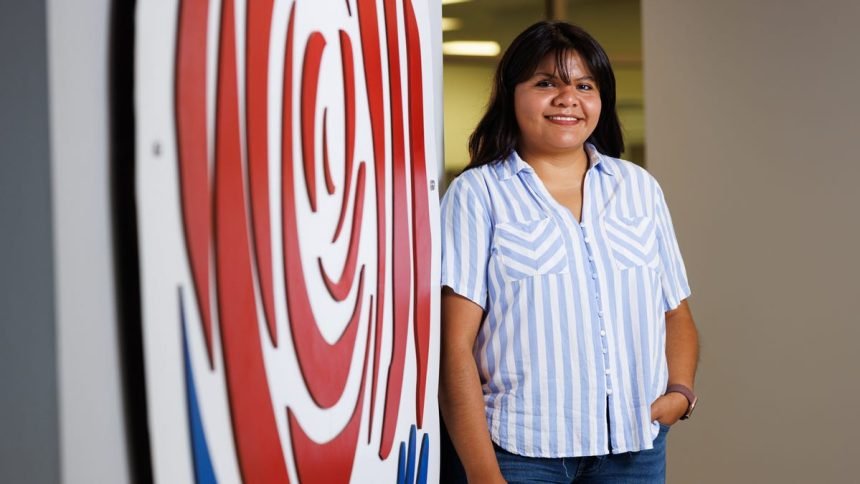
SOUTH BEND — Dara Marquez Venegas is no stranger to advocating for South Bend’s Latino, Hispanic and immigrant community.
From early advocacy work as a teenager in Elkhart to now working at La Casa de Amistad, Marquez Venegas strives to support residents in areas ranging from education opportunities to social services.
As the Director of Community Engagement at La Casa de Amistad, Marquez Venegas works to support the social services team by connecting clients to resources or programs at the center. She also assists with adult programming and outreach.
Marquez Venegas is the first person at La Casa to hold this position, which was created in 2023.
Juan Constantino, who became La Casa’s CEO in September 2021, said when the position became available, he was looking to engage with partners and enhance the connectivity from La Casa’s social services team to other social services agencies.
La Casa sees over 12,000 people in their space on South Michigan Street, which opened in 2021, Constantino said. The space is a bi-lingual environment for the community, Constantino said.
Constantino called Marquez Venegas a “clear community builder,” “community organizer” and a “brilliant individual.”
Marquez Venegas has a history of grassroots organization — in South Bend and nationwide — who has established trust in the area as a community leader well before joining the team at La Casa de Amistad, Constantino said.
“She’s done organizing with her own time, with her family and her community, and then she came full circle to get deeply involved again,” Constantino said.
“Being able to serve in South Bend has really been the opportunity to validate, essentially, our existence as Hispanic individuals and also as immigrants in our community,” Marquez Venegas said.
Building a support system
At 3 years old, Marquez Venegas’ family immigrated from Mexico to Elkhart for work. In the ’90s, when her family moved, the Hispanic population was much lower, so her family focused on finding people who spoke Spanish and navigated how to enroll into school. Her family moved into an apartment complex where they already knew people, which is still a similar experience today, Marquez Venegas said.
“You come where you know people, where you’ve heard of trustworthy people that you can come and meet here,” she said.
A report from the Institute for Latino Studies at the University of Notre Dame said the Latino population in South Bend in 1990 was 3% of the total. It’s now 17.3%.
“It’s important to be able to understand what resources are available and to not be alone or feel alone,” Marquez Venegas said.
Marquez Venegas learned about education opportunities that later led to her college in South Bend as a DACA — Deferred Action for Childhood Arrivals — recipient, which was established in June 2012 under former U.S. President Barack Obama to provide temporary protection from deportation to attend school and work. Those given that protection are popularly called Dreamers.
Constantino first met Marquez Venegas in college. She attended St. Mary’s College (where she studied chemistry and chemical engineering) and later attended graduate school at Purdue University for chemical engineering. Constantino studied at Holy Cross College. It was the first time Constantino, also a DACA recipient, told his story about being undocumented, he said.
Other undocumented students gathered to share their stories at St. Mary’s and Holy Cross, Constantino said. Through these gatherings, Constantino met Marquez Venegas, he said.
“The first time I told my story was through some of the organizing that she did, and that’s the first time I ever said it publicly,” Constantino said.
For Marquez Venegas, growing up undocumented allowed her to engage with people in the same situation, she said. In high school, she and her classmates became involved in community organizing to learn about resources to pursue higher education, she said.
Marquez Venegas graduated high school in 2011 when the Indiana General Assembly passed HB 1402 — which made undocumented persons not eligible for in-state tuition. The bill “stripped” higher education for a “decent price,” Marquez Venegas said.
Since then, they’ve both organized training for DACA recipients and traveled to Washington D.C. to “advocate for immigrant rights and for all undocumented people,” Constantino said.
Marquez Venegas “is also an extraordinary example to not only the overarching Latino community, but young professionals — particularly young women — in this community,” he said.
Making an impact at La Casa
Though Marquez Venegas did work in the STEM field for several years, she continued her advocacy work as a volunteer. This changed in 2020, during the COVID-19 pandemic. Her father died from COVID, Marquez Venegas said, which changed the way she saw health access for undocumented people, she said.
Work at La Casa aligns with her own personal mission, she said.
“There are so many community members and partners who don’t know all the ins and outs of the work we do and how it impacts our families and clients,” Constantino said.
Resources at La Casa de Amistad include an immigration legal clinic, which includes experts in immigration law, Marquez Venegas said. La Casa also offers citizenship classes — which also teaches the impact of becoming a citizen, such as voting and participating in policymaking — English classes, computer classes hosted at the St. Joseph County Public Library and Spanish classes, for people wanting to build on their Spanish speaking skills and learn about different cultures in Spanish-speaking countries.
Constantino said these areas can be done well only through trusted partnerships and relationships.