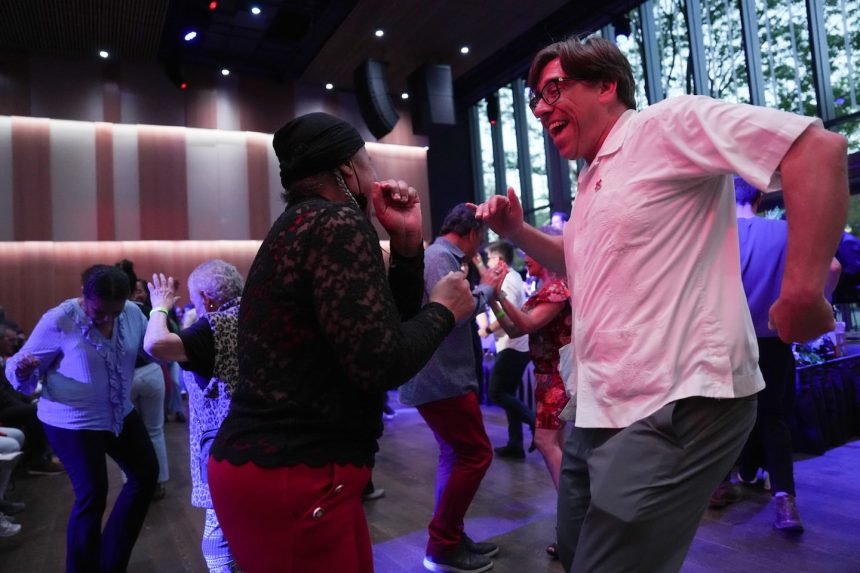
So far Calderón-Rosado has accomplished her goal. Throughout the weekend, visitors were drawn into the building by the percussive sounds of bomba music and given an opportunity to explore programming available on every floor of La CASA, including face painting, Puerto Rican bracelet making, and vejigante mask coloring.
There was also an array of nighttime activities in La CASA’s Jean and Tom Yawkey Hall, including an opening night concert from Latin percussion artist Eguie Castrillo, and a sold-out Saturday Dance Fiesta.

“A building is four walls, but what happens inside that building is really what brings it to life,” Calderón-Rosado said.
According to Calderón-Rosado, the reception from community members and investors alike has been overwhelmingly positive.
“I see this space as a place that will be an affordable space for local and up-and-coming artists for affordable rehearsal and performance, whether they’re Latino or not, and they can really come and see this as a hub for them,” she said.

Rosa Gonzalez, a Villa Victoria resident who has lived in the community for 19 years, emphasized how important it was to have a place where Latinos from not only Boston but from across New England can gather.
“For us Black and Brown people to be here in this community is huge,” Gonzalez said. “There were people from all over at the ribbon cutting. People from Framingham, Worcester, Rhode Island, Connecticut. So I’m pretty sure everyone will take advantage [of La CASA], whether it’s just to come here once and leave with something or make it something more frequent.”
For Gonzalez, who lives directly across the street from La CASA, she’s excited to have art be a stronger presence in her life.

“I have a little creative artist inside of me and I’ll blossom it,” Gonzalez said. “Art to me is something that’s exciting for me to learn more about.”
IBA, the largest Latina-led non-profit in New England, was originally founded in 1968 to help provide affordable housing. However, it has since expanded its mission to more broadly help people achieve social mobility, and according to Calderón-Rosado, art has always been at the forefront of IBA’s work.
“The community activists who founded IBA understood very early on the importance of the arts, not just for celebrating culture and heritage and roots, but to build community,” she said. “La CASA will continue that legacy of building community through the arts.”
One of the unique components of La CASA’s architecture is the way it honors the past yet looks to the future. Throughout the building, elements from All Saints Lutheran Church are used in the construction, which stood on the site before La CASA’s erection. There is original stained glass in the basement, terracotta tiles, and pieces of the church’s granite steps are incorporated into the foundation of La CASA, honoring the space that came before.
“I’m very proud we’ve been able to build a new space that will carry on part of the history of the building that was here, but also honoring it through elements of the old building that are now integrated permanently into the new one,” Calderón-Rosado said.
Gitana Savage can be reached at gitana.savage@globe.com. Follow her on X @gitana_savage.