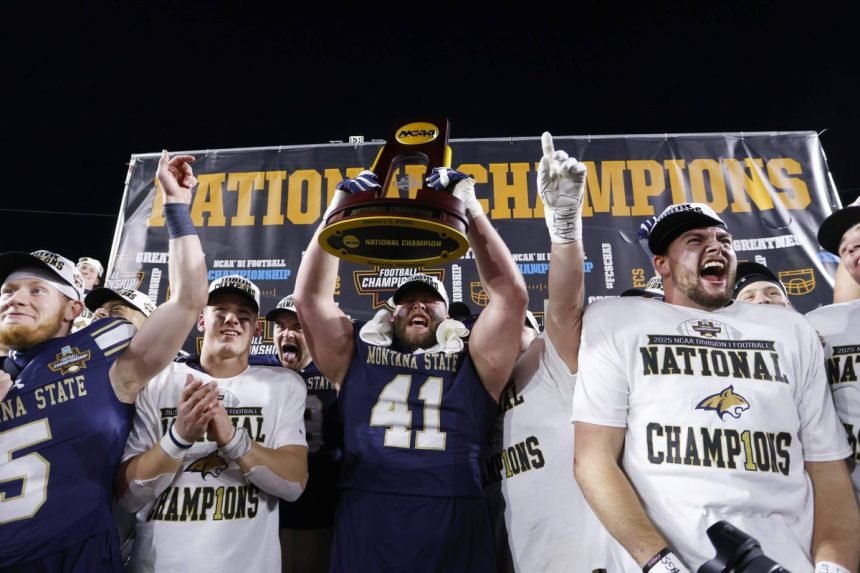
If the idea of further College Football Playoff expansion feels like heresy in a sport that has been defined by its regular season, it isn’t. Brackets with 24-plus teams have existed in college football for years.
You just have to look to the NCAA’s lower levels to find them.
The Football Championship Subdivision’s playoffs have had 24 teams since 2013. The fields are even larger in Division II (32 teams) and Division III (40 teams).
Granted, the top Football Bowl Subdivision is different because it has bigger brands, bigger rosters, bigger players, bigger budgets and (often) longer seasons than everyone else. Its postseason history was built around bowls — hence the name — while FCS has had a playoff since its inception in 1978, when it was known as Division I-AA.
But as the FBS approaches the next mile marker in potential expansion as it debates the 24-team model everyone but the SEC now endorses, we reached out to coaches who have been in the FCS, D-II and D-III playoffs. What was their experience like? How do they think it would work in the FBS? Is this a good idea?
Here are six takeaways from lower divisions that resonate at the highest level:
1. The regular season still matters
The top concern about CFP expansion — raised this week by SEC commissioner Greg Sankey — is that doubling the current 12-team field will water down the regular season. A top-10 matchup in November won’t mean as much if both teams are already headed to the Playoff, so what’s to stop either team from resting its starters or easing up?
“That doesn’t happen,” said California (Pa.) head coach Gary Dunn, whose playoff resume includes four D-II runs for the Vulcans, an FCS appearance as a Duquesne assistant and a second-round win over Curt Cignetti in 2016.
It’s not just Dunn. None of the coaches we spoke with said they have sat a healthy player for a regular-season game.
For University of Indianapolis coach Chris Keevers, the top matchups don’t feel different.
“If you want to make sure you’re in the playoff, you have to beat those teams. That hasn’t changed,” said Keevers, who has made four consecutive D-II playoffs with the Greyhounds. “Just because there’s more teams in the playoffs, it hasn’t watered the regular season down. You have a little more wiggle room, yes, but I don’t feel like it’s changed the competitiveness of a regular-season game.”
That’s because home-field advantage and byes are valuable enough to keep the stakes high in contests that might look irrelevant, like Stephen F. Austin’s regular-season finale last November.
SFA had already clinched the Southland Conference title and an FCS playoff berth regardless of what happened at 1-10 Northwestern State. But the Lumberjacks were a top-15 team vying for one of eight first-round byes, so they were incentivized to keep pushing. SFA led 48-0 at halftime in a blowout win that helped clinch a bye and proved the point of Louisiana Tech offensive coordinator Nathan Young (a former Lumberjacks assistant).
“I think it actually puts more value at the end of the regular season than it does devalue you,” said Young, who played and coached in the D-II playoffs at Abilene Christian.
2. Rivalries still resonate
The Monon Bell rivalry doesn’t have the national sizzle of Ohio State-Michigan or the Iron Bowl, but it has a long history (the first game was in 1890) and matters a lot to DePauw and Wabash, a pair of D-III schools 30 miles apart in Indiana. If anything, a bigger bracket has made the game even bigger.
Their 2023 meeting on the last weekend of the regular season decided the conference championship and a playoff appearance for the second year in a row. Imagine the reaction when DePauw blocked a field goal in the first overtime, scored a walk-off touchdown in the second and stormed its rival’s field to celebrate a trophy victory and playoff berth.
“That’s a special one,” DePauw coach Brett Dietz said.
What about the years when the conference title has already been locked up? Dietz faced that situation in 2021. His Tigers lost their finale 42-35, but it wasn’t because they rested anyone healthy enough to play or tried to coast into the postseason. Wabash simply stormed back with four touchdowns in the final 20 minutes.
“All of our kids want to play in that game, right?” Dietz said. “Most of them would not agree if they were being a healthy scratch.”
3. Byes are more important than you think
A first-round bye hasn’t helped FBS teams. Since the CFP expanded to 12 teams two seasons ago, Indiana is the only team to have a bye and win its first matchup (the rest are 0-7).
It has, however, been an advantage in larger playoffs at lower levels.
“It’s huge. Huge,” said North Dakota State head coach Tim Polasek, a five-time FCS national champion (four as an assistant, one as a head coach). “When it gets to November, we started talking about playoff football starting right now, and positioning is important. Every one of these snaps is going to matter, is going to have an impact, whether or not we get a chance to hoist a trophy.”
The current FBS schedule creates a long layoff between conference championships and the quarterfinals for those with a bye — 25 days last year in the case of Indiana, Georgia and Texas Tech. At lower levels, it’s a week off. That’s enough time to let bodies heal, but not so much time that rust sets in.
The data backs that up. Since the FCS field grew beyond 16 for the 2010 season, every national champion started with a first-round bye. Only two teams that played in Round 1 have even made the title game: Youngstown State in 2016 and Illinois State last season.
Since the D-II field expanded to 28 in 2015, three national champions have won without a bye. That’s enough to show an advantage without it being an insurmountable one.
For Dietz and DePauw, ending the regular season with a rivalry game makes a week off even more critical.
“Our kids are coming off a physically hard and emotionally draining kind of game,” Dietz said, “then you’ve got to turn around and play a playoff game right after that that’s going to have less fans.”
Indiana won the second version of the 12-team CFP. The Big Ten and others are already pushing to double the bracket’s size. (Patrick Smith / Getty Images)
4. The right system rewards strength of schedule
After California (Pa.) went 9-1 in 2021 but still missed the D-II playoffs, Dunn realized the culprit was a relatively weak strength of schedule.
“That’s when we changed our schedule format to try to find the best out-of-conference opponent we could have,” Dunn said.
Last year, his Vulcans earned an at-large berth thanks in part to a pair of nonconference victories over ranked teams, Charleston and Frostburg State. Charleston is on this season’s schedule, too.
The calculus is similar at UIndy. Because the Great Lakes Valley Conference isn’t a powerhouse, Keevers seeks tough out-of-league opponents to bolster his Greyhounds’ resume if they don’t earn an automatic berth. Last year, UIndy split a pair of matchups between teams that finished in the top 20 (Ashland and Findlay).
Their philosophies clash with an FBS trend to question, if not cut, high-profile nonconference series (USC-Notre Dame, Alabama-Oklahoma State). For Dunn, the key is that the criteria and metrics explicitly emphasize strength of schedule, whether that’s results against teams with a winning record, opponents’ winning percentages or quality wins.
“If strength of schedule is not a huge part of that,” Dunn said, “then you are going to see a lot of those early games that everyone wants to see go away.”
5. The long season adds up
This was the biggest concern coaches raised.
Furman’s Clay Hendrix cited the strain it has on academics at his private FCS school. Keevers has adjusted UIndy’s practice methods to try to protect players’ health as the playoff field doubled over his three decades there.
Although D-II (11 games) and D-III (10 games) have shorter regular seasons than the FBS, the bigger postseason means national finalists can still play 16 total games. Last year’s FCS runner-up, Illinois State, played 17.
Even if conference championships end at the FBS level, national champions will play 16 or 17 games in a 24-team bracket. Last season, Indiana became the first major program in more than a century to go 16-0.
“At some point, there’s diminishing returns on the games,” Keevers said. “They’ve limited rosters. You don’t get any free-agent pickups. You can’t get all those guys on the waiver wires. If they’re dead after the regular season, it’s not gonna work.”
Even if a team makes it through one long season, what about the next? Polasek witnessed those residual effects as North Dakota State built a dynasty, playing at least 15 games in a dozen seasons since 2011.
“When we had to do 15- and 16-game seasons there for a stretch of five years in a row, that had a great impact on those fifth-year seniors and fourth-year juniors, the amount of tread that was left on the tires,” Polasek said. “And we had to be really mindful of managing those guys.”
Polasek said programs could have to change how they structure their workouts so players are big and strong enough to withstand a longer season without being overworked.
6. The new system will not be perfect
Whatever format a potential 24-team CFP takes, you can expect unintended consequences. Scheduling is one reason why.
“I know in FCS, there’s always going to be teams with good records because somebody’s going to catch the schedule right,” said Hendrix, who has led Furman to the playoffs four times as a head coach and won the 1988 national title there as an assistant.
With bloated FBS conferences, a team could luck into a weak schedule and stumble toward a league title (especially if there’s no championship game as a backstop). There’s no perfect way to balance that team’s record against a fortuitous slate of games.
Another factor multiple coaches brought up: The Missouri Valley Football Conference has earned 16 of the 72 FCS playoff berths over the past three seasons, leading to some MVFC fatigue. It’s easy to see the SEC or Big Ten (or both) doing the same thing regularly at the FBS level. How will other conferences and fans react if a bigger bracket only creates the illusion of inclusion?
Expansion will resolve some issues by ensuring a spot for the next version of 2025 Notre Dame — a two-loss team that was good enough to compete for a title but shaky enough to end up on the wrong side of the bubble. But doubling the field will only shift the goalposts of debate.
“If you go to 24,” Hendrix said, “there’s always going to be a No. 25.”