In the 1950s, it was known as the Harlem of the South. Overtown—an enclave in downtown Miami—was a vibrant arts community, attracting jazz legends like Sammy Davis Jr. and Ella Fitzgerald to perform, with celebrity athletes like Muhammed Ali and Jackie Robinson in the audience.
But the history of this treasured downtown Miami neighborhood is still unknown to many. Now, through a virtual art exhibit created by graduate students at the University of Miami in collaboration with the Miami Museum of Contemporary Art of the African Diaspora (Miami MoCAAD), students and museum leaders hope more people can learn about the area’s history.
A few years ago, the Miami MoCAAD commissioned local artists to create three murals celebrating Miami’s Black history in Overtown. This fall, they asked students from the Department of Interactive Media in the School of Communication to create an engaging virtual exhibit that would allow the murals to reach audiences unable to visit Overtown.
“This project was a way for students to engage with this community space and tell these stories of Overtown through that interactive lens,” said Lorena Lopez, lecturer of interactive media, who led the class and guided the exhibit’s creation.
It is all part of the museum’s tech-forward approach to engage audiences of all ages in art today.
“These murals are an important part of Miami MoCAAD’s effort to expand how you experience art,” said Marilyn Holifield, board chair and cofounder of Miami MoCAAD, a virtual-first museum that launched in 2015. “We want to expand how to tell stories that art illuminates, and this is our latest innovation, which will make art even more accessible because it’ll have art exhibitions embedded in our website that are accessible by your phone, on your laptop, and in your headsets.”
To fully appreciate the virtual murals exhibit, called “Telling Overtown Stories, Saying Their Names,” participants should don a VR headset that allows them to walk into the three mural “portals” and to learn about their historical context through an immersive experience.
“In creating this experience, we were thinking about what you can do in VR that you can’t do in the real world,” added Lopez. “These portals give you a deeper dive into why these murals are important to the history of Overtown in general.”
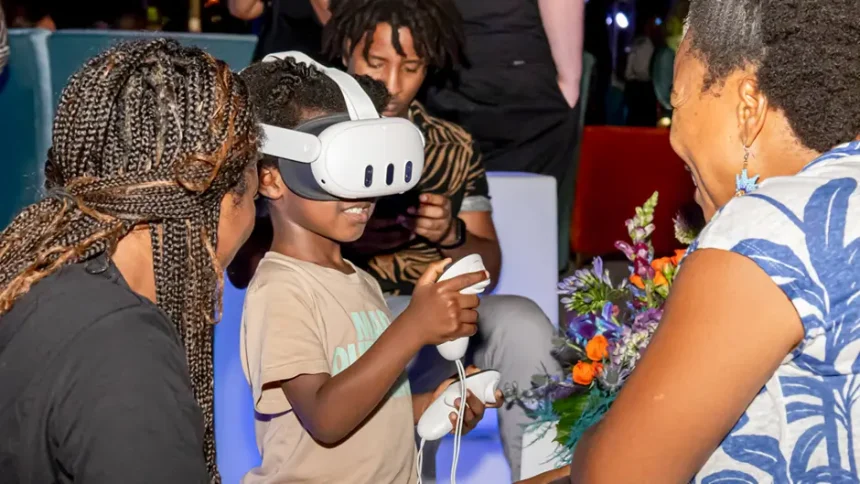
To start, Lopez and the eight students in the Innovative Collaboration Lab course visited Overtown to tour the murals, and then split into teams—design, development, and research. Each week, the teams worked together to produce phases of the virtual exhibit, often meeting with staff from Miami MoCAAD. In December, they launched the murals exhibit and offered headsets for anyone to try the experience at the museum’s 10th anniversary event, “Soul Basel,” on the plaza outside the historic Lyric Theater in Overtown.
Andrea Queeley was there with her son Ayomarcus, 5, and both were exploring the mural experiences in virtual reality.
“This is the first time I have worn a headset, but I see the advantage of this technology because it can help a person or child to access this exhibit from other locations,” she said.
Lakeisha Frith agreed.
“It was neat to be transported to different places through a mural,” she said. “I love traditional visual art, but this technology is more interactive, so it could be better for younger audiences.”
Miami MoCAAD uses VR applications in after-school workshops that the museum offers throughout the year. They are also currently displaying the murals in a mobile exhibition where the three pieces are illuminated in light boxes at the North Dade Regional Library. They will be showcased at Miami International Airport later this year.
The murals are featured on three different buildings in Overtown today, all within walking distance of each other.
Through the VR experience, users walk into a virtual version of Overtown and hear a brief history of the neighborhood. Then, they can stroll up to the murals and enter them to explore environments like the port of Miami in the 1930s, part of the context for one of the murals titled “International Longshoreman’s Association, Local 1416.” It is also the name of the local union chapter formed for port employees in 1936, which helped offer jobs with living wages to many African Americans in Miami.
“Those jobs provided the ladder to the middle class in the Black community,” said Holifield.
Another of the murals, “OVERtown: Our Family Tree,” features colorful images of different generations of African Americans in Overtown and is painted on the former law office building of Judge Lawson E. Thomas, the first Black judge in Miami. Lawson was known for treating African Americans with dignity, no matter the charges, so the portal allows users to enter Judge Lawson’s courtroom and learn about his life and civil rights work—even before he became a judge.
The third mural is a celebration of Black global soccer stars. Called “Overtown Pitch: Game Changers,” it is now featured on the site of the historic Carver Hotel and was inspired by the courage of the Miami Edison Senior High School girls’ soccer team, whose victories galvanized their community, Holifield added. Inside the interactive version of “Overtown Pitch: Game Changers,” users get to attend a street festival for the Miami Edison soccer team. On their way to the soccer stadium, they can learn about famous Black soccer stars, like Kylian Mbappé and Crystal Dunn.
Students in the class made sure that many of the props and designs for these spaces were authentic to the history, look, and time periods in Miami’s past.
“We wanted to let the user understand what union formation was like at the Port of Miami as well as their wages, and what happened to longshoremen before the union was formed,” said Jane Yao, one of the students on the user experience team.
For Ma’at Hetep, the project was personal. Her uncle was one of the longshoremen, so she grew up hearing stories about the port and Overtown. She felt fortunate that this project allowed her to delve deeper into the neighborhood’s history.
“It was rewarding being able to represent these stories,” she said. “The only kind of literature back in the day about people living in Overtown were obituaries, so being able to showcase these stories in such a cool, interactive format was a lot of fun.”
For other students, the project was an opportunity to learn more about the Miami community.
“I did not know about Overtown before this, but this project was a good opportunity to do some research on different culture,” said Yifan Xu, a graduate student from China.
Raquel Henao said she is excited to see the project’s impact.
“The fact that this will live somewhere and be involved with community, where multiple people will see this, is very special,” she said.