This year, Denver again earned the ignominious distinction as the sixth worst city in the country for certain air pollutants. Poor air quality is a public health threat, leading to respiratory symptoms and negative long-term health outcomes — coughing, asthma attacks, cardiovascular diseases, etc.
As the Trump administration proudly rolls back federal regulations intended to protect people from air pollution and climate change, it’s imperative that local governments pass policies to fill the void. However, thus far in 2025, Denver’s City Council has done more to signal its disapproval of poor air quality than actually tackle it.
GET THE MORNING HEADLINES.
Denver’s 13-member council made headlines at the start of May when it unanimously rejected a $25 million contract with Suncor Energy’s Commerce City oil refinery to purchase asphalt. The council cited concerns of environmental justice and persistent regulatory violations committed by Suncor.
While divestment from negligent or unethical businesses can be a powerful tool to drive change, the practice must be undertaken strategically. In this case, Denver is taking a stance against Suncor by paying an additional $300,000 to an oil refinery with a similarly long rap sheet of regulatory violations — including some that led to explosions and fires. Because Denver’s asphalt will now come from Cenovus Energy in Wisconsin, it must be transported by rail to Colorado, which creates additional environmental risk. Twenty-five percent of the nation’s hazardous material accidents are caused by railroad derailments. For example, in 2023, a train spilled 500,000 pounds of asphalt into the Yellowstone River damaging hundreds of miles of natural habitat.
And finally, asphalt is a byproduct of the oil refining process, and will be produced regardless of whether or not the city buys it. The Denver council’s symbolic support of environmental justice and clean air is well-intentioned, but not strategic. A more effective means of opposing Suncor would be to reduce demand for gasoline — perhaps by promoting public transit or other modes of transportation, which would have the added benefit of reducing air pollution and greenhouse gas emissions.
More micromobility
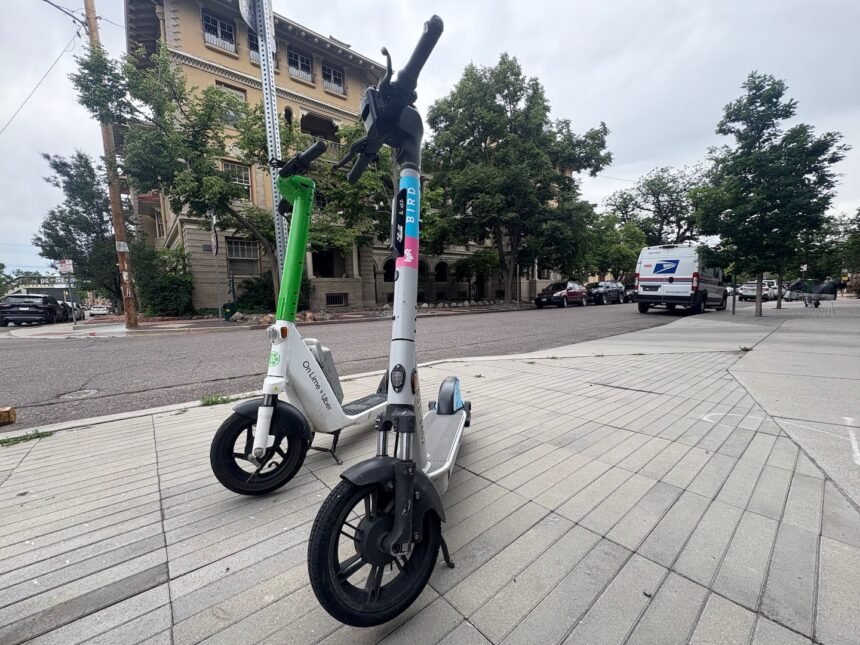
Just weeks after the Denver City Council’s symbolic move against Suncor, the council passed an ordinance to crack down on micromobility. Since Denver signed an exclusive contract with Lime and Lyft in 2020, ridership of shared electric scooters and bikes has increased steadily. On average, Denverites take 11,100 micromobility rides every day, many of which replace car trips. Considering the emission reduction potential of micromobility, Denver’s council should focus on increasing adoption while balancing the needs of pedestrians and other road users. Unfortunately, the new ordinance isn’t balanced — it forces micromobility companies to mitigate “sidewalk riding,” which is tantamount to making micromobility less safe and, therefore, less desirable.
In 2024, 134 pedestrians and bicyclists were killed by cars in Denver — a 78% increase in fatalities since 2015. Although bike infrastructure is expanding, the city is still decades away from a truly connected, cycle-safe city.
Going forward, Lime and Lyft must enforce Denver’s law prohibiting sidewalk riding or face fines. A possible outcome is charging riders more if they ride on sidewalks. But in a city where sidewalk riding is sometimes the only safe option, that discourages safety. For many riders, this would create a lose-lose situation: Avoid the sidewalk even on busy, dangerous roads, or use sidewalks for safety and incur fines. Or, drive a car, instead.
The new micromobility ordinance isn’t all bad, though. It implements a much needed mechanism to reduce improperly parked scooters and bikes, which too often obstruct sidewalks for pedestrians and wheelchair users. The council should have stopped there — regulate parking, but don’t dictate how riders should safely navigate our car-oriented landscape. The best way to encourage riders to avoid sidewalks is to build safe bike infrastructure.
Alternatives to widening
Contrary to its stated support of cleaner air, Denver’s City Council has recently made moves to further entrench the city’s car reliance by taking steps to widen Peña Boulevard. This Spring, in a 9-2 vote, the council approved a $15 million study to investigate widening Peña and assess other options to alleviate traffic congestion. One council member suggested that the study is a mere “formality” unlikely to seriously consider alternatives to widening Peña.
Transportation contributes significantly to the region’s poor air quality and is the greatest source of greenhouse gas emissions in Colorado. Investing in road expansion would undermine the city’s commitments to clean air, climate action, and a transit-oriented future. To retain a modicum of consistency, City Council should instead fund bus rapid transit, improvements to the Denver A-Line, greater security at Park-n-Rides along the A-line, or any number of options that would make public transit the most convenient method of traversing the city and getting to the airport.
Considering Denver’s record of poor air quality and the ongoing attacks on our nation’s bedrock environmental protection laws, Denver’s City Council should focus less on signaling support for clean air and environmental justice and more on substantive policies. Besides limiting the construction of new gas stations, the city has done nothing to improve Denver’s air quality this year — the opposite, actually.
Hopefully, the council reconsiders its priorities — before Peña is widened and micromobility ridership drops.
YOU MAKE OUR WORK POSSIBLE.