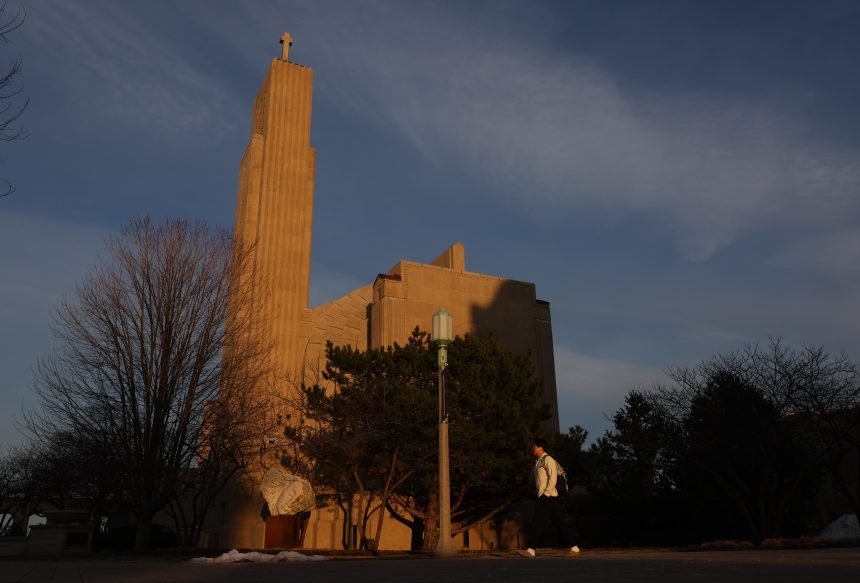
Loyola University Chicago is sunsetting its Hispanic Studies Master of Arts program in the wake of a nearly yearlong review of all academic programs at the institution.
The university launched a program review of its undergraduate minors, undergraduate majors, graduate certificates, master’s degrees, and doctoral degrees in August 2025, assessing programs to determine whether they should continue as is, be modified, or sunset.
The program review took a holistic look at each program in the context of student interest, student success, market demand, mission centrality, and financial performance, the statement said.
All enrolled students will have the option to complete their studies in the master’s degree program, the statement read, with an average of two students graduating each year. University officials declined to comment on the total number of students enrolled in the program.
They also declined to comment on whether other programs will be discontinued. “Ultimately, the decisions reflect responsible stewardship of resources to further the academic mission of the University,” the statement said.
No additional students will be admitted to the program going forward. The move has drawn ire from some of the program’s supporters, including the Latin American Studies Association, which described it as a “beacon of academic and socio-cultural diversity,” in a July 22 open letter to Provost Douglas Woods and Vice-Provost and Dean of the Graduate School Michael Rozier.
“Though small, Loyola’s Hispanic Studies MA program has historically made an outsized contribution to our field and directly bolstered Loyola’s standing as a hub for world-class education and research. As your own evaluation process underscored, this is the moment to invest in and grow such programs, not to shutter them,” the letter read. “We urge you in the strongest possible terms to reconsider your decision to close Loyola’s Hispanic Studies MA program.”
Furthermore, the letter states that the move raises questions about the university’s “commitment to academic freedom and to cultural, intellectual, and socio-economic diversity” in a time when “both academic freedoms and minority populations are under threat.”
The university said in its statement to the Tribune it will continue to serve students through several adjacent programs, although it was not specific.
But Ana Rodríguez Navas, the program’s director and professor of Latin American literature and culture at Loyola, told the Tribune that she is worried that the loss of the decades-old program will remove a cultural space of learning for students and the city.
“We are the only graduate-level program that engages with Hispanic cultures as a whole…we are the only graduate-level program conducted entirely in Spanish as well,” Rodríguez Navas said. “Not only do we learn about these cultures, but we teach and learn in the original language. So no, there is absolutely nothing that can be replicated in any other program at the university,” she said.
Loyola’s decision was “devastating” and “rushed,” Rodríguez Navas said, adding that she feels it’s a “shocking change of direction” for the university. The program’s success has led to graduates working in the Chicago Public Schools and other districts teaching Spanish, at law firms, as visiting lecturers, writers and more, she added. The program has been a safe space for some students and is necessary at a time when Hispanic communities across the country are under pressure, including in Chicago, she said.
“You can’t understand Chicago without understanding Hispanic culture and history,” Rodríguez Navas said. “…If we want doctors and nurses and teachers and lawyers, journalists who understand the community we live in, these are exactly the kinds of programs that we need. We need to be investing in them. We need to be growing them, not shutting them down.”