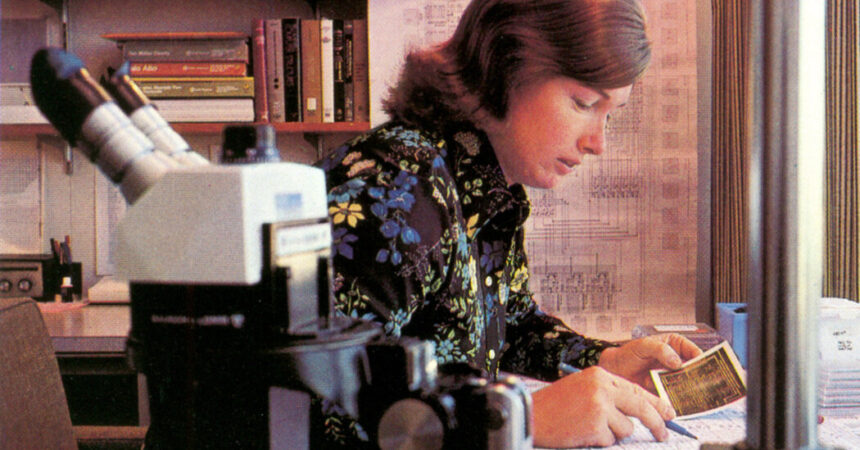
Lynn Conway, a pioneering computer scientist who was fired by IBM in the 1960s after telling managers that she was transgender, despite her significant technological innovations — and who received a rare formal apology from the company 52 years later — died on June 9 in Jackson, Mich. She was 86.
Her husband, Charles Rogers, said she died in a hospital from complications of two recent heart attacks.
In 1968, after leaving IBM, Ms. Conway was among the earliest Americans to undergo gender reassignment surgery. But she kept it a secret, living in what she called “stealth” mode for 31 years out of fear of career reprisals and concern for her physical safety. She rebuilt her career from scratch, eventually landing at the fabled Xerox PARC laboratory, where she again made important contributions in her field. After she publicly disclosed her transition in 1999, she became a prominent transgender activist.
IBM offered its apology to her in 2020, in a ceremony that 1,200 employees watched virtually.
Ms. Conway was “probably our very first employee to come out,” Diane Gherson, then an IBM vice president, told the gathering. “And for that, we deeply regret what you went through — and know I speak for all of us.”
Ms. Conway’s innovations in her field were not always recognized, both because of her hidden past at IBM and because designing the guts of a computer is unsung work. But her contributions paved the way for personal computers and cellphones and bolstered national defense.
In 2009, the Institute of Electrical and Electronics Engineers gave Ms. Conway its Computer Pioneer Award, citing her “foundational contributions” to the development of supercomputers at IBM and her creation, at Xerox PARC, of a new way to design computer chips — “thereby launching a worldwide revolution.”
At Xerox in the 1970s, Ms. Conway, while working with Carver Mead of the California Institute of Technology, developed a way to pack millions of circuits onto a microchip, a process known as very large-scale integrated design, or VLSI.
“My field would not exist without Lynn Conway,” Valeria Bertacco, a professor of computer science and engineering at the University of Michigan, was quoted as saying in an online tribute to Ms. Conway. “Chips used to be designed by drawing them with paper and pencil like an architect’s blueprints in the predigital era. Conway’s work developed algorithms that enabled our field to use software to arrange millions, and later billions, of transistors on a chip.”
Lynn Ann Conway was born on Jan. 2, 1938, in Mount Vernon, N.Y., to Rufus and Christine Savage. Her father was a chemical engineer for Texaco, and her mother taught kindergarten. The couple divorced when Lynn, the elder of two children, was 7.
“Although I was born and raised as a boy,” Ms. Conway wrote in a long personal account of her life that she began posting online in 2000, “all during my childhood years I felt like, and desperately wanted to be, a girl.”
Her math and science talents were quickly apparent. At 16, she built a reflecting telescope with a six-inch lens.
As a student at the Massachusetts Institute of Technology in the 1950s, she injected herself with estrogen and dressed as a woman off-campus.
But the contradictions of her double life caused intense stress; her grades fell, and she dropped out of M.I.T.
She enrolled at Columbia University in 1961 and went on to earn bachelor’s and master’s degrees in electrical engineering.
She was offered a position at IBM’s research center in Yorktown Heights, N.Y., where she was assigned to the secretive Project Y, which was designing the world’s fastest supercomputer. When the engineers relocated to Menlo Park, Calif., Ms. Conway moved to what would soon become the global hub of technology known as Silicon Valley.
By then she was married to a nurse, and the couple had two daughters. “The marriage itself was an illusion,” Ms. Conway wrote. She had lost none of the overwhelming conviction that she inhabited the wrong body, and at one point she put a pistol to her head in an effort to end her life.
In the mid-1960s, she learned about the pioneering hormonal and surgical procedures that a handful of doctors were performing. She told her spouse of her desire to transition, which broke up the marriage. She was barred from contact with her children for many years by their mother.
“When IBM fired me, all my family, relatives, friends and many colleagues, too, simultaneously lost confidence in me,” Ms. Conway wrote on her website. “They became ashamed being seen with me, and very embarrassed about what I was doing. None of them would have anything to do with me after that.”
Seeking work post-transition, she was rejected for jobs once she disclosed her medical history. Nor did she feel she could mention her IBM work history. “I had to start all over pretty much from scratch technically, and prove myself all over again,” she wrote.
“The idea of being ‘outed’ and somehow declared to ‘be a man’ was an unthinkable thing to be avoided at all costs,” she added, “so for the following 30 years I almost never talked about my past to anyone other than close friends and a few lovers.”
She finally found work as a contract programmer. That work led to a better position at the Memorex Corporation, the recording tape company, and, in 1973, to a job at Xerox’s new Palo Alto Research Center, a hub of brain power and innovation that famously gave birth to the personal computer, the point-and-click user interface and the Ethernet protocol.
Ms. Conway’s breakthrough in designing complex computer chips with Dr. Mead was codified in their 1979 textbook, “Introduction to VLSI Systems,” which became a standard handbook for waves of computer science students and engineers.
In 1983, Ms. Conway was recruited to lead a supercomputer program at the Defense Department’s Advanced Research Projects Agency, or DARPA. The fact that she passed her security clearance reassured her that being transgender was becoming less stigmatized.
She went on to accept positions as a professor and associate dean in the engineering school at the University of Michigan, from which she retired in 1988. She was elected to the Electronic Design Hall of Fame and the National Academy of Engineering.
In the late 1990s, a researcher exploring the work of IBM in the ’60s came across Ms. Conway’s contributions to computer design, which had gone almost entirely unrecognized because of the past identity she had concealed.
At IBM, she had developed a way to program a computer to perform multiple operations at once, cutting down on processing time. Known as dynamic instruction scheduling, the technology became incorporated in many superfast computers.
In 2002 she married Mr. Rogers, an engineer she had met on a canoe outing in Ann Arbor, Mich. In addition to him, she is survived by her daughters, whom Mr. Rogers said were largely estranged from her, and six grandchildren.
In retirement, she became an elder stateswoman of the transgender community. She emailed and spoke with many who were transitioning, shared information on gender surgeries and advocated transgender acceptance.
She also campaigned against psychotherapists who activists said sought to define transgenderism as a pathology.
On her website, Ms. Conway reflected on the increasing, if imperfect, acceptance of transgender people since she had hidden her transition.
“Fortunately, those dark days have receded,” she wrote. “Nowadays many tens of thousands of transitioners have not only moved on into happy and fulfilling lives, but are also open and proud about their life accomplishments.”