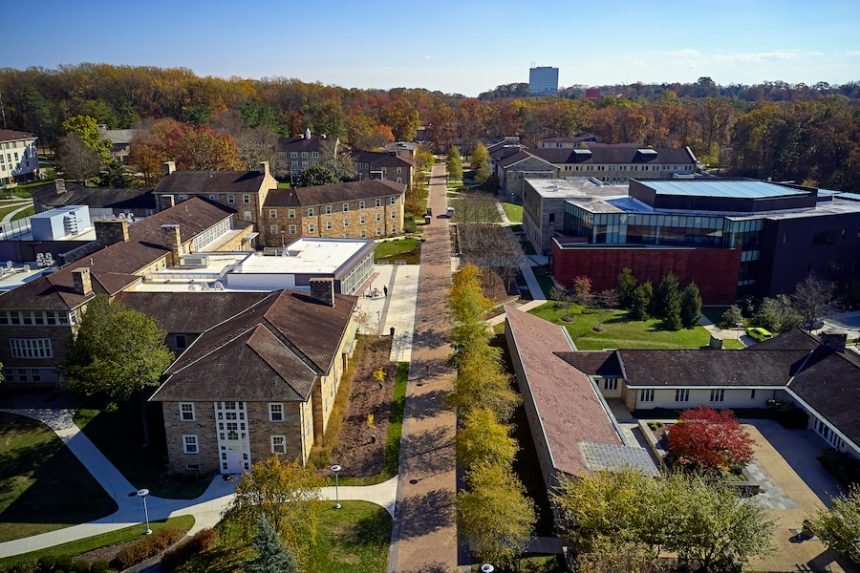
For the first time in its 141-year history, Goucher College enrolls more Black and Hispanic students in its first-year classes than white students.
The diverse first-year class and a new slate of transfer students mean Goucher is a majority-minority campus. On the surface, it’s an unexpected feat. The U.S. Supreme Court in 2023 banned race-conscious admissions, also known as affirmative action, and in the nearly three years since, many colleges have reported drastic declines in the diversity of their student bodies.
But less selective colleges like Goucher have seen historic increases in applications and enrollment from Black and Hispanic students. Experts call it “the cascade effect.” It’s the idea that students who may have been admitted to the nation’s most elite schools with the help of race-conscious admissions now enroll in less selective schools.
“I do believe in the cascade effect,” said Michael Marshall, the vice president for enrollment and student success at Goucher. “We, as an institution, do benefit from it.”
Data shows Black student enrollment at the small Baltimore County liberal arts college increased from 57 students in the first year-class before the affirmative action ban to 84 students after. That’s a 47% increase in a single year. At the same time, white enrollment fell — just 33% of first-year students enrolling in 2024 were white. The college has under 1,000 undergraduate students, according to federal data.
The trend at Goucher, which admits about 75% of students who apply, is echoed at similarly selective colleges.
According to the National Center for Education Statistics, the University of Maryland, Baltimore County, accepts about 70% of the students who apply. White student enrollment at the public university has dropped by about 1% since affirmative action was banned. At the same time, Hispanic enrollment has increased nearly 49%, from 160 students in 2023’s first-year class to 238 students in 2024. Black enrollment also increased, from 474 in 2023’s first-year class to 556 in 2024’s — a 17% jump.
And at Towson University, with an acceptance rate of about 80%, Hispanic enrollment increased about 3%, from 388 first-year students in 2023 to 399 in 2024. Black enrollment increased 4%, from 1,128 in 2023 before the ban to 1,177 the next year.
James Murphy, a senior fellow at the nonprofit Class Action, which aims to reduce barriers to elite colleges, said this is the first year that researchers are seeing a significant difference in college admissions post-affirmative action.
“What’s happening at one college affects what’s happening at other colleges,” Murphy said. “If an elite college isn’t accepting Hispanic students or Black students who were likely to get in before, those students aren’t just skipping college altogether.”
The cascade effect was a term previously used rarely and only in academic settings, Murphy said. The idea was born after California voters in 1996 approved Proposition 209, a ban on race-conscious admissions at public universities.
Data showed, after the ban was enacted, students “cascaded” to less selective colleges. Fewer Black and Hispanic students got into the highly competitive University of California, Los Angeles, and UC Berkeley, Murphy said. Instead, they were filling the ranks of a less selective tier of colleges, including the universities of California at Irvine and Santa Barbara.
The same has started in Maryland. Unlike Goucher, Towson and UMBC, the Johns Hopkins University has had a stark decline in Black enrollment in recent years.
Black students in the first-year class declined from 139 students in 2023 to 48 in 2024. That’s a drop of 65%.
Hispanic first-year students saw a similar decline, from 295 in 2023 to 148 in 2024, a 50% decrease.
The 2025 first-year class has similar demographics.
Black and Hispanic students are historically underrepresented at colleges in the United States — that’s the reason race-conscious admissions began in the first place. Johns Hopkins, for example, began enrolling Black students in 1945 — 69 years after it was founded.
The recent drop at elite institutions like Hopkins is concerning, said Julie Park, a professor at the University of Maryland, College Park, who studies diversity in higher education.
Students will still earn a great education at a school like Goucher or Towson, she said. But they won’t necessarily have access to the same career connections that an elite university like Hopkins provides.
According to federal data, Johns Hopkins graduates have higher median earnings than those who attended Goucher, Towson or UMBC. Ten years after starting college, a Hopkins graduate makes about $87,500, compared to $53,000 for a Goucher grad. Median earnings are $64,000 for Towson alumni and just under $70,000 for those who attended UMBC.
“Elite, selective institutions tend to be the ones that are best positioned to support students,” Park said. “The less selective institutions do great work and are important, but they don’t have the same pipeline.”
Some higher education experts are concerned the cascade effect will send more students to for-profit colleges.
“That’s really worrisome,” Park said. “That system is known for predatory practices and not graduating students, and we could very well see that grow in a state like Maryland.”
Leaders at Goucher seem to know that. Marshall, the vice president for enrollment and student services, was eager to speak about the college’s efforts to get students a diploma and place them in high-paying jobs.
“Retention and completion is so important,” he said. “For many years, we focused on access. But we also want to focus on employment, career outcomes and outcomes overall.”
About the Education Hub
This reporting is part of The Banner’s Education Hub, community-funded journalism that provides parents with resources they need to make decisions about how their children learn. Read more.